


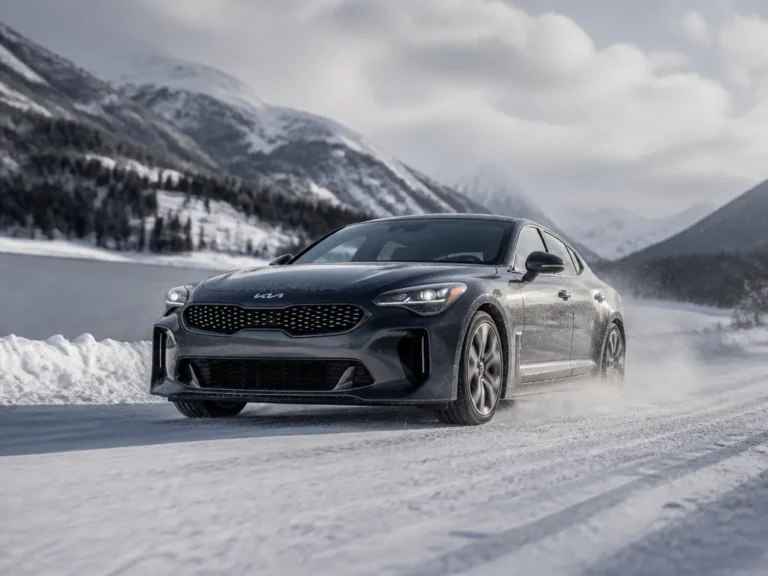
You’re driving your Kia Stinger through packed snow and ice and wondering if the traction control will save you, or if you should park it. The big question is simple: can a Stinger handle real winter conditions day to day, and what changes (tires, technique, preparation) make it feel confident?
Kia Stinger winter drivability depends on drivetrain and tires. Expect slower launches, more stability-control intervention on ice, and longer stopping distances versus dry pavement. This guide breaks down AWD versus RWD behavior, what to feel in starts, turns, and braking, and a winter checklist to prep your car before the first storm.
Kia Stinger snow and winter driving comes down to two things: traction setup and driving technique. On packed snow, the Stinger can feel controllable if you run real winter tires, but ice still triggers traction control often. Plan for extra braking distance, smoother throttle, and gentle steering inputs.
Kia Stinger In Snow And Winter Driving
Stinger winter confidence comes down to grip, tire choice, and how gently you drive when the road is slick. In snow and on ice, a sport sedan can feel “busy” through steering and braking, and the traction systems will work sooner than you expect. Match the car with proper tires, then tune your inputs so the electronics can do their job instead of fighting wheelspin.
What Matters Most In Snow And Ice For A Sport Sedan?
In packed snow, the limiting factor is usually tire compound and tread pattern, not the horsepower. With an aggressive powertrain and a heavier front end, the Stinger can spin or skip when you stab the throttle, especially exiting turns. Braking performance depends on tire grip and how ABS modulates, so you want predictable pedal feel and a controlled slide rather than hard stops on marginal tires.
Cold weather adds two more practical issues: tire pressure changes and reduced tire temperature. If you start the day with pressures too low from sitting in the cold, you lose contact patch. The result is slower response and more wandering in ruts, even if the car’s stability control is active.
Traction Control And Stability Control: What You’ll Feel
When traction control kicks in, the usual sensation is reduced engine power and a slight tugging through the drivetrain as the system brakes spinning wheels. In heavy snow, you can get intermittent “cut-in” behavior during light throttle, then smoother progress once you keep the car in the tires’ most stable grip range. On ice, expect earlier intervention, because the tires can go from “moving” to “slipping” in a fraction of a second.
ABS behavior is usually straightforward: the pedal pulses as the system prevents wheel lock, and the steering stays calmer than a locked-wheel slide. The trade-off is longer stopping distance on ice compared with dry pavement, even with everything working correctly. If you feel the car draw to one side under braking, that often points to tire condition, uneven pressures, or a dirty blade of ice, not a “bad” sensor.
Insider tip: On slick roads, your job is to stay boring. Smooth throttle, longer following distance, and minimal steering changes reduce the chance the car needs to correct at the same time it is braking or powering out of a turn.
| Road surface | Typical Stinger winter feel | What to adjust |
|---|---|---|
| Slush | Grip is decent, but wheelspin can happen with abrupt throttle | Moderate throttle, keep torque smooth |
| Packed snow | Stability control may intervene during turns and exits | Wider turns, slower acceleration |
| Black ice | Traction control hits early, braking distance stretches | Extra following distance, avoid sudden inputs |
Awd Vs Rwd Traction Reality
Traction in winter comes down to which wheels get drive torque, and how fast you ask for it. The Kia Stinger can be noticeably more stable in packed snow with AWD because power can be split when the rear starts to slip, but AWD cannot create grip on glare ice where tires lose contact.
Kia has offered different Stinger drivetrains by model year and trim, so the first job is confirming what you have.
In practice, you identify it by the drivetrain badge and the VIN, then match it to your build sheet. If your Stinger has AWD, it will typically be labeled as such on the fender or rear badge, and your dealership can confirm from the VIN even when the badge is missing or swapped.
For packed snow launches, AWD usually feels smoother because the car can pull from both ends instead of relying on the rear tires to do all the work. RWD Stingers often spin the inside rear first when you over-accelerate, which feels like a brief surge followed by a “free” pedal-to-wheel response. Both drivetrains benefit from throttle discipline, but the AWD car tolerates slightly more throttle before the traction control intervenes.
Turning behavior changes with drivetrain because drive torque interacts with available tire grip. AWD can pull you forward more effectively out of a turn, but in mid-corner, traction still follows tire grip and snow depth, so you can still run out of steering feel. RWD tends to understeer more at the limit when you add power too early, and many drivers notice the rear wants to widen if they accelerate while the car is still pointed into the slide.
Driver takeaway: on packed snow, aim for a gentle throttle increase only after the steering angle is set and the car is tracking. Sudden throttle on either drivetrain makes the stability system do the work for you, which often feels like slower progress and longer distances.
How Hill Climbs And Descents Behave
Hill climbs expose drivetrain bias and tire grip first. RWD Stingers usually need steadier throttle because the rear tires are the “decision makers” for forward motion, so spin can build quickly on snowy ruts. AWD Stingers generally keep climbing with fewer traction-control interruptions, but the system will still limit torque when both axle tires struggle.
Hill descents are mostly about braking and stability control, and drivetrain does not eliminate the risk of sliding. AWD can help you stay more composed when you briefly need to add light throttle to settle the nose, but it cannot stop physics from overriding. Both setups will trigger traction and stability interventions when wheel speed differences grow too fast, so the best results come from smooth inputs and keeping speeds conservative.
| Situation | RWD Stinger | AWD Stinger |
|---|---|---|
| Packed-snow launch | Rear spin shows up sooner; throttle feels “edgy” | More consistent pull; traction control intervenes later |
| Turn-in and mid-corner | More chance of rear looseness if you add power early | Better forward stability; still limited by tire grip |
| Out of a turn | On-power traction limit is easier to reach | More drive helps reduce exit slide tendency |
| Hill climb | Steady throttle needed to avoid wheel spin in ruts | Smoother climb with fewer interruptions, still torque-limited |
| Hill descent | Stability depends on tire grip and brake control | Composure can feel better, but sliding risk remains |
The big reality check is that AWD is not magic on ice. What changes is how torque is distributed between axles, which can reduce wheel spin and improve control, but the tire contact patch is still the limiting factor. With summer tires or worn all-seasons, both AWD and RWD will lose the same physics battle on glare ice, and the stability system will only manage the situation after traction is already gone.
Packed-snow Start And Stop Behavior
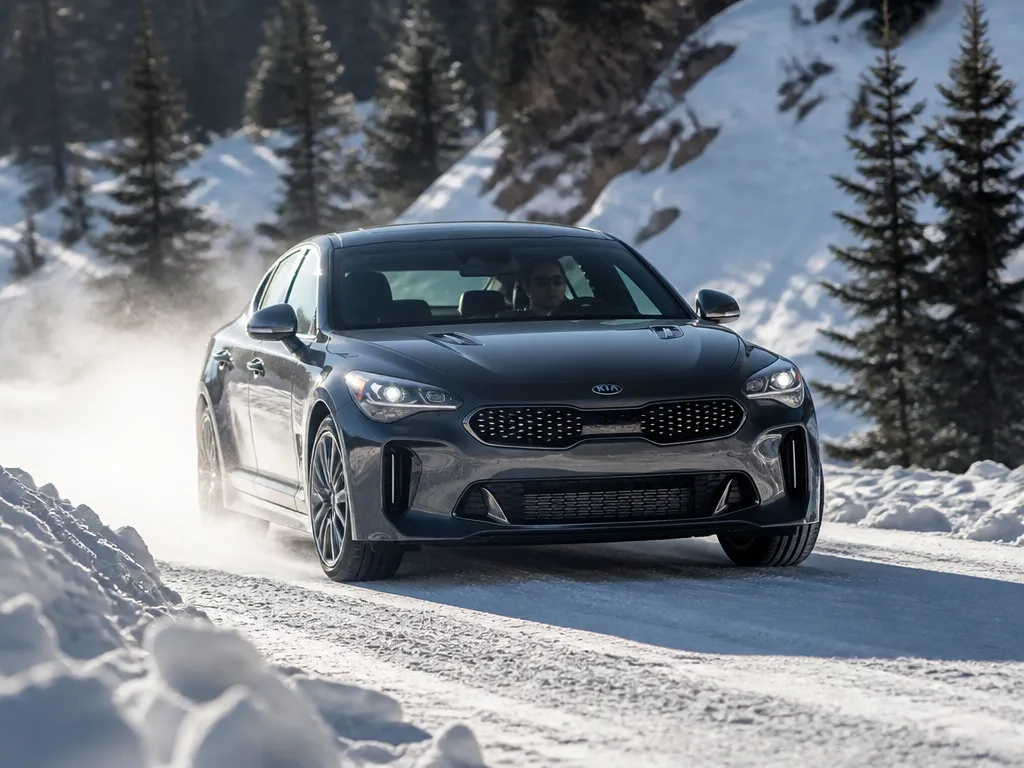
On packed snow, a Kia Stinger typically shows traction limits fast during takeoff, then repeats the pattern at each stop because the tire tread and road contact are inconsistent. Expect short moments of wheel spin and traction control intervention before it settles into a lower-grip “grab and go” rhythm.
Takeoff From A Stop: Wheel Spin And Traction Control Cues
When you release the brake and feed in throttle, the first sign you are over the grip limit is immediate hesitation followed by a jerk as the system catches up. On RWD cars, this often feels like the rear tires hunt for grip more than the steering feels “pushy,” while AWD cars can pull harder but still throttle back the moment the driven wheels slip.
For example, you might see the traction control or stability indicator light flicker during the initial 1 to 2 seconds, even if the car is behaving normally. A blinking indicator generally signals active intervention; a light that stays on may indicate that the system is switched off or has detected a fault, rather than persistent slip.
Braking On Slush: Abs Pulsing Feel And Realistic Stopping Distance
Packed snow and slush reduce tire grip, so ABS usually becomes the boss during harder braking attempts. The pedal can pulse and the car can feel busy, but ABS is doing its job by preventing a full lockup, which helps you stay more controllable in a straight line and at slight steering inputs.
For example, a short ABS pulse cycle is common when you brake at moderate pressure, but repeated aggressive pulsing means the tires are repeatedly trying to lock on a low-friction patch. Stopping distance stretches quickly as speeds rise, because the available friction stays capped even if ABS keeps the wheels turning.
Insider tip: in deep slush, the car can reach a point where ABS still works but you cannot “steer your way out.” Give yourself extra space and brake earlier, because ABS does not create grip, it manages wheel lock.
Brake Pedal And Steering Response When Grip Breaks
When grip breaks under braking, the most common driver complaint is “the pedal feels alive but the car won’t slow the way I expect.” The steering may feel vague, then suddenly sharpen when tires regain bite, which is a normal consequence of patchy ice and thin snow that changes contact area minute to minute.
For instance, if you brake while turning into an intersection and the front tires lose grip, the car can resist turning for a moment and then regain steering as traction returns. Treat that as a warning to straighten up and slow more gently, not as an invitation to increase steering angle.
Emergency Avoidance: Why Sudden Inputs Increase Instability Risk
Emergency maneuvers on packed snow punish abrupt changes in brake and steering because the tires have limited friction to share. A sudden lift or stab of throttle, combined with a sharp steering correction, can trigger traction control, ABS, and stability intervention all at once, which feels like the car is “fighting you.”
Turning Confidence On Ice
Kia Stinger traction behavior on low-friction roads is all about how quickly front and rear grip trade places once you load the tires mid-corner. Expect the car to be progressive when you make smooth inputs, then feel abrupt when you snap steering or change throttle suddenly.
Front Versus Rear Grip, And How Slide Types Show Up
On snow and glare ice, the Stinger tends to start rotating based on front tire grip. As speed or steering angle rises, front grip can run out first, and you will feel understeer as the nose pushes wide and the steering wheel keeps asking for more lock.
When rear grip drops, the car can transition toward oversteer in a way that feels like the rear “loosens” behind you. For RWD models, this usually shows up most when you add power mid-corner, and for AWD models it often shows up after traction control has been working hard for a moment, then timing slips you into a brief “more rotation than expected” phase.
Steering Wheel Feel: Straight-line Stability Versus Breakaway Onset
Mid-corner, the steering wheel on the Stinger usually feels “heavier” and less willing to add yaw once you are close to tire saturation. Straight-line stability often stays respectable until you hit a specific slip event, then you get a more noticeable change in effort and a quick change in the car’s trajectory.
Driver cue to watch is the gap between wheel angle and path. When the wheel angle grows but the car still refuses to rotate, you are in understeer territory; when the car rotates faster than your inputs and feels like it wants to pass the steering, you are flirting with oversteer.
Throttle-on Versus Throttle-off: Safest Winter Corner Technique
On low-friction surfaces, throttle changes can be more important than steering changes because they shift weight and available traction instantly. A common winter pattern is that throttle-on tends to help rotation on some cars until traction control is overwhelmed, then it can trigger a sudden traction event.
Throttle-off (lifting) usually reduces drive torque, but an abrupt lift can also transfer weight forward and reduce rear stability. The safest technique in the Stinger is to set up the turn with speed first, then use small, smooth throttle adjustments to maintain balance rather than chase grip mid-corner.
In winter driving, the best “traction control” is your right foot. Smooth inputs keep the system working inside its limits instead of reacting to spikes.
Crossing Ruts And Uneven Snow: How Traction Control Reacts
Ruts change wheel load left to right, so the Stinger’s stability and traction systems will often intervene even when you are driving gently. The typical cue is a brief change in engine response or a “nibble” at the brakes as the system tries to manage which tire has grip.
When crossing a rut diagonally, one side tire can hit a patch of firmer snow while the other stays on softer slush. That mismatch can create a yaw moment that feels like the car is tugging toward the low-grip side, so keep steering inputs straight and avoid adding power while your tires are on different traction levels.
Winter Tires Vs All-seasons
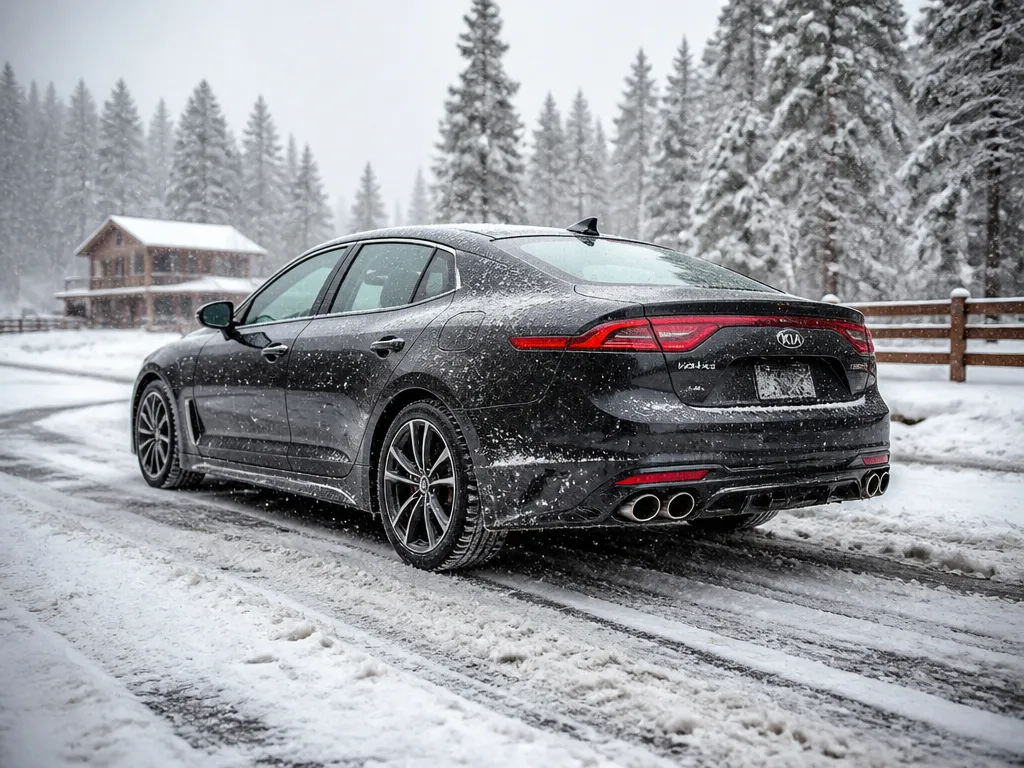
All-seasons are engineered to balance dry roads, wet weather, and light snow, so they lose grip fast once conditions turn icy or packed. Winter tires keep a softer tread compound in cold temps, so the Stinger has more bite when you accelerate, more control when you brake, and steadier front-to-rear balance when you turn.
Why All-seasons Fall Short On Real Snow And Ice
When temperatures drop, an all-season tread hardens, and its rubber cannot deform into the micro-texture of ice and compacted snow. The tread blocks also move less under load, so your traction control and ABS get more interruptions, with longer stopping distances and a quicker slide when you turn in. For a Stinger, that means you feel earlier front push (especially on RWD setups) or reduced confidence with sudden inputs on slippery corners.
In practice, the problem shows up as “spins then saves itself” behavior. You may get brief forward motion, then the system pulls power or you feel ABS cycling harder and earlier. The tires are the first link in that chain, so swapping rubber is the biggest improvement you can make for winter drivability without changing the drivetrain.
| Condition | All-seasons | Winter tires |
|---|---|---|
| Packed snow | Grip drops quickly as rubber stiffens | More bite from softer compound and sipes |
| Black ice and glaze | Longer ABS events, harder steering corrections | Better control through more consistent ABS modulation |
| Cold dry roads | Acceptable, but still less consistent than dedicated winter rubber | Excellent grip, smoother braking feel |
What Winter Tires Improve Most For The Kia Stinger
Winter tires are the biggest lever for three outcomes that matter on the Stinger in winter: traction bite, ABS control, and cornering consistency. Better bite reduces how hard traction control intervenes during takeoff on slick ramps and plowed lots, and it helps the car follow your steering angle instead of waiting for grip to “come back.”
For regions that see frequent ice, studded tires can add extra mechanical grip, but they trade off noise and pavement wear. Stinger drivers in mild winter areas often do better by going studless with a true winter tire, since studs are most worth it where roads stay icy for long stretches.
Shop note: If your roads are mostly plowed slush and packed snow, a high-quality studless winter tire is usually the better daily choice. If you routinely deal with glare ice on untreated surfaces, studded tires can be worth the trade-offs.
Studless Vs Studded, Plus Tread Depth And Fitment Checks
Studdless winter tires rely on tread sipes and compound grip, so they feel progressive and quiet on cleared roads. Studded tires can improve confidence on persistent ice, but they need careful selection and realistic expectations on dry pavement.
Before you buy, check tread depth and tire age on your current set if you are reusing wheels. Winter tires should not be “winter-tired” on worn tread, and age matters because rubber hardens even if tread depth looks okay. Also confirm sizing matches your Stinger’s wheel and clearance needs, and keep the winter tire size within the same overall rolling diameter tolerance you plan to use year-round.
When All-seasons Are Acceptable, And When They Are Not
All-seasons are acceptable if you live where winter means cold rain and occasional light snow on mostly maintained roads, and you drive gently with extra following distance. All-seasons are a bad idea if you regularly park on ice, commute on plowed-but-packed routes, or expect glare ice, because the traction gap shows up during braking and mid-corner slip.
For a Stinger, the limitation is not just “can it move,” it is “can it stop and steer predictably.” If you cannot afford surprises during hard braking, winter tires are the safer choice for daily use, even if your AWD variant changes how power is delivered.
Stinger Winter Checklist Before Storms
Start by setting up tires, brakes, and battery health. On a Kia Stinger, winter confidence comes down to how predictably it can grip and stop when temperatures drop.
For example, a Stinger with a bent splash shield often feels “grabby” on the first stops after hitting slush, because the rotor surface gets contaminated and takes longer to clean off.
For instance, a tire traction plan for winter is simple: keep longer following distances, avoid sudden throttle on turn-in, and treat braking as a gradual, steady input first. The goal is to keep the car in a controllable grip zone long enough for traction control and ABS to do their job.
Pro tip: If you are planning to switch tires, match winter tire pressure and tread condition to your coldest typical temperatures, then check pressures after the first real cold morning drive.
| Checklist item | What to look for | Winter impact |
|---|---|---|
| Tires | Low tread, cracked sidewalls, uneven wear | Loss of grip on snow and ice, unpredictable steering |
| Brakes | Rotor/splash shield damage, vibration or pull during low-speed stops | Slushy contamination and reduced confidence |
| Battery | Corroded terminals, weak cranking speed | Hard starts and delayed system wake-up |
| Fluids and visibility | Washer fluid rating, coolant level/mix, streaking wipers, slow defrost | Poor sightlines and cooling-related drivability issues |
Before you leave for the first storm day: verify tire pressures, top off winter washer fluid, confirm defrost speed, and do one safe low-speed brake check in a clear area. That routine catches most “winter surprises” before they turn into a roadside problem.
Sport-sedan Technique For Snow
Winter traction on a Kia Stinger gets decided by throttle shape and spacing, not by horsepower. With less grip, small steering and throttle mistakes turn into TC intervention, then into oversteer you cannot save in time.
Throttle Sensitivity And Awd/rwd Behavior
The Stinger’s traction control wants smooth, predictable torque delivery. If you stab the accelerator mid-corner or on a slick exit, the system can ramp up (audibly and through driveline feel), and the rear can rotate before you get traction back.
In practice, use a “wait then feed” approach: commit to your steering angle, then add throttle in a gradual ramp. On packed snow, aim for the throttle position where the car keeps rotating smoothly but does not surge, even if that feels slower than you expect.
Braking Technique: Earlier, Gentler, And Consistent
ABS on winter tires gives you shorter, more controlled stops when you keep pressure stable. Last-second hard braking can lock up a tire’s grip margin, and you end up steering while the system is busy modulating.
Brake early and build up deceleration smoothly. If you have to slow more, add pressure gradually rather than chopping it off and stomping again.
Corner Entry And Exit: Set Speed Early, Then Manage Traction
For a performance-oriented sedan like the Stinger, the best snow line is the one with the least steering change. Enter slower than you think, then minimize angle adjustments so the tires can do one job at a time.
Use a two-phase approach: set the corner speed early, then hold a modest steering angle and feed power on exit. If the car understeers, ease off throttle slightly and complete the steering before adding power again.
Spacing And “Traction Margin” Targets You Can Actually Feel
Traction margin is the extra grip you have before ABS or TC starts taking over, and it shrinks on packed snow. Manage it by driving far enough ahead that you can keep braking smooth and still stop in a straight line.
Instead of guessing by speed, judge grip by repeatability. If a gentle brake feels like it needs ABS, or a mild throttle causes TC flashing and wheelspin, assume you are already near the limit and raise your spacing again.
| Condition | What it feels like | Spacing/Speed adjustment |
|---|---|---|
| Packed snow | Consistent but reduced bite, TC may flash on exits | Add distance and keep throttle ramp slow, avoid mid-corner acceleration |
| Slushy patches | Grip changes quickly, steering response feels delayed | Reduce speed early, avoid sudden steering and throttle changes |
| Black ice | Sudden loss of response, ABS pulses with the lightest braking | Increase following distance aggressively, expect long stops |
When Traction Control Ramps Up: What To Do And What Not To Do
When TC ramps up in the Stinger, the driveline is telling you you are too close to the edge. The correct response is to reduce torque and stabilize steering, then rebuild traction gently.
Do not fight it with bigger inputs. Avoid jerking the wheel to “find grip” while TC is active, and avoid repeated throttle stabs that keep resetting the slip state.
Insider tip for snow control: if you feel the car change its attitude (nose pushing wide, rear trying to swing, or TC working harder), your job is to make it calm down first, then continue. Chasing the slide with throttle and steering is where performance cars get you in trouble on slick surfaces.
Limitations And When To Avoid
The traction system can only do so much once tire rubber reaches its limit on ice. On the Kia Stinger, ice is the point where the grip curve flattens, so adding throttle or steering angle will slide you instead of clawing back control.
Expect frequent traction control and ABS activity on mixed snow and slush, then fewer interventions when roads are packed and consistent.
In practice, short, brief events during normal driving are acceptable, repeated long corrections are a warning, and sudden behavior changes mean conditions or tire grip are shifting faster than the driver can compensate.
Ice Grip Limit And What It Looks Like
On ice, the tires cannot “grip harder” no matter how smoothly you drive. You may still feel stability when the car is pointed straight, but steering response gets vague and braking can turn into glide because the tire contact patch cannot generate more friction.
Uncommanded drift is the big red flag. For example, if the Stinger slowly slews sideways while you hold a steady wheel angle and calm throttle, you are past the tires’ and vehicle-control system’s ability to stabilize in that surface condition.
Decision Rules For When To Drive Or Switch Plans
Use this go or no-go mindset when the road is clearly icy. The Stinger can be a very capable winter daily with the right tires, but severe ice plus worn tires or unknown braking performance is a combination that increases your stopping distance and your chance of losing direction.
| Condition | What you’ll likely feel | Action rule |
|---|---|---|
| Severe, shiny ice | Unpredictable breakaway, longer ABS pulses | Avoid driving, find alternate route or wait. |
| Worn tires or uneven wear | TC/ABS keeps working even with gentle inputs | Do not continue past a safe turnaround. |
| Unknown braking performance | Pedal may feel “okay” but stopping is inconsistent | Limit travel and get brakes checked. |
| Major fault lights or drivetrain issues | Control logic may reduce intervention capability | Do not push it, schedule service. |
Rule of thumb: if traction control or ABS is repeatedly intervening in the same spot on the same speed, treat that as “road grip has dropped below your usable margin” and change plans.
When The Car Feels Like It Has “Mystery Slip”
“Mystery slip” usually comes from one of three issues: tire grip that changed (pressure, tread, contamination), braking imbalance (dragging caliper or uneven pads/rotors), or a temporary sensor/control problem. Start with the basics first before you blame the AWD system, since winter problems often trace back to tires or brakes.
Bring the Stinger to a professional if you see persistent warning lights, get repeated ABS/TC events on dry or lightly wet pavement, or notice pulling, grinding, or a brake that drags after the car sits. Winter driving can expose weaknesses fast, and steering plus braking control is too important to troubleshoot with guesswork.
Quick Summary
Winter drivability for the Kia Stinger hinges on the combo of drivetrain and tires. AWD can grip sooner during acceleration on packed snow, but tires matter most of all. Real winter tires usually restore grip quickly once temperatures drop below 45°F (7°C), whereas all seasons tend to lose traction. Expect longer stopping distances and more stability control intervention on ice, and be prepared for ABS cycling as the system keeps the wheels under control. Maintain smooth throttle and gentle steering to avoid wheel spin, and plan for higher brake effort with cold tires.
Preparation and technique drive the rest of the message. Start with tires before the freeze, brake early so ABS can do its job without chasing marginal grip, and stay boring on slick roads with wider lane margins and fewer quick lane changes.
| Surface / Condition | Stinger Behavior | Practical Tips |
|---|---|---|
| Packed snow | AWD grips sooner during acceleration; traction control can intervene later | Install real winter tires; maintain smooth throttle |
| Ice | Traction control cuts power early; ABS may pulse | Brake early, steer smoothly, and avoid abrupt inputs |
| Cold temps (below 45°F / 7°C) | Winter tires regain grip quickly; pressure changes affect contact patch | Check tire pressures when cold and keep tires warm |
Frequently Asked Questions
How Does The Kia Stinger’s Awd Option Affect Snow Handling Compared To Rwd?
If your Stinger has Intelligent AWD, it helps with traction in light to moderate snow, but it does not replace the need for proper winter tires. In any amount of snow, drive slowly and anticipate longer stopping distances.
Should I Run Winter Tires On A Kia Stinger If It Has Awd?
Yes, install four winter tires on the Stinger even with AWD, and ensure a tread depth of at least 6/32 inch for better snow grip. AWD helps acceleration but not necessarily braking on snow or ice.
What Tire Markings Tell Me I Have Proper Winter Tires For A Kia Stinger?
Look for the Three Peak Mountain Snowflake symbol (3PMSF) on the sidewall; M+S alone does not guarantee performance in severe winter conditions.
What Driving Technique Yields The Safest Performance For A Kia Stinger In Snow?
Reductions in speed with a 6-second following distance rule, smooth throttle, and gentle braking are key; avoid hard turns or sudden inputs to maintain traction.
What Winterizing Steps Should I Take On A Kia Stinger To Prepare For Snow Driving?
Check the 12V battery health, use winter-grade windshield washer fluid, inspect wiper blades, and ensure headlights are clean and aligned; a healthy battery should read about 12.6V when the engine is off.