


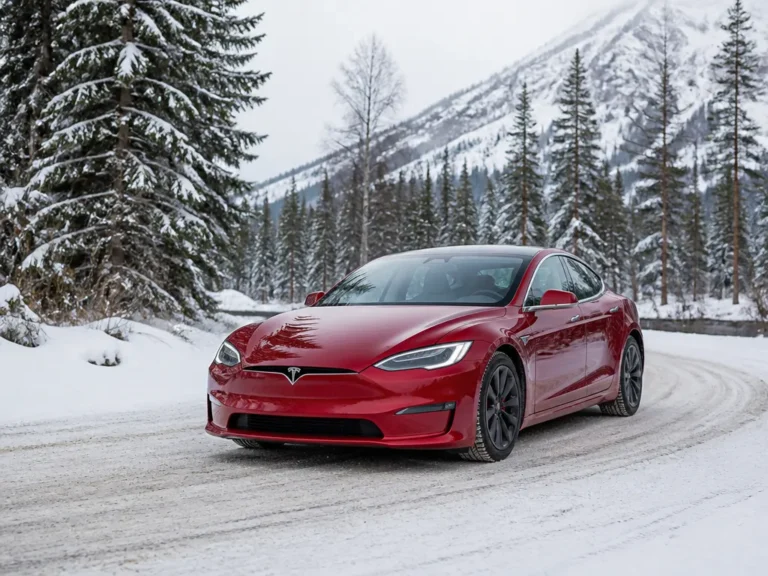
You searched “tesla cars in the snow” because your next storm has you worried about range, traction, and charging, not theory. Maybe you drive a Model 3 or Model Y and you’re seeing lower efficiency on cold mornings. This guide breaks down how each Tesla model behaves in snow, what changes in sub-freezing temps, and what to do before you leave.
Expect range to drop in cold weather because the battery and cabin need heat. Choose winter tires for the biggest traction gain, especially on slush and packed snow. Precondition before driving and plan charging, because cold batteries charge slower and DC fast charging can take longer.
Tesla cars in the snow perform best with the right tires, preconditioning, and a realistic range plan. Cold can reduce usable range by roughly 20 percent to 40 percent, especially near 0 C and colder, and battery charging often slows until the pack warms. With winter tires and proper traction control settings, braking and grip improve noticeably on packed snow.
Tesla Cars In The Snow: What Changes
Cold weather hurts EV range mainly by reducing battery efficiency and by increasing energy draw from the cabin heater. Snow and ice also reduce tire grip, so traction limits force you to accelerate and brake more gently than you would on dry pavement.
On a Tesla, the battery needs heat to deliver power smoothly. Cold pack temperatures mean the battery management system keeps less power available until the cells warm up, and more energy is spent running thermal management and maintaining cabin comfort. In real driving, this shows up as shorter usable range and more frequent charging stops, especially on trips with lots of heater use.
Traction, Stability, And Why Regen Can Feel Different
Snow is tricky because the limiting factor is tire friction, not motor power. Slush and packed snow can create a slick surface that makes wheel slip more likely, so grip drops and braking distances lengthen.
Regenerative braking is still available, but the feel changes when traction is limited. When tires have reduced grip, the car may blend regen with friction brakes or reduce regen strength to avoid sudden deceleration that can destabilize the car on slick surfaces. The result is a more muted “one pedal” slowdown in deep snow, even when you lift off at the same rate.
Owner takeaway: If the regen response feels weaker or jerky in snow, treat it like a traction limit indicator and adjust your pedal habits, spacing, and following distance.
Charging In Cold Weather: Battery Conditioning And Speed Changes
Cold batteries charge slower. Tesla battery management typically conditions the pack first, using available power to bring cells into a workable temperature range, then the charger can deliver higher current. If the battery is very cold, you may see longer charging sessions for the same amount of energy.
| What changes in winter | What you feel as the driver | What to do about it |
|---|---|---|
| Battery efficiency drops | Less range, more frequent stops | Precondition, drive smoother, reduce heater load when safe |
| Heater demand rises | Range drains faster in cold cabin conditions | Use seat heaters, manage defrost timing, keep settings reasonable |
| Tire grip falls on snow/ice | Slower acceleration, longer braking distances | Use proper winter tires, increase following distance, ease into pedal inputs |
| Regen adapts to traction limits | Different one pedal slowdown or blending with friction | Brake earlier, lift more gently, stay smooth at turns |
| Cold battery slows charging | Longer sessions to gain the same range | Precondition to warm the pack, charge sooner, avoid arriving at 0% |
Model differences matter later in the article because tire size, weight, and drivetrain tuning change how traction limits show up. Model 3 and Model Y are common winter platforms, but Model S and Model X can experience similar winter physics with different mass and wheel/tire setups.
Range Drop In Cold Snow Temps
Cold weather can cut Tesla range significantly, mainly because the battery is less efficient and cabin plus battery heating takes power. At around 0℃ (32℉F), a conservative expectation is roughly a 20-30% range drop, while at -10℃ (14℉F) it is commonly closer to a 35-50% drop. Real-world results swing a lot with snow depth, tire condition, and how fast you drive.
Quantified Range Impact By Temperature And Driving
Range drops are worst when the car has to warm the battery from a cold start and when you drive briskly enough that the motors draw more energy. Highway speeds tend to hurt more than city driving because aerodynamic drag climbs with speed, and snow slush can increase rolling resistance.
| Ambient temp | Conservative expected range loss | Typical speed pattern | What drives the loss |
|---|---|---|---|
| 0℃ (32℉F) | 20-30% | Mixed, up to ~65 mph / 105 km/h | Battery warming + HVAC load, plus higher rolling resistance on snow |
| -10℃ (14℉F) | 35-50% | City traffic to moderate highway | Battery efficiency drop + greater heating demand, higher energy use per mile |
| -10℃ (14℉F) at higher speeds | 45-60% (use extreme caution) | Fast highway, steady cruise | More drag at speed plus traction energy losses in slush |
Model differences are usually smaller than the driving factors above. Model 3 and Model Y often see similar percentage drops to each other in the same conditions, while Model S and Model X can be affected more by how heavy the vehicle is and how you manage cabin comfort and speed.
Awd Vs Rwd: What Changes In Snow
All-wheel drive helps you move and stay moving in low-traction snow, but it can cost you some efficiency compared to rear-wheel drive. In cold conditions, the bigger factor is that AWD systems may keep more power flowing across axles to maintain traction, especially during acceleration and when roads alternate between packed snow and bare patches.
In practice, the “winner” depends on your throttle habits. If you accelerate early and hard, AWD may spend more energy finding grip; if you drive smoothly and keep speeds down, the AWD advantage usually shows up as fewer slowdowns and fewer traction losses rather than big efficiency swings.
Speed Sensitivity: Highway Vs City
Highway driving is usually the range killer in snow because aerodynamic drag increases quickly with speed and snow slush raises rolling resistance. City driving can feel slower, but stop-and-go traffic can still be range friendly if you use regen well and keep cabin temps reasonable.
Planning rule of thumb: On packed-snow routes, assume the same temperature range loss but add a speed penalty if you will cruise steadily above about 65 mph (105 km/h). Plan as if your “real” efficiency is closer to the high end of the conservative range.
Battery Thermal Management And Preconditioning
Battery preconditioning before you drive or before you arrive at a charger is one of the biggest ways to protect range in cold snow. Preconditioning warms the battery so it can deliver power efficiently and can also improve how much regen you get while driving.
For longer trips, schedule charging stops based on the coldest segment you will face, not the average temperature. Short hops in very cold weather can be harsher than fewer longer drives because each cold start forces fresh battery warming.
Charge-stop Planning Without Guessing
Charge planning in snow should be conservative and staged. A good approach is to start with the car’s projected usable range, then apply a weather buffer, plan your first stop earlier than you normally would, and keep at least a reserve for detours or slower travel speed.
In the real world, Tesla’s route guidance and your in-car energy estimate are helpful, but in severe cold they can be optimistic. The safest habit is to plan two steps ahead: earlier departure from your last charge and a backup charger along the way, because snow delays make “arrive at 5%” math unreliable.
Model-by-model Traction And Handling
Traction in snow is mostly a tire story first, then a control-system story second. Tesla torque delivery stays strong, so with the wrong tires it can spin the drive wheels early and take longer to build speed. With correct winter tires, each model feels predictable, but braking feel and stability behavior still change with snow depth, surface type, and tire temperature.
Model 3: Limits, Steering Feel, And Braking Behavior
Model 3 typically accelerates most confidently in light snow, then shows traction limits when the surface is glare ice or wet snow. Steering feel is quick and accurate, but on low grip the front end follows tire grip rather than “pushing” through it like some heavier AWD crossovers. In slippery conditions, allow extra space for stops because brake blend and regen strength can be reduced when the pack is cold.
Braking behavior in snow is a mix of friction brakes and regen, so pedal effort can feel different as the system decides how much deceleration it can recover. When regen is limited (common in cold weather), you rely more on friction braking, which increases stopping distance on very icy pavement. A good test is to practice a few controlled stops in an empty lot after your first cold night, so you learn how the pedal response changes.
| Surface | Model 3 feel | Driver takeaway |
|---|---|---|
| Light snow (packed) | Strong launch, easy to steer | Use short, progressive throttle |
| Wet slush | Traction grip can vary side to side | Avoid late steering corrections |
| Glare ice | Wheel spin and longer stops | Expect regen and friction limits |
Model Y: Traction Control Behavior And Stability Under Snow Load
Model Y tends to feel stable in moderate snow because its taller stance keeps tires planted, and AWD helps keep the car moving without big throttle surprises. Traction control will intervene quickly if the fronts or rears lose grip, so hard inputs can trigger visible power reduction even when you still feel “on the gas.” On deeper ruts, stability is usually good, but you need smoother steering because the tires follow the deepest groove they can bite into.
Regen feel also matters on Model Y, since the deceleration you expect from lifting off the pedal changes with battery temperature and available traction. On a loose snow surface, regen can momentarily feel like it pulls the car straight, then releases when grip returns, especially if one axle regains traction first. Give yourself time to learn how the car slows when you lift in your local conditions.
Model S: Low-speed Control And Weight Distribution In Slick Conditions
Model S has excellent traction on the right tires, but low-speed control is where the driver notices differences most. The car’s weight distribution and low center of gravity help stability, yet the wider, performance-oriented tires (on many trims) can lose bite sooner on glare ice. At walking speed in slush, turning while rolling can lead to subtle slip, so slow steering inputs matter.
In slick conditions, brake feel can shift because the system prioritizes regen when available. If regen is limited, the pedal may require more effort to match the slowdown you remember from warmer weather. For confidence, practice low-speed turns and gentle stops before committing to traffic, since the first few minutes of cold driving reveal the traction reality.
Model X: Handling In Deep Snow, Regen Vs Grip
Model X usually has the traction advantage in deeper snow simply because it is easier to keep momentum without immediately sinking, and its AWD can distribute torque effectively. Handling in deep snow is still governed by tire contact patch size and tread depth, so the “feel” changes as snow compacts under the tires. Steering can feel slightly heavier as load shifts, but the car generally stays composed if you keep throttle and steering inputs smooth.
Regen versus grip is a bigger deal in deep snow because the surface alternates between packed and loose snow. Lift-off deceleration can feel inconsistent as tires regain and lose traction through ruts and slush. The practical approach is to plan longer following distances and use earlier, lighter deceleration rather than trying to count on regen alone.
Common Real-world Caveats That Change Every Model’s Results
Practical rule: If you can, do one short test drive after a snowfall in a safe area. Pay attention to launch behavior, steering response, and how the car slows when you lift. That one exercise tells you how much your tires and battery conditions are limiting performance on your roads.
Across Model 3, Y, S, and X, the same trade-off shows up: quick torque can expose traction limits on the first bad surface it encounters. Winter tires reduce that problem dramatically, then the car’s stability control and AWD can do what they were designed for. Without the right tires, even the best control logic can only manage what the contact patch allows.
Winter Tires For Each Tesla
Cold weather punishes summer and all-season tires because rubber gets stiff and tread blocks lose grip. Winter tires are built with softer compounds and deeper, more aggressive tread, so they recover traction in slush and packed snow while reducing the chance of wheelspin on takeoff.
Non-studded Winter Tires Vs. Studs
Non-studded winter tires are the best balance for most snowy climates. They use siping and tread patterning to claw through snow and stay flexible when temperatures hover below freezing, which matters for everyday commuting and wet slush.
Studded tires help when you deal with long stretches of glare ice, especially around bridges, shaded overpasses, and maintained-but-slick city routes. Studs improve forward traction and some braking on ice, but they can feel noisier and wear faster on plowed roads and dry pavement.
Tire Sizing And Clearance By Model
Model-specific fitment matters because Tesla wheel well clearance and brake caliper shape limit what you can mount. Before buying, verify the exact factory tire size for your wheels and check that your preferred winter size keeps enough clearance to the strut and suspension at full lock.
For example, many owners can move between approved aspect ratios on the same rim width, which can slightly change the sidewall height and ride comfort. Sidewall height also affects how the tire deforms under load, which is helpful in snow, but only if clearance stays within spec.
| Model | What to verify for snow tire fit | Practical target |
|---|---|---|
| Model 3 | Factory wheel size, rim width, clearance at full steering lock | Winter size that matches OEM load index and stays within wheel-well tolerance |
| Model Y | Wheel well clearance and sensor coverage on staggered setups | Maintain OEM-equivalent load rating so traction control can work normally |
| Model S | Brake hardware clearance and overall rolling circumference match | Keep rolling diameter close to factory to avoid traction behavior surprises |
| Model X | Suspension clearance around larger wheel setups | Winter tires sized for the exact wheel you have, not a generic chart guess |
Tread Depth, Pressure Checks, And Sidewall Realities
Winter tires need tread depth because snow performance comes from both tread depth and siping. A worn winter tire can still move in dry cold weather, but snow bite drops fast once you are down near the end of its usable siped life.
Cold weather also drops tire pressure, which kills grip and can worsen range because more rolling resistance comes from underinflation. Tesla owners should check pressures when tires are cold, then re-check after the first few days because the new temperature setpoint will stabilize.
How Upgrades Change Range And Braking
Winter tires usually reduce real-world range compared with summer tires because tread blocks and sipes increase rolling resistance. The range penalty varies by tire model and compound, but expect lower efficiency, especially in deeper snow where tread scrub and wheel slip use more energy.
Winter tires improve stopping distance and traction management in snow and cold rain, but the gain is tied to tire type and conditions. Braking improvement is strongest on snow and ice, while acceleration gains depend on whether your tires can maintain contact and whether traction control can limit wheelspin effectively.
Winter tire choice is a trade: you typically trade some range for meaningful control. In cold climates, that trade is usually worth it because traction and braking confidence prevent the “one bad moment” that ruins a whole day.
Regenerative Braking In Snow
In low-traction snow and ice, regenerative braking can feel delayed at first and then “catch” as traction returns. The one-pedal feel is still there, but slip at the tires changes how much regen the car can safely command.
Cold pavement also changes regen behavior because the drivetrain and battery protection systems limit power in harsh conditions. When traction is low, the Tesla often has less usable grip for deceleration, so you may notice the car reduces regen early, then resumes once the wheels regain stability.
Why Regen Feels Different On Ice
Regenerative braking is tied to wheel speed and traction estimates. If the tires start to slide, stability control will intervene and the car can back off or modulate regen to keep the driven wheels from spinning or skidding.
For example, a light lift of the accelerator on a patchy snow surface may command strong decel on top of snow, then soften when the tires roll onto glare ice. That “variable decel” is why many drivers think the regen is inconsistent, when the vehicle is actually trying to keep each wheel in a safe slip window.
How To Optimize One-pedal Control
Driving mode settings matter mostly for traction and acceleration responses, not for the basic fact that regen is traction-limited. “Snow” or “Traction” oriented modes typically soften throttle mapping, which helps you avoid wheel slip that would otherwise cause stability control to cut back regen.
| Situation | What you’ll feel | Driver adjustment |
|---|---|---|
| Glare ice after a lift | Regen may weaken suddenly or feel jerky | Lift more gently, maintain a longer buffer |
| Deep snow with variable grip | Regen changes as tires search for traction | Use smoother pedal transitions, avoid abrupt release |
| Slippery uphill | Regen can be reduced while traction control works | Brake earlier, use steadier throttle on the climb |
Slip and traction control interactions are the key to understanding what’s happening during both acceleration and regen. If the car senses wheel slip, it will reduce drive or decel torque through the stability system, which can look like “less regen than expected” even though the one-pedal setup is unchanged.
Smooth weight transfer is everything on slick surfaces. Keep your pedal actions slow and predictable so the load shifts gradually, which reduces tire unloading and the chance of triggering traction control mid-deceleration.
Weight transfer on Tesla models tends to happen fast when you snap to full lift, which can unload the front tires on some layouts and cause instability. For Model 3 and Model Y in particular, treat quick accelerator releases like an abrupt brake request, because the vehicle can momentarily exceed available tire friction when grip is marginal.
On Model S and Model X, the same principles apply, but the higher mass and longer front-to-rear distances can make jerks feel more noticeable. Practice consistent lift points in an empty lot, then repeat those inputs in traffic so your deceleration stays smooth even as the traction changes street to street.
Charging Tesla In Winter Snow
Cold weather slows charging because the battery has to warm up before it will accept high power. Preconditioning heats the pack and typically improves DC fast charging performance, but it can also raise energy use and reduce range if you wait to preheat until right before charging.
Battery Thermal Management: Preconditioning Is About Charge Rate
Teslas manage battery temperature with thermal management, and winter snow adds an extra load because the pack cools faster. Preconditioning warms the battery using power from the drivetrain system, so the cells are closer to an ideal temperature when you plug in.
Preconditioning is especially useful for DC fast charging, where charging power is limited when the battery is cold. For Model 3 and Model Y, charging performance can feel “mysteriously slow” when you arrive after sitting outside in sub-freezing conditions; preheating is the fix that prevents that time penalty. For Model S and Model X, the same basic rule applies, though the impact can feel smaller or larger depending on your route heating habits and arrival temperature.
Cold-weather Dc Fast Charging: What Times Usually Look Like
Expect slower charging in snow than in warmer weather because the battery needs time to reach a safe charge window. The biggest slowdowns happen when you start with a very cold pack, then they improve as the battery temperature rises.
DC fast charging time in cold weather is also sensitive to your state of charge when you arrive and whether you are also running cabin heat. Charging will taper as you approach higher percentages, so a cold-start slowdown can stack with the normal “ramp down” near the top of the battery. Use conservative expectations for road trips, and plan to stop earlier rather than later.
| Situation | What to expect | Practical takeaway |
|---|---|---|
| Battery cold, no preconditioning | Lower initial DC fast charge power, longer first segment | Arrive earlier than you think, or precondition while en route |
| Battery warmed via preconditioning | Higher initial charge power, faster early throughput | Use the navigation-to-charger feature when possible |
| Arrive very low or very high SOC in winter | Either limited by cold pack or tapering effects | Target a mid SOC arrival and exit point |
On-route Strategy: Protect Your Schedule
Charging stops in snow should be planned with buffer because cold starts can stretch the early portion of DC fast charging. A practical approach is to aim for a slightly earlier arrival SOC and a shorter session, then adjust at the next stop if the pack warms faster than expected.
For example, if your route normally works with one “quick top-up,” the winter version often needs a different pattern, like two mid-level charges instead of one big fill. This keeps you away from prolonged cold-start charging windows and reduces the chance you miss your connection time due to charger power limiting.
Insider tip: If you see charging power ramp much slower than usual after plugging in, assume the battery is still catching up thermally. Leave yourself extra time instead of adding stress to the schedule.
Safety Features And Winter Limits
Traction Control (TCS) and Stability Control are Tesla’s first line of defense on snow and ice, and they reduce wheel slip by cutting torque and braking individual wheels when needed. Regenerative braking also helps in slippery conditions, but it can feel different when battery limits reduce regen or when you lift the pedal on glare ice. Tesla’s winter driving safety comes down to how these systems react, and how you react to their feedback.
Traction And Stability Behavior On Snow/ice
On compact snow, a Tesla will typically allow some slip before TCS clamps down, then it uses brake pulse control to keep the car pointed where you steer. On ice, the margin is thinner, so you can feel more frequent traction events (audible brake control and slight deceleration changes) even when you are driving smoothly. Model differences are mostly tire and weight related, not a completely different control strategy, so tire choice and pedal discipline matter most.
For example, aggressive throttle or steering input mid-turn is the quickest way to trigger stability intervention because the car must choose between maintaining speed and keeping the yaw under control.
In practice, you get the best results by making inputs slower: reduce steering angle changes, ease into acceleration, and let the car settle before you add more. If the car repeatedly signals traction events during straight-line travel, you are likely on a surface closer to ice than snow.
Parking And Low-speed Traction Pitfalls
Low-speed traction problems often come from tire scrubbing and sudden torque changes, especially when you creep and correct repeatedly. A common trap is letting the car roll a short distance on an icy driveway, then snapping the accelerator to “catch up,” which forces the drivetrain to deliver torque when grip is worst.
For parking, keep your final approach gentle and straight, then let the car settle. Avoid rocking the car (forward, back, forward) to “walk it out,” because alternating traction losses can overwork the tires and increase the chance you end up sideways.
| Situation | What you may feel | What to do |
|---|---|---|
| Climbing a snowy incline | TCS light can come on, slower acceleration than expected | Ease off the pedal, keep steady throttle, stop if you start spinning |
| Turning on packed snow | Brake pulsing sensation, stability control engagement | Reduce steering angle and speed, straighten gradually |
| Backing out on ice | Grip feels inconsistent, longer stopping distance | Use smaller inputs, plan a path, avoid repeated corrections |
Braking Confidence: Abs Behavior Vs Low-friction Surfaces
ABS is designed for low-friction surfaces, and on snow it can shorten stopping distance while the pedal may pulse. A pulsing brake pedal is a normal ABS effect, but it should calm down when you regain stable traction. If ABS is active constantly even with light braking, that is your cue the surface is closer to ice than snow.
Mechanic’s tip: Treat repeated ABS cycling as a traction warning, not a “fix” you can drive faster through. Slow down enough that the ABS events become occasional, not constant.
Alerts And Symptoms To Watch For
Winter-specific behavior changes can be normal, but warning messages are not. Watch for reduced regen indicators (regen limiting messages or noticeably weaker deceleration when you lift off), traction or stability alerts, and any unusual brake or steering warnings. Cold-soaked battery conditions can reduce regen availability, yet steering and braking should remain predictable.
Get conservative and act on these symptoms immediately:
When To Stop Driving And Get Checked
Stop driving and schedule service if you see warnings related to braking, steering assist, the drive unit, or high-voltage components, especially if the car also feels abnormal. Also stop if a warning appears along with symptoms like pulling, uneven braking feel, grinding from the brakes, repeated loss of stability despite careful inputs, or regen that stays severely limited beyond the cold soak period.
For safety, treat anything involving brakes, steering, or high-voltage systems as “professional-only.” A dealer or qualified EV technician can scan fault codes, inspect brake system health, and confirm thermal and regen limits, which you cannot reliably verify at home without specialized tooling.
Snow-trip Checklist For Tesla Owners
Before you leave, tires and visibility decide whether your trip is calm or stressful, so set those first. Cold weather also changes battery behavior, so plan for longer charging time and more buffer range than you do in summer. This checklist is built for Tesla Model 3, Model Y, Model S, and Model X winter trips.
Pre-drive Checks (Do This Before You Roll)
Cold snow driving punishes small issues, so quick checks catch problems early. Take 5 to 10 minutes and do the items below, even if the car “seems fine.”
Before leaving, manage battery temperature with preconditioning so you get better power delivery and more predictable regen. Precondition long enough that the battery is warm before your first big demand (highway merges, steep grades, or sustained snow). Use your navigation to a planned charger if your vehicle supports it, since it helps time battery conditioning with your route.
On-route Charging Plan In Snowy Weather
Cold batteries charge slower, and snow-covered approaches can eat time at the charger. Build a plan with spacing so you are not arriving at 1% battery or parking while a fresh snowstorm is still rolling through.
| Situation | What to do |
|---|---|
| Snowstorm reduces average speed | Increase planned charging stops so you are not relying on optimistic energy use estimates. |
| Battery is cold on arrival | Let the car complete battery warm-up at the charger, then move when the charge rate stabilizes. |
| Access road is icy or narrow | Park where you can safely leave, and avoid blocking the charger if traction is poor. |
Emergency time matters more than convenience in winter. Keep a charger list that includes nearby alternates, then verify access conditions like snowbanks at drive-up lanes. Model S and Model X owners should also watch for lower ground clearance with deep snow at some hotel or roadside sites.
Emergency Readiness (Pack For Traction And Power Loss)
Snow trips go wrong when tires lose grip and you cannot move enough to reach help. Pack traction aids and power tools so you can recover without needing another vehicle to pull you.
Mechanic tip: If you ever need to rock out of snow, do it gently. Spinning creates heat in tires and can pack snow deeper into the tread, turning a quick recovery into a long one.
If You Get Stuck (Safe Steps And Avoiding Battery Overexertion)
Getting stuck is a safety problem first, a driving technique problem second. Start by ensuring you are out of harm’s way, then improve traction before you try again.
Model 3 and Model Y owners often get stuck in two scenarios, deep packed snow ruts or icy glare on the approach road. Model S and Model X add another variable, deeper snow drift around parking lots can catch the tires and reduce your ability to regain forward motion. If recovery attempts fail quickly, call roadside assistance rather than escalating wheel spin.
Quick Summary
Cold weather changes Tesla cars in snow mainly because the battery and cabin demand more energy while the pack delivers less power when it is cold. The article calls out that usable range can drop roughly 20 percent to 40 percent, especially near 0 C and colder. It also explains that snow and ice reduce tire grip, so traction limits force gentler acceleration and braking than you would on dry pavement. Overall, winter tires, preconditioning, and a realistic range plan matter most for how the car feels and performs.
For charging and drivability, the article emphasizes that cold batteries charge slower, since Tesla battery management conditions the pack first and DC fast charging can take longer until the battery warms. Precondition early using the app, and charge sooner in the trip because arriving at 0% is riskier when range is reduced. It also notes that AWD generally helps in slippery conditions versus RWD, and that Snow or Traction mode plus regen adjustments can make “one pedal” slowing feel different on slick surfaces. The most important takeaway is to precondition, plan for 20 to 40 percent less range, and rely on true winter tires.
| Cold weather effect | What you feel | What to do |
|---|---|---|
| Battery efficiency drops | Less range, more frequent charging stops | Precondition before driving, drive smoother, manage heater load when safe |
| Cabin heater demand rises | Range drains faster in a cold cabin | Use seat heaters, time defrost reasonably, keep settings moderate |
| Traction on snow/ice falls | Longer braking distances, slower acceleration | Use winter-rated tires, increase following distance, ease into inputs |
| Regen behavior changes | More muted one pedal slowdown or blended friction braking | Brake earlier, lift more gently, stay smooth through turns |
| Cold pack slows charging | Longer sessions to gain the same range, slower DC fast charge ramp-up | Precondition to warm the pack, charge earlier, avoid arriving at 0% |
Frequently Asked Questions
How Do Tesla Cars Handle Snow Traction Compared To Gas Cars?
Most Tesla models use all-wheel drive traction and regenerative braking, which can help you stay stable on packed snow. That said, tire choice matters more than the drivetrain, so switching to real winter tires is usually the biggest improvement for icy or deep snow.
Should I Use Winter Tires On A Tesla In The Snow, Or Are All-season Tires Enough?
All-season tires can work in light snow, but for consistent winter driving you should plan on dedicated winter tires, especially if you deal with ice, slush, or cold temperatures. Cold weather reduces grip for rubber not designed for winter compounds, and winter tires are built for that.
Will A Tesla’s Range Drop A Lot In Winter Snow?
Yes, electric range typically drops in cold weather, and snow driving usually worsens it due to extra rolling resistance and sometimes more heating use. The exact drop varies by model and temperature, so check your Tesla’s in-car range estimate before you commit to longer trips.
Can Regenerative Braking Cause Slipping When Driving A Tesla In Snow?
It can, because strong regen changes how weight transfers to the tires when you lift off. If you feel the car is too touchy on slick surfaces, try driving more smoothly with earlier, lighter pedal inputs and adjust your regen setting if your model allows it.
What Winter Safety Upgrades Should I Do For A Tesla In Snow?
Focus on the basics: winter tires, keeping the vehicle clear of snow and ice, and using clean windshield washer fluid rated for cold temps. Avoid DIY work on high-voltage systems or braking components, and if you notice warnings or unusual traction behavior, have it checked by a qualified technician.
How Much Does Tesla Snow Driving Cost, And What Tires Or Maintenance Should I Expect?
The main added cost is usually winter tires, since you may replace them less often if you swap seasons correctly. Beyond that, plan on normal wear items plus occasional battery and charging checks in cold weather, but exact costs depend heavily on your local tire prices and how many winter miles you drive.