


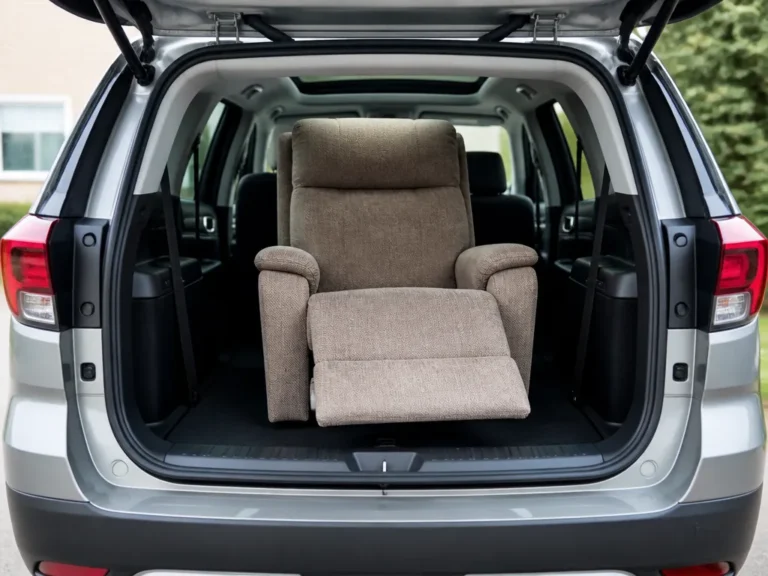
Your new recliner is 30 inches wide, and the SUV feels close, but the second-row hump and door opening seem tight. You are trying to figure out if the chair fits upright, if it only fits folded or reclined, and what you must measure before you buy, move, or load it through the rear hatch.
Yes, most recliners can fit in common SUVs, but only when you match recliner dimensions to the cargo opening and floor clearance. This article walks through measuring the chair and SUV, planning seat fold or removal, choosing the safest loading orientation, and troubleshooting when the hatch will not close.
To fit a recliner in an SUV, measure the recliner’s overall width, height (upright and reclined), and depth, plus the SUV’s rear opening width and height. Check the chair’s width against opening width with clearance for angles, and ensure legs/footrest clear the wheel wells and cargo height. Plan to load reclined or folded if upright fails.
Fit A Recliner In An Suv: Quick Viability Check
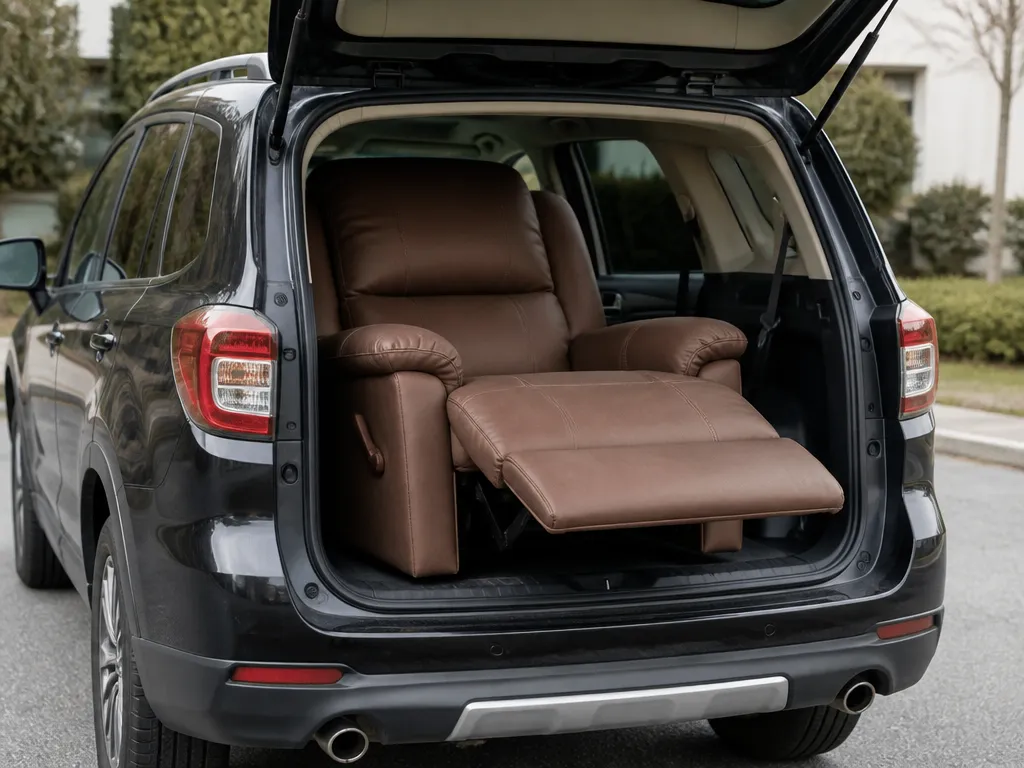
Most SUVs can swallow a recliner if you transport it in the right orientation and the chair allows it to fold or tilt. The deal-breakers are usually the recliner’s width and height with arms/footrest attached, plus whether the recline height clears the liftgate opening and the rear seat back. Run this quick measurement pass before you wrestle anything or pay delivery money.
Start With The Recliner Type (It Changes The Fit)
Standard living-room recliners are bulkier because the arms and full seat height often need to go through the SUV opening as one unit. Lift chairs can fit better only if the mechanism lets you tip it back or lower the seat without binding. Power recline chairs can be the easiest for one specific reason, the seat back and footrest often move into a tighter “transport” position.
Transport rules change by design, so treat the chair like a piece of equipment, not furniture. The best-case fit happens when the recliner can be folded, tilted, or partially disassembled (legs off, arms unbolted, back removed) with a clear path into the cargo area.
Top 5 Measurements That Make Or Break It
Grab a tape measure and write these down for your exact model, even if the listing has dimensions. One mismatch in any category can force you to remove seats or switch vehicles.
| Measure on the Recliner | Why it matters in an SUV |
|---|---|
| W (arm-to-arm or widest point) | Determines if it clears the tailgate opening and rear corners. |
| H (to highest point in upright mode) | Determines if it hits the headliner or liftgate ribs. |
| D (front-to-back in the transport position you’ll use) | Determines if it reaches far enough into the cargo area without wedging. |
| Arm/footrest protrusion | Creates “hidden width,” the part listings often ignore. |
| Transport angle (upright vs reclined vs tipped back) | Controls height clearance and how the chair clears the wheel wells. |
Fast reality check: Measure the recliner in the same position you plan to load it (upright, reclined, or tilted). A chair that “fits reclined” can still fail when upright because the height-to-opening clearance is different.
Suv Reality Check: Opening Size Vs Usable Cargo Space
Use the SUV’s actual openings, not brochure figures. Measure the liftgate/door opening width and height, then measure from the cargo sill to the seat backs (or to the folded seat position) to get usable depth where the recliner can sit.
Wheel wells and cargo floor height are the two biggest surprises. If your recliner’s depth depends on sitting flat, a high cargo floor or a deep wheel well can eat the clearance you thought you had.
Fast Pass Or Fail Rules (Upright Vs Folded/reclined)
Pass when the recliner’s transport-mode width is smaller than the SUV opening and the transport-mode height clears the liftgate edge without contact. Fail when the chair can only pass through the opening in a position you cannot hold while loading, or if the footrest/arms create a protrusion that exceeds the measured opening width.
For example, a 30-inch-wide recliner can clear the opening width but still fail if the arms extend to 32-33 inches at the protruding corners or if the reclined position raises the highest point above the opening height. A lift chair may fit with the seat angled back, yet fail in “standing” upright transport because the highest point hits the liftgate ribs.
Recliner Measurement Checklist (Must-have Numbers)
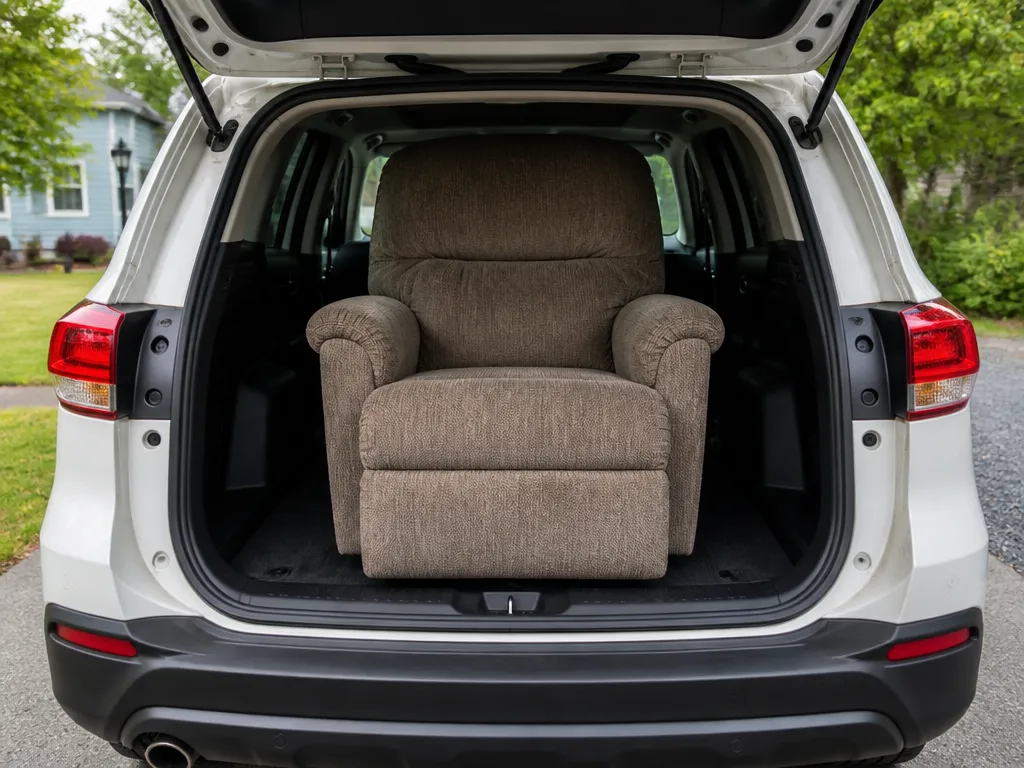
Measure the recliner in the positions you will actually load it, because most “fits” fail due to the transport footprint (legs and arms swing farther than the seat does). Write down tightest-point measurements in inches for every position, especially the under-seat and floor clearance that can hit wheel wells.
Recliner Envelope, Measured At The Tightest Points
Place the chair on a flat floor and extend it to the three states you care about: upright (seated), reclined (seated), and transport (any legs down, back tilted, and arms at maximum width). Measure overall width, overall height, and overall depth in each state using a tape measure, then record the smallest SUV-relevant clearances you’ll compare later.
For example, a typical 30 inch wide recliner can fit an SUV only when transport width is under your SUV’s cargo opening width and when the chair’s depth does not jam the rear door edge. Many chairs that “fit” in photos still fail because the legs extend and the underside scrapes the wheel-well hump.
Arm Spread, Leg Rest Travel, And What Changes The Footprint
Arm width affects whether you can slide the recliner into the cargo area without forcing it past trim or door seals. Leg rest travel controls front protrusion, and transport recline or tilt controls overall depth and sometimes height.
Tip: measure for “stops.” Put painter’s tape on the chair where it will hit first in your SUV (usually door jamb edge, rear cargo lip, or wheel well), then measure from floor to that taped stop and from that stop to the opposite end.
Disassembly Options, And The Measurements To Prove The Parts Will Fit
Write down which components can be removed without breaking anything: base, legs, arm assemblies, headrest, and some lift-chair mechanisms. Then measure each removed part’s width, height, and depth so you can confirm you are not relying on one impossible axis.
Record “pass/fail” rules while you’re measuring, because you often learn the hard limit quickly. Most SUVs can swallow a larger overall volume when the chair is disassembled, but lift-chair bases can be bulky if they do not come apart cleanly.
| Chair state | Measure (inches) | Write down your number | What usually causes interference |
|---|---|---|---|
| Upright | W (arm tip to arm tip), H (floor to highest point), D (front to back) | Wheel wells from low underside or extended footrest stays down | |
| Reclined | W, H, D, plus leg rest protrusion | Rear hatch edge from increased depth or headrest height | |
| Transport position | W, H, D with any legs folded and arms set | Door opening width from cup holders and arm pods |
Quick Measurement Workflow So You Do Not Redo It
For example, a recliner might measure 31 inches wide upright, but only 27 inches in transport if the legs fold inward. Recording both numbers prevents you from assuming “upright fit” equals “real loading fit,” which is where most mismatches happen.
Suv Cargo Space Measurement Checklist
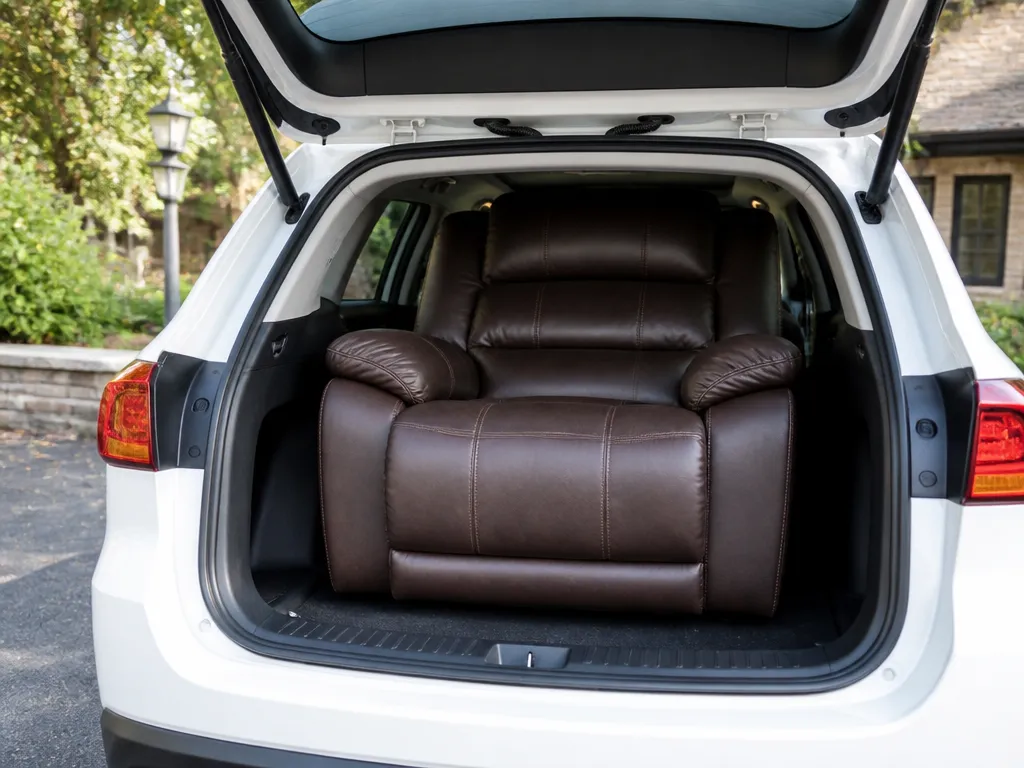
Cargo fit comes down to a few hard numbers: rear opening width and height (including rubber seals), usable width between wheel wells at the height where the recliner’s widest point sits, and the usable floor-to-headliner height for the recliner’s tallest frame corner. Measure everything with the same seat and trunk setup you plan to use during loading.
Measure The Suv Rear Opening Where The Recliner Actually Passes
Start at the hatch or liftgate opening because a recliner can fit in the cargo area yet refuse to pass the opening. Measure width across the opening at the lowest point the recliner frame will cross, then again near the headliner-side trim.
Measure height at the centerline and at the corners, because roof bows and weather seals often cut the effective height. Record your “tightest” numbers and treat them like deal-breakers during fitment math.
| Measurement you need | What to record | How to measure it | Why it can stop fitment |
|---|---|---|---|
| Rear opening width (hatch/door) | Smallest width across the opening | Measure inside edge to inside edge at the height where the recliner frame widest part passes | Recliner armrests or legs hit seals or quarter trim before the body clears |
| Rear opening height | Smallest height at center and corners | Measure vertical clearance from cargo sill to the underside of hatch structure, accounting for seals | Recliner tallest point catches roof bow or headliner-side trim |
| Cargo width between wheel wells | Width at multiple heights (low, mid, high) | Measure across the floor-to-wall gap where the recliner’s widest vertical section will sit | Some chairs “fit on paper” on the floor but bind at mid-frame |
| Cargo floor to headliner height (usable) | Tallest usable clearance | From top of cargo floor to underside of headliner trim at the chair’s expected location | Tall frame corners hit headliner or roof curvature |
| Cargo depth (floor-to-seatback) | Floor-to-first major obstruction length | Measure from the cargo floor to the nearest seatback surface or folded-seat stop | Recliner backrest can run out of depth even if it clears width |
| Cargo depth (floor-to-tailgate) | Usable length with hatch open | Measure from floor to the inner face of the tailgate/buffer area at the loading position | Recliner legs or footrest location hits hatch structure |
| Intrusions list | Vent, tie-down, spare-well/bumps measurements | Measure depth and height where intrusions rise above the floor plane | Tie-down rings and vents steal clearance at one specific height |
| Door sill/threshold clearance and ramp angle | Height of sill and slope steepness | Measure sill height, then note how quickly the opening drops to the cargo floor | Recliners can snag on the sill or damage legs if you force the angle |
For example, a typical 30 inch wide recliner frame may clear the cargo floor width, but a recliner’s mid-frame flare can be 1 to 2 inches wider at the wheel-well height. Record cargo width at at least three heights so you do not rely on a single floor measurement.
For instance, a taller recliner corner might clear the hatch height when upright, then fail once you recline it because the tallest point rotates into the headliner zone. Measure and compare the usable floor-to-headliner height at the exact reclined/tilted position you plan to use during loading.
Insider tip: When you roll the recliner in, the “effective” clearance is the smallest rectangle you can fit around it without passing through trim or seals. If you only measure one side of the cargo area, you can miss the tight side where the hatch seal bulges or where wheel wells pinch inward.
Clearance planning also depends on how the chair sits relative to the wheel wells. Decide whether the recliner will travel straight in, or whether it will pivot slightly while entering, then measure wheel-well width at that pivot height.
Write down every tightest number immediately: the smallest opening width, smallest opening height, smallest wheel-well width, and the lowest headliner clearance. Fitment math goes off these values, not the “maximum” dimensions you hope for.
Fitment Math And Clearance Rules
Start with one hard rule: the recliner’s transport envelope must fit inside the SUV’s cargo opening and cargo rectangle with clearance on every side. Treat the chair like a box with a “tallest point” height, a “widest side profile” width, and a “front-to-back” length, then check those three dimensions against the opening, floor, and headroom. When the numbers are close, add margin, because upholstery, armrests, and door seals eat space fast.
Core Clearance Math (The Stuff That Makes Or Breaks The Job)
Use these measurements, taken with the recliner in the position you will actually load it (folded, tilted, or upright). Measure with a tape and write them down before you test-fit.
Apply conservative clearance rules: target at least 1 to 2 inches (25 to 50 mm) of extra room in each critical direction. That margin matters because knuckles and door trim flex when you guide the chair, and because recliner mechanisms can shift a little during closing or tilting.
Width, Height, And Diagonal Logic
Width rule (wheel wells): compare the chair depth side profile to the narrowed cargo width. If your SUV cargo width between wheel wells is Wu, you need Wc ≤ (Wu minus clearance) for the loading orientation you plan to use.
Height rule (headliner and sag): compare the recliner’s tallest point (Hc) to usable height from the cargo floor to the lowest obstruction near the rear hatch. Add room for trim compression and body sag during loading, then require Hc ≤ (Hu minus clearance).
For example, a 30-inch wide recliner that is 1 inch over the wheel-well-limited width when upright may still pass when tilted because its “effective width” at the narrowest plane changes. Diagonal loading can help when you rotate the chair so the longest dimension runs across the diagonal of the opening, but diagonal placement only works if the chair clears both the width bottleneck and the hatch height bottleneck at the same time.
Diagonal logic tip: Diagonal orientation helps with width when one axis is tight, but it can make height worse because the chair often rides higher at one corner. Test-fit in the exact orientation you measured, not the “looks close” one.
| Check | Math | Practical consequence |
|---|---|---|
| Door opening | Wc ≤ (DoorW – 1 to 2 in) AND Hc ≤ (DoorH – 1 to 2 in) | Fails if armrests or control housings catch at the hatch lip. |
| Wheel wells | Wc ≤ (Wu – 1 to 2 in) | Fails if you try to push a wide chair straight in. |
| Cargo height | Hc ≤ (Hu – 1 to 2 in) | Fails if the chair’s top hits headliner trim during final seating. |
| Diagonal attempt | Rotate and re-check width and height simultaneously | Can succeed with width only, and still fail on height. |
Upright Vs Tilted Outcomes (Common “It Fits Only One Way” Cases)
Upright loading is strictest because the recliner’s armrests and back height hit the hatch and cargo rectangle at their maximum. Tilted or partially reclined loading changes the geometry: the chair’s tallest point can drop, and the widest plane may move away from the wheel-well restriction.
For example, a recliner that is 40 inches tall when upright might still clear an SUV’s rear height limit when tilted, because the high back rotates down while the base stays on the cargo floor. A second example is the “width problem” case: a chair that is too wide between wheel wells upright may slide in diagonally or when reclined farther, because the armrests rotate into a narrower side profile. The chair can fit “only when tilted,” yet still fail during upright placement after you close the hatch, because the last inch of clearance is where the recliner shifts and where the seals and trim live.
Best Loading Orientation For Safety
Loading a recliner into an SUV is safest when the chair goes in upright only if its bulk fits without twisting, and safest overall when you keep its heaviest frame components flat and aligned with the cargo opening. The wrong orientation (reclined, sideways, or diagonal) increases the chance the backrest slips, the arm hits trim, or the legs shift into door jamb pinch points.
Rear Hatch Vs Side Door: Which Opening Reduces Pinch Points And Misalignment
Most SUVs load a recliner with fewer pinch points through the rear hatch because the opening is wider and the cargo area is deeper. Side doors often force you to angle the chair into a narrower throat, which makes the corners catch on the door sill and trim sooner.
In practice, a rear hatch also lets you guide the recliner straight in with both hands, keeping the frame square to the vehicle. A side door can work, but expect more edge contact and more risk of the chair “walking” as you reposition it.
Upright Vs Reclined, Sideways, Or Diagonal: When Each Is Safest And Why
Upright orientation is safest for control because the center of mass stays lower and you can steer with the seat base and backrest as rigid planes. Reclined, sideways, or diagonal orientations become risky when the backrest or armrests act like a lever, letting the chair slide against carpet and plastics.
For many recliners, “it fits” changes after you recline the chair, but “it’s safe” depends on how much the chair can slide before you reach the final position. A short diagonal entry often works when you have to clear a wheel well or a cargo-floor step, yet it should be a controlled, brief angle, not a long partial insert.
Seat Configuration Strategy: Keep The Most Stable Surface Flat
Seat folding is about creating a straight, stable floor surface for the recliner base, since the base is the easiest part to control and the hardest to catch mid-motion. Fold rows only as needed, then aim to have the recliner sit on the flattest possible panel area before you fine-tune position.
For example, folding the second row fully down often beats leaving it partly up, because a partial step creates a pivot point where the recliner base can tilt. SUVs with a cargo floor lip are sensitive here, so plan to clear the lip early and land both base edges on a continuous surface.
Clearance-first Loading Sequence: Protect Edges, Guide With Hands Not Shoulders, Avoid Glass Contact
A clearance-first approach prevents you from learning fitment problems halfway through the move. Protect the chair edges and vehicle trim before you cross the threshold, then move slowly until you confirm the backrest and arm corners clear the hatch frame, door seals, and glass.
Guiding with your shoulders is how people get pinch injuries and scrape damage, because shoulders are wide and stiff. Your hands should do the steering at the frame corners, while your body stays back and you let the chair slide on protection.
Minimum contact/protection checklist: Moving blankets (vehicle and chair), corner guards on chair ends, non-slip mat on cargo floor, soft tape or foam for any sharp hatch lip, and a clear “no-reach” zone so nobody puts arms in the pinch gap near the door jamb.
Tie-down And Protection Steps
Secure the recliner so it cannot shift, tip, or strike occupants during stops and turns. Protect the vehicle and the recliner by keeping straps on rated anchors, avoiding pinch points, and cushioning contact areas that can rub or scuff.
In practice, a recliner that fits upright in the cargo area can still become a problem when you close the hatch, because the seatback may swing or settle as the suspension compresses.
For example, you may gain clearance by tilting the recliner slightly or folding the legs so the center of mass sits lower before you tighten the straps.
| Contact / Risk Area | What to Do | Why It Matters |
|---|---|---|
| Seatbelt buckle path | Keep straps out of the belt lane | Prevents belt interference during a crash event |
| Airbag zones (roof/pillars) | Avoid strap hardware in curtain areas | Reduces risk of obstruction |
| Hatch seal and latch | Route straps away from sealing surfaces | Prevents strap damage and loss of tension |
| Wheel well and carpet | Use mat or non-slip liner | Stops sliding and reduces abrasion |
After tightening, grab the recliner by the frame and try to rock it side to side and front to back. If it moves more than a couple of centimeters, adjust strap placement and tighten again before you drive.
Troubleshooting Fitment Blockers
Fitment failures usually come down to three dimensions: height to the highest protrusion, fore-aft depth to the hatch opening, and side clearance to wheel wells and trim. The quickest fix is changing the recliner’s position first, then switching to the next seat angle, and only then unloading or partially disassembling.
Hatch Won’t Close: Height, Protrusion, Or Recline Angle
When the hatch won’t latch, measure the “interference point,” not the overall recliner height. A 30 inch wide recliner might fit in width but fail because the headrest, armrest, or footrest is the tallest item in the load orientation.
For example, if the hatch stops right where the headrest sits, lower the recline angle to bring the top section down. If the hatch hits a corner instead of the center, rotate the recliner 90 degrees so the wide face is parallel to the hatch opening.
Recliner Catches On Wheel Well: Orientation, Recline Depth, Reset
Wheel well contact is almost always an orientation problem. Switch the recliner so the narrowest side faces the wheel well, and keep the lower frame as flat to the cargo floor as the transport position allows.
For instance, many recliner carts or “lounge transport” frames clear when tilted back slightly, but they snag when fully upright because the lower legs swing outward. If the recliner shifts while you’re forcing the hatch, the next closure attempt will be worse since the alignment is already skewed.
Armrest Catches C-pillar Or Side Trim: Rotate/tilt And Verify Door Opening
Armrest-to-trim contact happens at a specific height, so test with the recliner at the exact “almost closed” position. Rotate the armrest side away from the tightest gap, and tilt the seat so the armrest tracks lower along the cargo opening.
Door opening width at that height matters more than the SUV’s published cargo width. Measure the clear opening at the height where the armrest rides during closure, then compare it to the armrest end-to-end dimension.
| Symptom | Likely cause | Next action |
|---|---|---|
| Armrest hits C-pillar/side trim | Armrest rides at a narrow opening height | Rotate 90 degrees, tilt to lower armrest height, remeasure at that height |
| Wheel well snag | Lower frame legs swing into the well | Switch orientation, recline further, unload and reset alignment |
| Hatch won’t latch | Highest protrusion is too tall or too forward | Transport position first, change recline angle, reposition 2 to 4 inches |
Insufficient Cargo Height Or Step-blocked Loading: Remove A Row Or Change Entry Technique
If cargo height is the limiter, you’ll feel it as consistent hatch failure even after rotation. The practical options are removing the 3rd row (if equipped) or choosing a more compact transport position that keeps the tallest part tucked down.
Load-floor step won’t allow entry usually means the recliner is too tall at the moment the wheels or feet pass the threshold. Adjust technique by placing the recliner diagonally first (one corner enters, then rotate on the floor), or remove the least-needed row for access so you can load straight without forcing angles.
Hard rule: If you’re forcing the hatch against contact, stop. Forcing twists the recliner and can change the clearance enough to create a new failure point.
Example Scenarios By Suv Class
Most standard recliners fit inside an SUV only after you fold, tilt, or remove something. The biggest variables are opening height at the hatch (or side door), wheel-well intrusion into the cargo path, and whether the chair has legs and arms attached when you move it.
For a compact SUV, a 30-inch-wide manual or power recliner usually fits when the second row can fold flat and you load with the chair in a recline or tilted posture. Compact models often lose the battle at the cargo opening height and at the wheel-well curve, especially when the base sits high or the recliner’s footrest sticks forward.
For a midsize SUV, the odds jump because many models let the second row fold down nearly flat while leaving a larger rectangle behind the front seats. Midsize SUVs often let you keep the recliner together (legs attached) if you recline the chair to shorten its front projection and clear the wheel wells.
For a 3-row SUV, the best odds happen with the 3rd row folded down, because you gain height and, more importantly, length to keep the chair from pivoting into the wheel-well corners. A standard 30-inch-wide recliner often fits this way even when it cannot pass through the opening if the chair is upright.
Lift-chair models are special because the base can be taller and the mechanism can create a bulkier shape when folded. Many lift chairs still fit, but you often need partial disassembly or a tighter transport posture to clear the opening and prevent the legs or actuator housings from contacting the roofline or rear panel.
For a simple “30-inch-wide recliner” clarity check, treat fit like a clearance triangle: width is only one leg of the problem. The chair may clear the hatch width but still fail if the effective height at the opening is short or if the front corners strike the wheel well before the base passes.
| Scenario | Likely Fit? | What Usually Decides |
|---|---|---|
| Compact SUV, 2nd row folded, recliner tilted | Likely | Opening height and wheel-well lip clearance |
| Compact SUV, recliner upright, legs attached | Unlikely | Footrest sweep and base height at the threshold |
| Midsize SUV, 2nd row folded flat | Likely | Armrest protrusion and wheel-well curve |
| 3-row SUV, 3rd row folded down, cargo floor unstacked | Likely | Straight-line depth and hatch lip clearance |
| Lift chair, upright with legs extended | Unlikely without changes | Transport height and actuator/leg envelope |
Pro tip: Do a dry-run with a tape measure and a “dummy box” (a taped-together cardboard rectangle). Slide it in the same orientation you plan to load, because that quickly reveals wheel-well contact and hatch-lip height issues before you wrestle the chair.
Quick Summary
A recliner can fit in many SUVs, but the fit depends on matching the chair’s upright and reclined measurements to the SUV’s actual rear opening and floor clearance, not just the chair’s “30 inches wide” listing. The article tells you to measure the recliner’s overall width, height, and depth, both upright and in its transport or reclined position, because a chair that clears reclined can still hit the liftgate when upright. It also emphasizes checking how the door or hatch opening feels tight around the second-row hump and corners.
To avoid a failed load at the hatch, the article says to measure the SUV’s opening width and height at the narrowest point, not the whole cargo area, and to clear wheel wells first. You also need usable depth from the cargo sill to the seat back or folded-seat position, then compare it to the chair’s widest point and the way legs and the footrest protrude. Confirm cargo headroom by comparing the recliner’s arm and back height to floor-to-headliner clearance, then plan loading upright only if it truly clears.
| Measure this | Why it matters for fitting |
|---|---|
| Recliner width, height, and depth (upright and transport position) | Determines clearance through the hatch and avoids hidden width from arms or footrest |
| Hatch or door opening width and height (narrowest spot) | Shows whether the recliner passes under liftgate ribs and through tight corners |
| Usable depth from cargo sill to seat back or folded-seat position | Prevents the chair from wedging before it reaches the cargo area |
| Wheel well intrusion and cargo floor height | Closes the “surprise gap” if the chair’s depth depends on sitting flat |
| Floor-to-headliner clearance | Prevents the upright chair from hitting headroom limits during loading |
Frequently Asked Questions
What Measurements Do I Need To Fit A Recliner In An Suv?
Measure your cargo floor length behind the last row, the maximum recliner width, and the recline sweep length so the backrest does not hit the seatbacks. Use a yardstick or tape measure with the recliner in its reclined position to confirm clearance for headrests, seat belts, and tailgate opening.
Can I Fit A Recliner In An Suv Without Removing The Rear Seats?
Sometimes yes, if your recliner’s footrest length and reclined back height fit within the seat-through cargo opening. If the recliner requires more length than the cargo space behind the seats, you will likely need to fold or remove the rear row, or choose a smaller recliner model.
How Do I Prevent The Recliner From Blocking Seat Belts Or Airbags?
Keep the recliner’s structure out of the seat belt path and never obstruct the area where an airbag would deploy. If your recliner anchors near a seat belt retractor or interferes with side curtain airbag coverage, you should adjust the fit plan or get a different configuration, since blocking restraint components is a bad idea.
What’s The Safest Way To Secure A Recliner In An Suv?
Use proper tie-down points or a restraint kit meant for cargo, and secure the recliner so it cannot slide forward when you brake. Don’t rely on straps around fabric or plastic trims, and aim for a “no movement” check by pushing firmly at the recliner’s base and back.
How Long Does It Usually Take To Fit And Test A Recliner In An Suv?
Plan for 1 to 3 hours for trial positioning, folding or removing seats if needed, and final tie-down setup. A good practice is to do a short test with the recliner locked in its final position, then re-check clearance at full recline before you drive.
What Common Mistake Stops Recliners From Fitting In An Suv?
The biggest mistake is ignoring the reclined position dimensions, not just the upright size. People also forget door and tailgate clearance, so the recliner may “fit” in the cargo area but not pass through the opening or clear the liftgate when adjusted.