


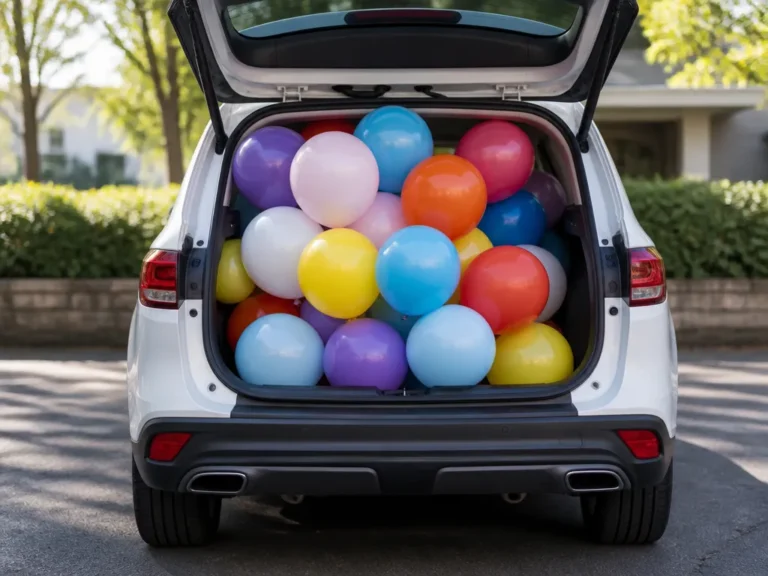
You probably never thought about the internal volume of your SUV in terms of party supplies, but here we are. Whether you are prepping for a bizarre stunt or just trying to visualize the actual cargo capacity behind those rear seats, fitting balloons into a vehicle is the ultimate test of usable interior space. We are moving past the glossy brochure numbers to see how much room you actually have.
SUV balloon capacity typically ranges from 1,200 to 2,500 standard 11-inch balloons depending on the vehicle size and whether you fold the rear seats flat. While a mid-size SUV like a Toyota RAV4 holds roughly 1,450 units, a larger Chevrolet Tahoe can accommodate approximately 2,500 when packed to the roofline.
How Many Balloons Will Fit In An Suv? (Estimates)
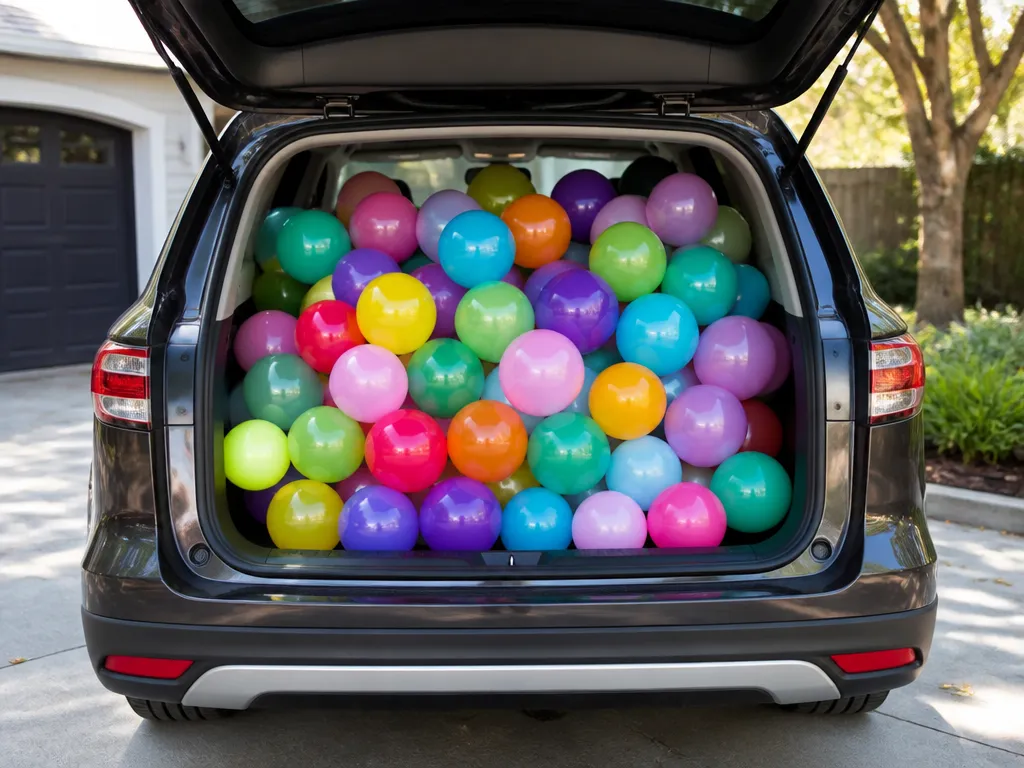
Standard 11-inch latex party balloons occupy roughly 0.4 cubic feet of space once you account for the air gaps between them. Based on average cargo volumes, a compact SUV can hold approximately 1,200 balloons, while a full-size model can accommodate upwards of 2,500.
Capacity Estimates By Vehicle Class
Cargo volume varies significantly between vehicle segments, which dictates the total balloon count. These estimates assume the rear seats are folded flat to maximize interior dimensions.
Mechanic Tip: Remember that interior volume measurements include nooks, crannies, and the space between seats. Real-world packing is less efficient than mathematical volume due to the irregular shapes of vehicle interiors and the tendency for balloons to deform when compressed.
Comparison Of Interior Volume
The following table illustrates the relationship between total cargo capacity and the estimated number of inflated balloons. Each calculation uses the 0.4 cubic foot displacement factor.
| Vehicle Category | Avg. Cubic Feet | Estimated Balloon Count |
|---|---|---|
| Compact | 72 | 1,200 |
| Midsize | 85 | 1,450 |
| Full-Size | 125 | 2,500 |
In practice, the actual number fluctuates based on how tightly you pack the balloons. Always prioritize visibility if you plan to move the vehicle with a cargo load, as obstructing your rear-view mirror is a safety hazard.
Calculating Your Specific Cargo Volume
Determining the capacity of your vehicle starts with the manufacturer’s official cubic footage rating, which provides the baseline for your internal space. You calculate the total potential by multiplying the length, width, and height of the cargo area in inches, then dividing by 1,728 to convert that figure into cubic feet.
Standard 11-inch latex balloons are the industry benchmark for these estimations due to their predictable shape. When inflated to their standard diameter, a single 11-inch sphere occupies approximately 0.4 cubic feet of space. Keep in mind that balloons are compressible and do not stack like perfect cubes, which requires a packing efficiency factor in your final math.
Applying The Packing Efficiency Factor
Air-filled balloons behave differently than helium-filled ones because they lack the buoyant lift that pushes them against the roof of the SUV. Air-filled balloons settle at the bottom of the cargo area, creating significant gaps between them as they deform under the weight of the layers above. You should expect a packing efficiency of roughly 60 to 70 percent to account for the irregular voids left between spheres.
| Balloon Type | Volume per Unit | Behavior |
|---|---|---|
| Air-Filled | 0.4 cubic feet | Settles, stacks with high void space |
| Helium-Filled | 0.4 cubic feet | Rises, creates density at the ceiling |
Mechanic’s Tip: When calculating your max capacity, never rely on the vehicle’s total interior volume, as that includes the driver’s seat and dashboard. Stick strictly to the cargo volume behind the second or third row of seats for an accurate, real-world estimate.
For instance, if your SUV has 40 cubic feet of cargo space, you multiply that by the packing factor of 0.65 to find the usable volume. This leaves you with 26 cubic feet of actual space for the balloons. Dividing that figure by the 0.4 cubic feet required for one balloon results in an estimate of 65 balloons for a tight, comfortable fit without damaging the interior trim or obscuring your rearview mirror.
Popular Suv Model Comparisons
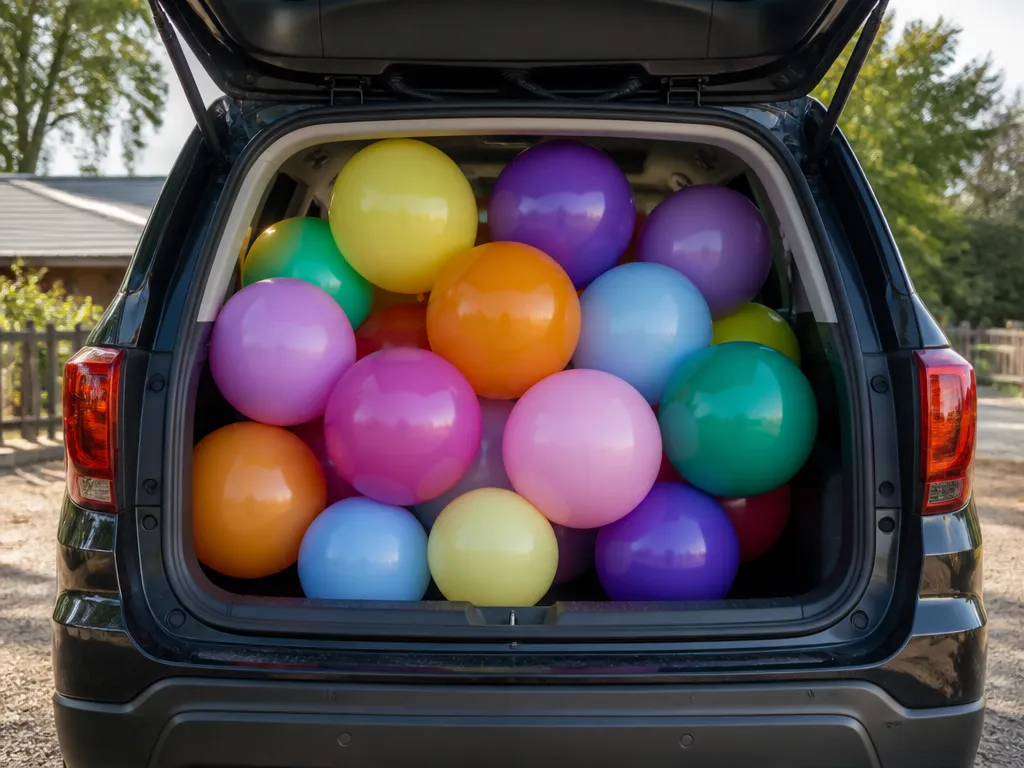
Interior cargo volume provides the best baseline for estimating capacity when loading common items like 12-inch party balloons. A standard 12-inch balloon occupies roughly 0.5 cubic feet of space, though they compress slightly when packed together.
The following table compares maximum cargo capacity with the rear seats folded down across three common SUV segments. These estimates assume a loose pack, where air gaps between spheres account for approximately 25 percent of the total volume.
| SUV Model | Max Cargo (Cu. Ft.) | Estimated Balloon Count |
|---|---|---|
| Toyota RAV4 | 69.8 | ~1,050 |
| Honda Pilot | 87.0 | ~1,300 |
| Chevrolet Tahoe | 122.9 | ~1,840 |
Cargo Configuration Variables
Real-world packing efficiency changes based on the vehicle interior shape. The Toyota RAV4 features a more sloped rear hatch, which limits vertical clearance for balloons near the tailgate compared to the boxier silhouette of the Honda Pilot.
Chevrolet Tahoe models provide a significant advantage due to their wide floor and squared-off interior panels. These dimensions allow for a more consistent stacking pattern that reduces wasted space in the corners of the cargo area.
Mechanic Tip: When testing your own vehicle capacity, remember that rear wheel wells often intrude into the cargo area. These protrusions act as significant barriers that break up the load floor, making it difficult to achieve a perfect cubic calculation.
Individual results will vary based on how tightly you inflate the balloons. A balloon inflated to 11 inches instead of 12 inches creates a much tighter fit and can increase your total count by 15 to 20 percent. Always prioritize clear rearward visibility if you plan to transport a load that reaches the roofline.
Theoretical Volume Vs. Usable Space
Manufacturer cargo volume figures represent the total cubic feet available from the floor to the roof, but these numbers ignore the physical reality of interior obstructions. Real-world capacity drops significantly because internal components prevent you from stacking objects in a perfect, solid block.
Physical Obstructions And Geometry
Wheel wells and seat hinges act as major space thieves in any SUV cargo area. While a spec sheet might claim 70 cubic feet of space, the intrusion of rear wheel arches often narrows the floor width by several inches, creating dead zones where rounded items cannot sit flush. High-mounted seat belt retractors and plastic trim panels further reduce the usable width near the tailgate opening.
Mechanic Tip: Always measure the narrowest point of the cargo opening, usually between the liftgate struts or the taillight housings, rather than the widest point inside the vehicle. The interior width is often useless if you cannot fit the object through the door.
The Reality Of Folded Seats
Folding the rear seats creates a larger footprint, but the resulting surface is rarely perfectly flat. Most modern SUVs leave a gap or a slight incline where the seat back meets the cargo floor, creating a wedge-shaped void that is difficult to fill efficiently. If you attempt to pack a cargo area to its maximum potential, you must account for these awkward angles that break up the flow of your load.
| Obstruction Type | Impact on Efficiency |
|---|---|
| Wheel Wells | High; limits base floor width. |
| Seat Hinge/Latch | Moderate; creates uneven floor surface. |
| Tailgate/Hatch Arc | High; limits vertical clearance at the rear. |
| C-Pillar Trim | Low; reduces width at headliner height. |
Passenger compartment limitations also restrict how far forward you can push a load. Most vehicles require a buffer zone to prevent damage to the back of the front seats or the infotainment screens. Even with the seats folded down, the slope of the dashboard and the position of the center console dictate the maximum forward reach of your cargo.
Balloon Types And Transport Risks
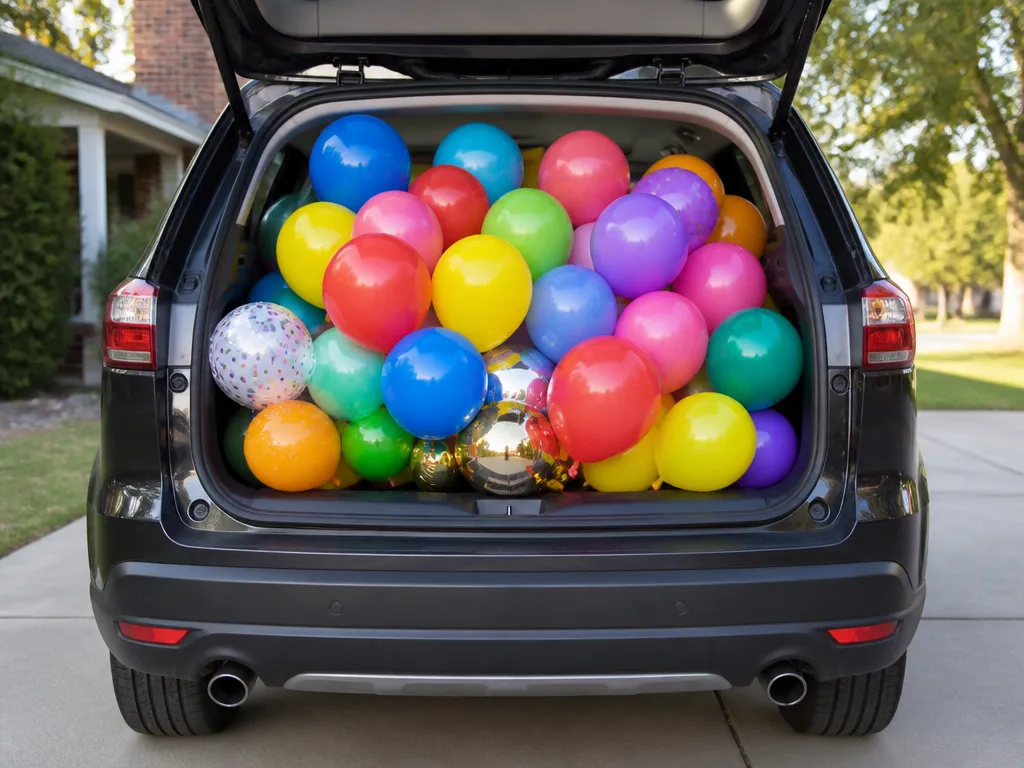
Latex balloons lose volume rapidly due to gas permeability, while Mylar balloons maintain their shape and size for days. Standard 11-inch latex balloons shrink by nearly 20 percent within 24 hours as helium escapes through the porous skin, whereas Mylar foils hold pressure consistently until exposed to extreme temperature changes.
Material Properties And Thermal Expansion
Temperature fluctuations inside a parked SUV pose the greatest risk to your transport load. Helium expands significantly as air temperatures rise, which can cause latex balloons to pop or Mylar seams to split under pressure. Always keep your vehicle climate controlled during transport to prevent a sudden loss of cargo integrity.
| Feature | Latex | Mylar (Foil) |
|---|---|---|
| Gas Retention | Poor (Porous) | Excellent (Sealed) |
| Durability | Low (Easy Puncture) | High (Resistant) |
| Expansion Risk | Very High | Moderate |
Mechanic’s Note: Never leave a large load of helium balloons in a vehicle sitting in direct sunlight. The greenhouse effect inside an SUV cabin can spike interior temperatures to over 120 degrees Fahrenheit in minutes, turning your cargo into a series of popping hazards that distract the driver.
Visibility And Safety Protocols
Obstructed vision remains a critical safety concern when filling an SUV with large, floating objects. Even if the balloons are tethered, stray strings or shifting clusters can block your view of the rearview mirror or side windows.
For instance, a cluster of Mylar balloons near the windshield can reflect light and create dangerous glare during night driving. Always prioritize a clean field of vision over maximizing every cubic inch of interior space.
Maximizing Interior Cargo Space
Maximizing SUV cargo capacity requires clearing every non-essential item from the cabin to create a contiguous open volume. Removing the rear seats entirely or folding them flat increases usable cubic footage by 40 to 60 percent depending on the vehicle model.
Clearing The Cabin
Cargo nets, rubber floor mats, and bulky first aid kits take up valuable floor space. For a maximum load, pull out the removable cargo tray and any loose tools from the under-floor storage compartments.
Small items often hide in side pockets or center consoles. Clearing these areas prevents small objects from shifting and causing noise or damage during transit.
Vertical Space And Security
High-roof SUVs like the Chevy Suburban or Ford Expedition have significant overhead room. Fill from the floor up and use the headliner as a ceiling to pack items tightly.
For instance, stacking lightweight items against the side panels prevents them from collapsing into the center of the cabin.
| Configuration | Space Usage | Best For |
|---|---|---|
| All Seats Up | Minimal | Passengers |
| Second Row Folded | Moderate | Long items |
| All Seats Removed | Maximum | Bulk loads |
Mechanic Tip: Never block your rearview mirror. If you cannot see behind you, use your side mirrors and drive slower to compensate for the blind spot.
Quick Summary
SUV balloon capacity varies significantly by vehicle size, ranging from 1,200 to 2,500 standard 11-inch balloons depending on the model and seat configuration. Standard 11-inch latex balloons occupy approximately 0.4 cubic feet of space each, but due to their spherical shape, they only fill about 74% of available space. To maximize capacity, remove headrests and cargo covers, and always subtract 15% from total volume to account for wheel wells and interior trim.
Vehicle class directly impacts balloon capacity, with compact SUVs holding approximately 1,200 balloons in their 70-75 cubic feet of cargo space, while midsize models with 80-90 cubic feet accommodate 1,450 balloons. Full-size SUVs offering 120 cubic feet or more can fit 2,500 balloons. Air-filled balloons settle at the bottom and create significant gaps, requiring a packing efficiency factor of 60-70%. Remember that manufacturer cargo volume includes nooks and crannies, so always stick to the actual cargo area behind seats for accurate calculations and never obstruct your rear-view mirror for safety.
| Vehicle Class | Avg. Cubic Feet | Estimated Balloon Count |
|---|---|---|
| Compact | 72 | 1,200 |
| Midsize | 85 | 1,450 |
| Full-Size | 125 | 2,500 |
Frequently Asked Questions
How Many Standard 12 Inch Balloons Can Fit Inside A Midsize Suv?
You can typically fit between 400 and 600 balloons in a midsize SUV if you fill the cargo area and the back seat completely. This count varies significantly based on how tightly you pack them and whether you fold the rear seats down flat.
Is It Safe To Drive With A Car Full Of Balloons?
It is generally safe, but you must ensure that zero balloons obstruct your rearview mirror or side windows while driving. If balloons drift into the driver footwell, they could interfere with your pedals, so keep the driver area strictly clear.
How Long Does It Take To Inflate Enough Balloons To Fill An Suv?
Filling an entire vehicle by hand takes a long time, so you should use an electric balloon pump to save your lungs. Even with a high speed electric pump, expect to spend at least two to three hours of continuous work to create enough volume to pack the space.
Will Leaving Balloons In A Hot Suv Cause Them To Pop?
Yes, heat causes the air inside the balloons to expand, which will lead to them popping if the vehicle gets too warm. You should keep the car parked in the shade and avoid leaving it in direct sunlight to prevent the balloons from bursting inside your upholstery.
What Is The Best Way To Transport Balloons In An Suv Without Them Flying Away?
The most effective method is to use large clear plastic bags to group the balloons together before loading them into the cargo area. This keeps them contained and prevents more than 50 balloons from escaping every time you open a door or lift the tailgate.