


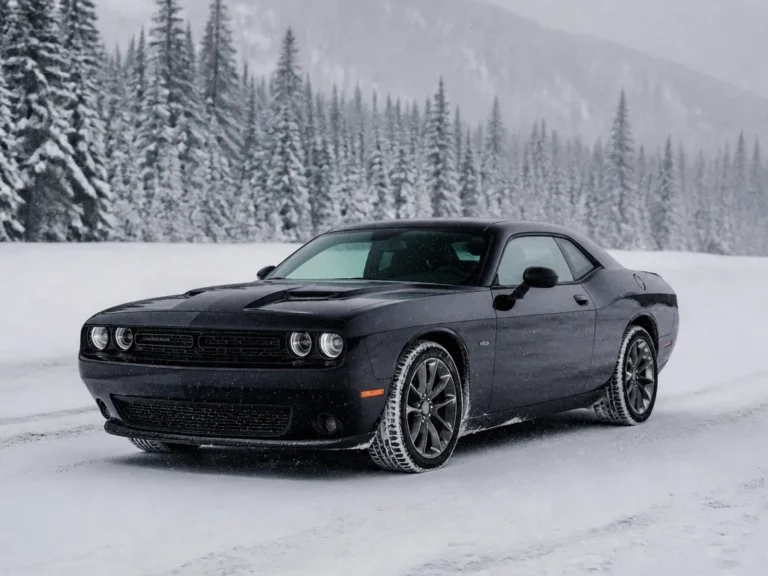
Planning to drive your Dodge Challenger in snow, but worried the rear end will slide the moment you touch the throttle? A lot of owners are surprised that a muscle car can feel fine on plowed roads and still get sketchy on ice patches. This guide breaks down how a rear-wheel-drive Challenger behaves, what actually improves traction, and what to do when grip disappears.
Dodge Challenger is rear-wheel-drive, so snow traction is limited because the rear drive tires handle propulsion while the front tires handle steering. The fix is straightforward: use four true winter tires, keep traction and stability control on, and drive with slower inputs for better control.
Dodge Challenger In Snow: Rwd Limits
Rear-wheel-drive (RWD) pushes the breakaway to the rear when traction drops, so the Challenger can start sliding sooner than you expect in snow and ice. Weight shifts to the rear during throttle and away from the rear during braking, which changes whether you get grip or oversteer. Traction control and stability control can reduce spin and straighten the car, but they cannot create the tire grip you do not have.
Why The Rear Breaks Loose First
The Challenger puts drive torque to the rear tires, so any loss of grip happens where the torque is applied. Snow is also slick in a specific way, the tire needs to cut through a thin layer of ice and find something to bite. When that grip is gone, the rear axle spins up, then the car rotates if you keep adding throttle or make steering inputs too hard.
Weight transfer amplifies this behavior. Lift off the throttle or brake hard shifts weight forward, which can reduce rear traction and make the car feel loose, then instability control has to intervene quickly to hold it together. These dynamics are why a calm, smooth pedal and gentle steering are the difference between “manageable” and “out of shape” in a Challenger.
| Driver input | What weight does | Typical Challenger feel | Most common mistake |
|---|---|---|---|
| Throttle on from a stop | Weight moves rearward | Rear tire spin, then possible rotation | High throttle too early |
| Lift/steady coasting | Weight shifts forward slightly | More neutral to slightly loose, depending on tire | Steering while the car is still settling |
| Hard braking | Weight moves forward hard | Front grip rises, rear can go light | Brake and turn aggressively together |
| Turning mid-corner | Loads shift across tires | Slide direction depends on speed and throttle | Quick steering corrections |
Common Snow Behavior Patterns
On takeoff, you often feel a quick flare of wheelspin before the electronic systems react. That spin is the rear telling you the available traction is already lower than your torque demand, so the fix is to reduce torque immediately.
In practice, you want the rear tires working for traction, not free-spinning, because the moment they spin, the car loses directional control authority.
On turns, the Challenger can show understeer or oversteer depending on throttle and speed. Lift in a slide may make the rotation worse if the rear is already unstable, while a tiny increase in throttle can sometimes pull the car into a steadier line on packed snow with good tires. Stability control can fight these trends, but it is still limited by how much lateral grip the tires can generate, especially on icy glaze.
What Traction Control And Stability Control Can And Cannot Do
Traction control mainly brakes a spinning wheel and reduces engine torque, so it helps you regain usable grip when the rear starts to spin. Stability control uses wheel speed, steering angle, and yaw to brake individual wheels and manage torque to keep the car aligned with your intended path. When the tires are on pure ice, these systems can only slow the problem down, they cannot provide forward bite or lateral grip that is physically unavailable.
“Think of the electronics as panic brakes for wheelspin and slide correction, not as extra traction. Your tires still decide how much the car can stick.”
When you feel the system working, drive accordingly. Ease off and straighten the wheel first, then reapply throttle smoothly once the rear tires regain traction. If stability control stays active repeatedly, that is a strong signal the driving conditions exceed what the tires and vehicle weight transfer can reliably handle, and the safest move is to slow down more than you think you need.
Winter Tire Plan For Challenger
Four dedicated winter tires on all four corners deliver maximum traction in snow and on ice with a Challenger. Keep the overall wheel/tire diameter within 2% of stock to preserve ABS and traction control behavior, and avoid mixing tire types on the same axle.
Dedicated winter tires provide the best cold-weather grip because the rubber remains pliable in low temperatures and the tread is designed to evacuate snow and shed slush. All-season tires are a compromise and lose significant bite once temps fall below about 40 F; summer tires quickly harden and offer little traction in snow. For predictability, run four winters on all four wheels.
| Option | Best For | Pros | Cons |
|---|---|---|---|
| Dedicated winter tires (studless) | Snow and ice in cold temps | Best cold-weather grip, predictable braking | Limited warm-weather performance; wear varies with temps |
| All-season tires with winter capability | Light snow, dry cold days | One-tire solution | Not as effective as dedicated winters in deep snow or ice |
| Studded winter tires | Extended ice roads | Excellent ice bite | Road wear, higher noise, and local restrictions |
| Mixing tire types on axle | Not recommended | None | Uneven grip, ABS/TC interference |
Dedicated winter tires excel on wet snow and ice, providing stable braking and confident turn-in in a wide range of cold temps. Studless designs stay pliable and grip well in slush, while studded options bite hard on glare ice but can wear faster and be noisy. Consider local regulations and road conditions when choosing between studless and studded.
For a Challenger, look for winter tires with a soft, temperature-sensitive compound and a tread that channels snow and water away from the contact patch while preserving lateral grip. Directional or asymmetric patterns help with stable handling on packed snow, and a higher load rating supports the car’s weight and torque distribution.
Match stock overall diameter and load index. Prefer four tires of the same size on all four wheels, using a winter-size that keeps rolling radius within a tight window of stock. If you must change wheel diameter, choose a tire that preserves the same rolling diameter and have the speedometer corrected if required.
Avoid mixing tire types or tread depths on the same axle. The Challenger relies on uniform grip front to rear for predictable steering and braking. Mismatched tires can cause uneven acceleration, braking quirks, and uncertain handling on slick surfaces.
Snow Settings And Traction Electronics
Snow mode helps throttle response and gear selection, while turning off safety systems greatly increases the risk of spin or loss of control.
Traction control monitors wheel speed and slip and applies braking to individual wheels or reduces engine torque to keep the drive wheels from spinning. It remains active to help launch and accelerate on slick pavement.
Electronic stability control coordinates braking and power delivery to maintain a stable path. On a rear-drive Challenger this is particularly valuable for preventing oversteer when you apply throttle in a snow corner.
Snow/Auto drive modes adjust throttle and transmission behavior to favor grip. Snow mode typically tames throttle response, enables earlier upshifts, and reduces downshifting aggression, while Auto uses normal logic but leans toward stability in light snow.
Starting And Accelerating Without Spin
Clear snow from the tire contact patches and check cold pressures to the vehicle’s winter spec. Start with smooth, progressive throttle while keeping the Challenger pointed straight; keep stability control engaged to minimize wheel spin on slick pavement.
Expert tip: Winter tires and proper tire pressures have the biggest impact on starting traction, more than any drive mode alone.
Braking And Downhill Control
In the Challenger, braking should be smooth and early on slick pavement to avoid abrupt ABS pulses and rear-end swing. Gentle inputs help keep weight on the front tires and minimize rear-wheel slip; heavy, panic braking can still trigger a slide on snow, even with stability control. Plan ahead for downhill and use engine braking to take load off the brakes.
Turning, Hills, And Recovery Steps
Snow handling on the Challenger hinges on smooth throttle and precise steering because rear tires lose grip first. Treat throttle like a dimmer switch and avoid abrupt moves.
Gentle steering inputs keep the car pointed where you want to go. Make small, deliberate corrections and avoid jerky motions that upset the rear grip.
Tip: On slick surfaces, tiny steering adjustments beat heavy maneuvers every time.
In a snowy corner, avoid heavy braking or quick acceleration. If you need speed changes mid turn, ease off, then reapply power once you’re through the apex.
Uphill starts require momentum planning to prevent wheel spin. Apply just enough throttle to creep uphill and let traction settle before you add more gas.
Downhill safety centers on spacing and controlled speed. Maintain a longer following distance, use light brake pressure, and rely on engine braking rather than riding the brake.
If you skid, lift throttle to transfer weight forward and regain grip, then steer into the direction you want to go. Don’t countersteer violently or snap the wheel, and straighten as soon as traction returns.
Pre-drive Winter Safety Checklist
Cold weather reduces the Challenger’s battery capacity and can make cranking sluggish. Check the battery’s health and voltage, aim for about 12.6 volts with the engine off, and test the charging system at idle if you have a meter.
Battery warming and safe practices are essential. If possible, park in a garage or use a battery warmer pad to raise temperature before starting. Do not apply direct heat to the battery or use open flames near the engine bay.
| Battery health | Voltage test and load test | Aim for ~12.6V engine off; charging 13.8 – 14.5V when running |
| Fluids | Winter washer fluid and coolant check | Ensure proper freeze point; verify oil viscosity for cold |
| Visibility | Wiper blades and lights | Replace streaky blades; verify alignment |
| Emergency gear | Traction aids and rescue items | Shovel, gloves, flashlight, tow strap |
| Road test | Safe area assessment | Light acceleration, controlled braking, gentle turning |
Before hitting plow snow or icy streets, a charged battery and clean visibility pay off. Start with a gentle roll and allow the engine to warm, avoiding heavy throttle until the fluids reach operating temperature.
When To Avoid Driving
Hard-packed glare ice and blowing snow create traction that the Challenger’s rear-wheel-drive layout cannot reliably overcome. If you cannot guarantee grip, postpone travel or choose a different vehicle. The risk rises on steep grades or unplowed routes with limited escape space.
The Dodge Challenger is rear-wheel drive, which makes it less forgiving on icy surfaces than all-wheel-drive rivals. Even with winter tires, extreme ice can overwhelm traction control. Severe winter conditions call for delaying trips or using a vehicle with AWD.
Before leaving, check whether the route includes steep grades, unplowed pavement, or limited escape space. Those factors can turn a manageable snow drive into a recovery situation.
| Condition | Impact | Action |
|---|---|---|
| Glare ice | Traction is unpredictable, braking distance lengthens | Avoid driving if possible; switch to a vehicle with AWD or winter tires |
| Blowing snow | Visibility drops; surface grip varies quickly | Delay trip; use plowed, well-sanded routes when you must go |
| Steep grades/unplowed routes | High risk of spin or slide | Reroute or postpone; only travel if you have proven traction aids and adequate tires |
RWD muscle cars struggle more than AWD machines in severe ice because weight transfer can abruptly reduce rear grip and ABS can’t conjure traction from thin air. If you have access to AWD or a dedicated winter setup, use that option instead for any uncertain road.
Expert tip: plan ahead, leave early if possible, pick the clearest plowed route you can find, and give yourself ample braking distance. Do not rely on ECM or ABS to fix a deliberate loss of traction on ice.
Quick Summary
For routine winter travel, install four dedicated winter tires before the first hard freeze and choose between studless or studded designs based on local conditions. Keep tire types matched and select a setup that preserves the stock rolling diameter. Studless winters work for most areas, while studs add bite on glare ice.
Snow behavior centers on weight transfer and rear grip. When you lift off the throttle or brake hard, weight shifts forward, reducing rear traction and increasing the chance of instability. On takeoff you often feel a quick flare of wheelspin before the systems react, and stability control can fight but cannot conjure new grip. Plan extra stopping distance because the rear tires break loose sooner in snow than you expect.
| Topic | Key Point |
|---|---|
| Drivetrain | Challenger is rear-wheel-drive; traction limited on snow |
| Tires | Four dedicated winter tires; avoid mixing; install before first freeze |
| Tire type | Studless works for most areas; studs help on glare ice |
| Controls | Traction and stability control kept ON |
| Driving technique | Smooth throttle and steering; extra stopping distance |
| Takeoff behavior | Rear wheel spin often occurs before TC reacts |
Frequently Asked Questions
Can A Dodge Challenger Handle Snow Without Special Tires?
You can drive it in light snow, but you will notice a big traction gap if you rely on all-season tires. For real confidence in snow, swap to tires that are designed for snow, and keep them properly inflated.
What Snow Mode Should I Use In A Dodge Challenger?
Use the car’s traction control and any available drive mode like “Snow” or “Weather” if your trim has it. If you do not have a dedicated snow mode, leave traction control on and pick the smoothest available drive setting to avoid wheel spin.
Do I Need Winter Wiper Blades For A Dodge Challenger In Snow?
Yes, it helps. In winter, snow slush and ice film can streak badly, so make sure your wipers are in good shape and that you use an appropriate winter windshield washer fluid.
How Should I Warm Up A Dodge Challenger In Cold Snowy Weather?
Start the car and let it idle until the engine smooths out, then drive gently right away. If the wheels feel unusually stiff or the steering feels off, stop and inspect for ice buildup before you continue.
What’s The Biggest Mistake When Driving A Dodge Challenger In Snow?
Spinning the tires and accelerating too hard. Start moving with light throttle, leave extra following distance, and if the car starts to slide, ease off the gas instead of trying to power through it.
Is It Safe To Use The Parking Brake On A Dodge Challenger After Driving In Snow?
It can be risky if moisture freezes at the brake. If you park outside after a snow drive, consider chocking the wheels and using only as needed, then check the brakes the next time you move.