


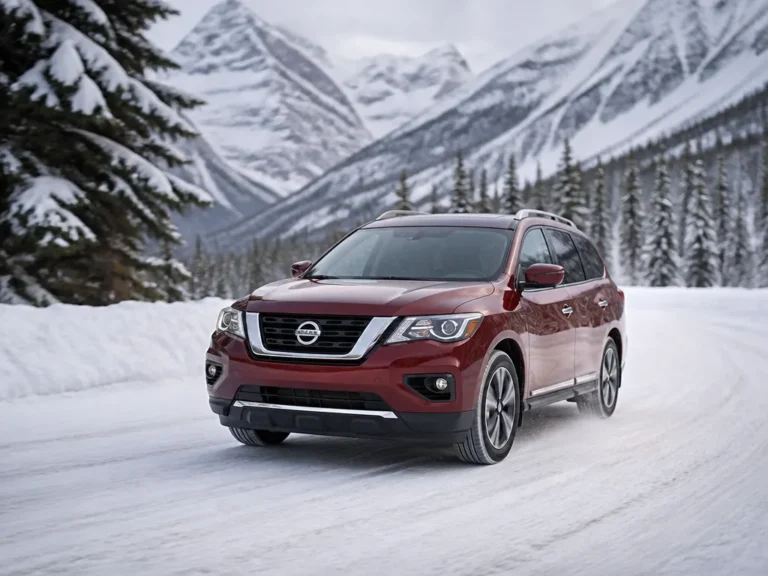
You’re rolling a Nissan Pathfinder out of the driveway and the roads turn into slush and ice, then the dash lights start talking: traction control, ABS, sometimes stability. The big question is how this Pathfinder’s AWD and control systems actually behave, and what you should do differently for acceleration, braking, turning, climbs, and descents.
Pathfinder winter control depends on tire grip first, then how AWD, ABS, traction control, and stability control manage wheel slip. Expect ABS pulsing under hard braking and reduced power when slip is detected. You’ll get a model-year-typical, step-by-step approach plus pre-drive checks so you can drive smoother and know what’s normal.
Nissan Pathfinder in snow winter driving explained: Start with tire traction, then drive the traction-control rhythm. In ice or slush, AWD helps you move, while ABS helps you stop by pulsing under braking. If wheels spin, traction control cuts power and applies braking to regain grip. Use low, steady throttle and allow extra stopping distance.
Nissan Pathfinder In Snow Winter Driving Explained
Nissan Pathfinder snow driving is all about traction limits, predictable braking, and understanding what the AWD and stability systems do when tires start to slip. On snow and ice, the vehicle will usually feel less eager to accelerate, brake pedal feel can change slightly as ABS works, and steering response can soften before stability control takes over.
What Changes On Snow And Ice In A Pathfinder
Snow reduces available grip at the tire, so the Pathfinder can only do so much before it needs traction control and ABS to manage wheel slip. Expect earlier throttle intervention (less power at the wheels) and a steering feel that can go “floaty” when the front tires lose bite. The most common pattern is drive wheels spinning briefly, then the system clamps down and re-routes torque while stability control calms things down.
For example, when you enter a turn on slick snow, the tires can break grip before the chassis rotates much. Stability control then intervenes, so the car may feel like it is resisting the turn for a moment while it restores directional control.
What To Watch For On The Dash
Dash indicators are your clue that the Pathfinder is actively managing traction. If you see traction/stability-related lights or hear chimes during normal snow driving, that usually means the system is doing its job, especially when you are accelerating harder than the surface allows.
| Indicator/Message | What it typically means on snow | What to do |
|---|---|---|
| ABS light | ABS is enabled and intervening during braking, or the ABS system needs attention if it stays on | Drive carefully; if the ABS light stays on after start, get it checked |
| Traction Control or Slip light | Wheel slip is occurring and the system is cutting engine torque | Ease off throttle and increase following distance |
| Vehicle Dynamic Control or Stability light | Stability control is limiting wheel slip and yaw during a skid risk | Reduce speed, steer smoothly, avoid abrupt inputs |
Insider tip: brief activation of traction or stability indicators is normal in deep snow. A warning that stays on steadily after you restart the vehicle is the one that deserves a real inspection.
Before You Drive: Pathfinder Setup Items That Matter Most
Winter performance starts with tires and visibility, not drivetrain mode selection. Cold weather also changes tire pressure and rubber stiffness, so you need to check basics before you trust the AWD to do the work.
Practicing with the vehicle in a safe empty lot matters too. Slippery-surface driving teaches you how quickly ABS pulses under braking and how much steering input is needed before the Pathfinder regains traction.
Pathfinder Awd And Traction Settings
Pathfinder snow traction is all about how the AWD system and stability controls manage wheel slip. In ice, you feel this as controlled power delivery and steering corrections, while the dash will often show TCS/VDC or ABS-related warnings if traction is limited or a fault exists.
AWD vs 2WD feel in snow: Most Pathfinders are AWD (not 2WD), but trim and model-year can change how aggressively power is sent to the rear. With AWD engaged, the vehicle is generally better at keeping both ends “in the same story” during takeoff, so you get fewer sudden speed changes at the wheels. With a true 2WD setup, the driven wheels break loose first, which makes the car pull or push more during acceleration and can trigger more stability intervention.
Tcs And Vdc/esc: What You See And What It Means
TCS (Traction Control System) is the first responder when a drive wheel spins. VDC/ESC (Vehicle Dynamic Control or Electronic Stability Control, depending on the labeling) takes over when slip turns into oversteer or understeer, applying brake to individual wheels and adjusting engine torque.
On snow, normal intervention feels like reduced acceleration, a faint brake pulse in the pedal, or a subtle “drag” as the system clamps a spinning wheel. The instrument cluster may show a TCS or VDC indicator or a message that traction/stability is active, and it may briefly limit power even when you press the accelerator.
| Dash indication | Most likely meaning on ice | Driver feel |
|---|---|---|
| TCS active (indicator flashing) | Drive wheels are slipping and torque is being reduced | Softer pull, less wheel spin, smoother correction |
| VDC/ESC active (indicator flashing) | Vehicle balance is drifting and brakes/torque are being managed | Steering “stays you,” brief brake engagement |
| TCS/VDC OFF warning (steady/disabled) | System disabled, or a fault has set a trouble condition | More wheel spin, more abrupt yaw changes |
Terrain/drive Modes (If Equipped) And When To Use Them
Some Pathfinders offer selectable drive or terrain modes such as Snow, Eco, or similar variants. Snow-type modes typically bias throttle mapping and traction control response for lower wheel-spin and calmer torque delivery. Eco modes can help with smoothness, but they can also feel slower when you need quick, controlled torque to get moving on a slope.
Use a snow or traction-focused mode when you see consistent slip on takeoff or when corners require gentle throttle. For cleared roads with good grip, you can switch back to normal, because too much “intervention tuning” can make the vehicle feel hesitant during normal acceleration.
Hill Descent Control And Hill Assist: Downhill Behavior And Indicators
Some Pathfinders have hill descent control (HDC) and hill start assist (HSA). HDC helps manage speed on steep descents by applying brakes in a controlled way, so the driver can focus on steering and finding traction instead of modulating the brake pedal every second.
On the dash, you’ll usually see an HDC/Hill Descent indicator when the system is available or active, and it may change color or status depending on whether conditions are met (speed, slope, gear selection). Hill assist typically holds brake pressure briefly during a start on an incline, so the vehicle does not roll backward while you transition from brake to accelerator.
Abs On Ice: What Pulsing Is Supposed To Look Like
ABS on slick surfaces is normal to feel as pedal pulsing or vibration during hard braking. ABS “chatters” because it is rapidly releasing and reapplying brake pressure to prevent wheel lock, and that is exactly what you want on ice.
ABS is a problem when you have ABS warning lights that stay on, or when the pedal behavior is erratic without strong braking input. Seek service if the ABS indicator is illuminated steadily, if the brake pedal sinks abnormally, or if ABS activation feels absent during hard braking on slippery road surfaces.
Practical rule: In snow, brake firmly and let ABS do its job. Feathering lightly can increase stopping distance because it may delay wheel lock while you still lose traction.
Tire Choice Dominates Traction
Snow and ice traction on a Nissan Pathfinder starts with the tire, not the drivetrain. Dedicated winter tires have deeper, softer tread and more biting edges, so they keep making grip as temperatures drop. All-seasons can work in light snow, but their performance drops fast on packed snow and slick ice.
Winter Tires Vs. All-seasons On A Pathfinder
For a Pathfinder in snow country, dedicated winter (3PMSF snow-rated) tires usually feel more predictable in stop and go driving because the tread stays flexible in cold weather. In real use, that means more consistent forward bite when you ease into the throttle, and shorter, steadier braking when you stop in a straight line.
In practice, all-seasons can still be “legal” and may move the SUV through shallow accumulations, but their compound hardens in cold temps and their tread pattern does less work on glazed surfaces. The result is more wheel slip under acceleration and more ABS pulsing under braking, even when the AWD is working normally.
| Condition on the Pathfinder route | Dedicated snow/winter tire (3PMSF) | All-season tire |
|---|---|---|
| Light snow on fresh pavement | Good bite with early throttle control | Often adequate, traction feels less progressive |
| Packed snow | Stronger grip due to deeper siping and edges | Grip falls quickly when tread is worn |
| Slushy mix | Better evacuation, less skating feel | Higher tendency to hydroplane and slip |
| Glazed ice | Best available control, still needs speed reduction | Grip is limited, expect longer slides |
Tread Depth And Wear: Measure Before You Guess
Tread depth controls how much “bite” the tire has left when snow builds in the grooves and sipes. Measure yours with a tread gauge, then compare to your tire’s wear indicators. Using worn tread in winter turns traction control into an always-on routine, which feels like reduced power even when the drivetrain is healthy.
On tread-wear questions, don’t guess. If your tires are near the wear bars, you should expect noticeably less snow performance, and ice confidence drops even more. Replacing before the season is usually cheaper than buying new tires after you’ve driven them through a winter you can’t safely control.
Cold Weather Tire Pressure: Set It The Right Way
Cold temperatures reduce tire pressure quickly, and underinflation kills snow performance by increasing sidewall flex and reducing tread contact. Set pressures when the tires are cold, meaning the vehicle has been parked for a few hours and the tires match the ambient temperature.
Inflation targets come from the label in the driver door jamb (or owner’s manual), and those numbers are different for front vs rear in many SUVs. After you drive, check again only if you can do so safely and promptly, since pressure rises with heat and you do not want to “chase” numbers mid-heat cycle.
Common mistake: setting pressure right after highway driving. Hot tires read high and you end up underinflated once they cool back down.
Snow Chains: Fitment, Clearance, And Safe On/off
Snow chains can help when you hit deep snow or slick grades where tires alone spin. On a Pathfinder, chain clearance is tight around wheel wells and suspension parts, so you need the correct chain type and size for your exact tire diameter and tread width.
Fitment varies by tire size and whether you use winter tires, so confirm chain compatibility in the chain maker’s chart. Installing chains while the car is moving is a fast way to injure yourself or damage brake lines and body panels.
Safety callout: If you cannot fit chains without forcing them, stop and reassess. Forcing the wrong size can rub sensors, wear through wheel well liners, and create a drivability hazard.
Pre-winter And Pre-drive Checklist
Snow and ice turn small problems into big ones, so set up visibility, tires, and power before you roll out. A Nissan Pathfinder can handle winter driving well, but only if the basics are tight: clear glass, proper tire grip, full fluids, and a battery that starts strong when it is cold.
In practice, snow drive prep is about preventing surprises: defrost that is weak, washer fluid that turns into slush lines, tires that are worn unevenly, or a battery that slows the first crank too much. If you see steering shake, a brake warning, or a persistent traction/ABS fault light, stop and get it checked before heading into deep snow or long distances.
| Checklist item | What you should look for | Why it matters in snow |
|---|---|---|
| Wipers and washer | Streaking, skipping, weak spray | Snow film and slush hide lane markings fast |
| Defrost performance | Slow warm-up, uneven airflow | Fog reduces reaction time immediately |
| Tires (tread and sidewall) | Uneven wear, cracks, bulges | Traction control and ABS work poorly on bad grip |
| Brakes and pedal feel | Soft pedal, pulling, unusual pulsation | Stopping distance grows quickly on ice |
“Before the first storm, do a 10-minute walk-around and a 2-minute defrost and wiper test. If something is borderline in dry weather, winter turns it into a problem you cannot outdrive.”
Start, Accelerate, And Stop Safely
In a snow covered Nissan Pathfinder, traction control and ABS are working hard the moment the tires lose grip, so your job is to feed them inputs they can manage. Gentle throttle, early braking, and smooth steering keep the system from cycling grip over and over, which is what causes most slide, surging, and “why did the truck fight me” moments.
Quick “feel” guide while driving:
| What you feel | Likely cause | Driver correction |
|---|---|---|
| Wheel spin, then sudden power fading | Traction control limiting torque | Reduce throttle and hold steady until grip returns |
| Brake pedal pulses | ABS cycling grip | Keep steady pressure, steer gently |
| Steering “doesn’t bite,” vehicle wants to slide | Low lateral traction on ice | Widen turn radius, reduce speed before the turn, avoid abrupt inputs |
Insider tip: If you must choose, slow down before you turn. The Pathfinder handles straight-line traction management better than mid-corner corrections on snow and ice.
Climb And Descending Control Moves
On snowy grades the Pathfinder benefits from smooth momentum management. Maintain a light, steady throttle to keep the wheels spinning just enough to grip, rather than digging into the snow. If traction breaks, ease off and reapply gradually rather than mashing the pedal.
Common Snow Issues And What To Check
Snow reduces grip and the Pathfinder’s AWD and traction control can intervene to keep you from losing control. When you see warning lights, feel changes in steering, or notice sluggish acceleration, run through basic checks on tires, sensors, and brakes before driving on.
Wheel Spin And Traction Control Lights
Symptom → Cause → Fix: Wheel spin and traction control lights illuminate during acceleration on slick pavement. Cause is often worn or mismatched tires, cold-inflation effects, or dirty wheel-speed sensors causing the system to misread slip. Fix: confirm tread depth (aim for at least 6/32 in), verify cold tire pressures per the placard, and clean sensor rings if accessible. If the light stays on, pull codes with a basic scanner or have a tech verify AWD and TC modules.
In practice, using winter tires and keeping wear even reduces false activations. Before you set out, ensure tires are winter-rated and matched to the Pathfinder; persistent lights warrant a dealer diagnostic to confirm sensor calibration and module communication.
Stability Control Intervention
Symptom → Cause → Fix: You may feel the Pathfinder straighten or apply brakes when entering or exiting a corner on snow. Cause is sensed oversteer or understeer from reduced grip; ESC or VDC intervenes to stabilize, which can show as a brief brake pulse or reduced throttle. Fix: drive with smooth inputs, avoid abrupt steering or heavy throttle in low traction, and check tires for winter suitability; if behavior repeats, inspect tires, alignment, and suspension for wear.
In practice, frequent corrections in curves can point to uneven tire wear or misalignment. Have a shop verify alignment and tire condition, and ensure you are running winter-rated tires that match the vehicle’s torque delivery for predictable handling.
Abs Pulsing And Long Stops
Symptom → Cause → Fix: Braking on ice or packed snow may cause a pulsing brake pedal and a longer stop distance. Cause is ABS actively modulating pressure to prevent wheel lock; on slippery surfaces, pulses can be frequent and feel abnormal if pads are glazed or tires wear unevenly. Fix: brake earlier with a steady pedal, maintain a safe following distance, and inspect brakes and tires for glazing or uneven wear; if pulses are excessive, have the brakes and ABS sensors checked.
In practice, expect longer stopping distances in snow and avoid panic braking. If you hear grinding noises or the ABS light comes on with no wet condition, diagnostic testing is needed to rule out sensor or hydraulic issues.
Steering Vagueness Or Instability
Symptom → Cause → Fix: Steering feels vague or wanders on snow and ice. Cause is improper tire pressures, uneven wear, or road-surface mismatch with the tire type. Fix: check tire pressures to the placard with cold tires, inspect wear and rotate if needed, and verify alignment is within spec; if vagueness persists, inspect tie rods, steering rack, and wheel alignment for wear or looseness.
In practice, stable tires and correct pressures improve predictability. If drift or pull persists after tires and alignment are addressed, stop and have the steering/suspension components checked before continuing.
Reduced Power Feel
Symptom → Cause → Fix: Engine seems slow to respond and acceleration is limited when trying to move on snow. Cause is traction control or AWD torque limiting in low grip conditions, sometimes aided by a cold engine. Fix: avoid rapid throttle inputs, give the system a moment to regain grip, and check for stored codes if this repeats; ensure tires are appropriate for winter and not glazing the pavement.
In practice, repeated power loss with steady throttle can indicate a sensor or drivetrain fault. If the condition persists, have the vehicle scanned for traction control and drivetrain faults and confirm there are no warning lights indicating a broader problem.
Quick Summary
Winter driving with a Nissan Pathfinder hinges on tire grip and how AWD, ABS, and traction control manage wheel slip. Expect ABS to pulse under hard braking and power reduction when slip is detected. Start with tire traction and follow the traction control rhythm; on ice or slush, AWD helps you move while ABS helps you stop by pulsing. If wheels spin, traction control cuts power and applies braking to regain grip, so use throttle and leave stopping distance. Tires set the limit; prioritize dedicated snow tires and check cold tire pressure, adjusting to the placard after tires have cooled.
Dash lights distinguish active intervention from a persistent fault: ABS can pulse during braking, while a steady ABS, traction, or stability warning deserves inspection. Before driving, focus on tires and visibility, with winter tires preferred, plan for longer stopping distances on all seasons, and set tire pressure to the placard when cold.
| Indicator | Typical meaning on snow | Action |
|---|---|---|
| ABS | ABS is enabled and intervening during braking, or may indicate a problem if it stays on after start | Drive carefully; if the light stays on, have the system checked |
| Traction Control or Slip | Wheel slip is occurring and the system is cutting engine torque | Ease off throttle and increase following distance |
| Vehicle Dynamic Control or Stability | Stability control is limiting wheel slip and yaw during a skid risk | Reduce speed, steer smoothly, avoid abrupt inputs |
| Pre drive focus | Winter performance starts with tires and visibility | Use winter tires, check cold tire pressure, set to placard |
Frequently Asked Questions
How Does The Nissan Pathfinder’s Intelligent 4×4 Help In Snow And What Mode Should I Use?
The Pathfinder’s Intelligent 4×4 provides variable torque distribution to help grip on slick surfaces. Auto mode is the default and safest choice for most snowy days, and switch to 4×4 only if you feel wheel slip; avoid 4×4 Lock on dry pavement.
Should I Run Winter Tires On A Nissan Pathfinder For Snow, And What Are The Benefits?
Yes, winter tires dramatically improve traction and braking in cold conditions, especially when temps stay below 7°C (45°F). They should have at least 4/32 inch tread depth, with 6/32 inch preferred for stronger snow performance, and be installed on all four wheels for balanced handling.
What Driving Techniques Should I Use When Driving A Nissan Pathfinder In Snow To Stay Safe?
Drive with smooth inputs and increased following distance; aim for a 6- to 8-second gap and avoid sudden throttle or braking to prevent wheel spin; if you feel the ABS pulsing, ease off and reapply gently.
What Winter Preparation Checks Should I Perform On A Nissan Pathfinder Before Snow Season?
Check tires for a minimum tread depth of 4/32 inch, with 6/32 inch preferred for winter traction, ensure the battery is strong, top up coolant with the correct winter mix, and test wipers and washer fluid to handle frozen splashes.
Is It Safe To Drive Through Heavy Snow In A Nissan Pathfinder, And What Limits Should I Respect?
AWD helps with traction but it is not a substitute for cautious driving; avoid deep, unplowed snow and keep speeds under about 40 mph in heavy snow, planning longer trips and keeping an emergency kit aboard.