


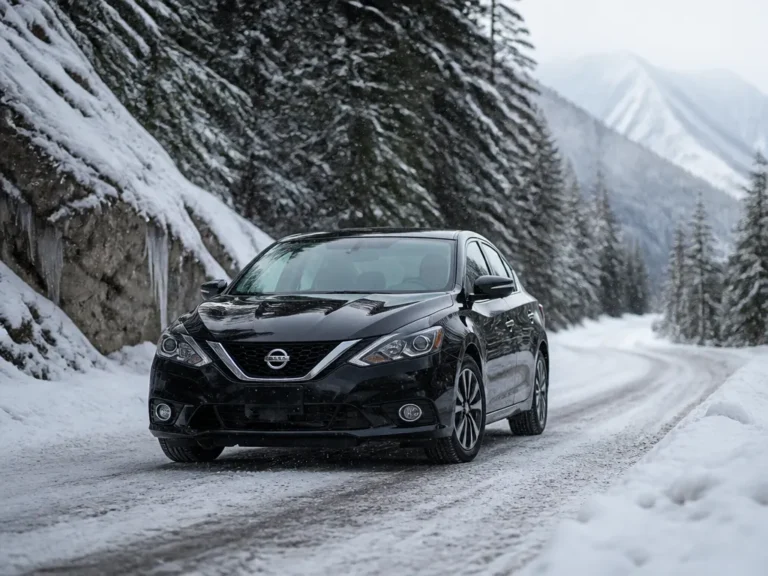
Your Nissan Sentra feels fine on dry roads, then snow shows up and suddenly traction slips, braking feels longer, and every hill start is a gamble. If you are searching “nissan sentra in snow and winter driving,” you likely want model-specific guidance for a FWD car, plus the right tire plan and winter prep steps.
Sentra is front-wheel drive, so winter grip starts at the front tires and transfers control changes when weight shifts. Winter tires are the safest upgrade, and cold weather also drops tire pressure by about 1 to 2 PSI per 10°F, so checking pressure matters. This guide gives you traction tips, tire choices, and what to inspect before the first storm.
Nissan Sentra In Snow And Winter Driving
Front-wheel drive helps the Sentra pull through snow because engine torque goes straight to the wheels that steer. Traction still depends on tires and tire condition, since FWD can accelerate you before braking performance and handling catch up. Expect longer stopping distances on packed snow and slush, especially if the tires are worn or the compound is getting hard.
Sentra Fwd Basics In Snow (What Changes Vs Dry Pavement)
The Sentra sends power to the front wheels, so you usually feel better pull-out performance from stoplights and gentle hills than a car that drives the rear. The trade-off is that the same front tires do double duty, steering and delivering drive torque, so they can saturate quickly on glare ice. Once the front tires lose grip, the car can understeer (plow) while you turn.
ABS helps you steer while braking on slippery surfaces, but ABS does not increase traction, it just prevents wheel lock. Brake distance still grows a lot on ice and compacted snow, so your real winter job is leaving more room and reducing speed before you need to stop. Stability control and traction control can reduce wheel spin, but they also cannot overcome physics when tires are mismatched or degraded.
What Winter Expectations Look Like (So You Plan Your Day)
In normal city driving, the biggest improvement comes from smoother throttle and earlier deceleration, because that preserves tire grip for steering. In highway conditions, speed changes matter more than quick lane changes, since lateral grip on snow-packed roads is limited and regain time is slow. For steep stop-and-go areas like bridges or overpasses, friction drops fast after a cold snap, and the Sentra will feel “light” in the front if the tires are not winter-rated.
For example, on a slushy commute, you can usually power through the slush without drama, but the moment you hit a clean, shiny patch, braking distance can jump and the car may plow wide if you turn while braking. For another example, on a packed-snow ramp, holding a steady steering angle and easing off the throttle early beats stabbing the brakes or making sharp corrections.
Safety Feature Interactions And Official References To Trust
Electronic stability control (ESC) and traction control aim to keep the car within the driver’s intended path by limiting wheel spin and brake-selecting when needed. Tire condition controls whether these systems can do their job, since bald all-seasons can still overwhelm the ESC with too little grip. Steering feel can change in winter because the tires absorb more of the road’s unevenness and the car’s stability strategy may intervene more often.
Official references to keep handy: Nissan USA model information is the best starting point for your exact Sentra year equipment and owner-available materials. For general brand-level reference, Nissan’s public presence is hosted at Nissan USA, and the Nissan corporate site explains model lineup and support links. The owner’s manual and the Nissan “Owner’s Guide” for your trim are the primary references for ESC, traction control, ABS, and tire requirements.
Quick-start winter checklist (Sentra-specific habits): correct tire pressure before storms, verify tires have real tread depth, keep the cabin at defrost so visibility stays clean, and set off earlier so you do not feel forced to brake late or accelerate hard.
Sentra Fwd Winter Performance
Weight Distribution And Front Grip
A Sentra’s front tires do the job of both steering and propelling the car, so they get the harshest winter workload. Under acceleration, weight transfers rearward, which can reduce front-tire loading and initial bite on a slippery surface. During cornering, the front tires also handle steering forces and drive torque, raising the risk of understeer.
Braking shifts weight more to the front axle, increasing front-tire loading, but stopping still depends on available tire grip. On icy roads, ABS can keep the wheels from locking, but the car can still slide if tire traction is insufficient, so you feel “stops that work, but don’t feel short.”
In practice, tire condition is the limiter: worn tread patterns and hardened rubber lose the ability to “cut through” slush and maintain micro-grip on packed snow. For a Sentra, this means the difference between decent winter control and a slippery front end is often measured in tire quality and remaining tread depth, not in driving talent.
Understeer And Throttle Response
Front-wheel-drive cars like the Sentra commonly show understeer because the front tires are both steering and delivering torque. In corners, lifting off the throttle can reduce torque to the front axle and sometimes lets the car rotate a bit more, while adding throttle mid-corner often increases push and worsens understeer.
Throttle should be smooth and earlier than you think. A gentle, gradual pedal lets the front tires stay loaded within their grip range, while abrupt input spins up the inside tread and forces the car to plow toward the outside barrier.
Braking Limits On Slippery Surfaces
On snow and ice, braking is limited by tire traction, not by how hard your foot presses the pedal. A Sentra will generally stop in a straighter line under ABS, but stopping distance can still be dramatically longer, especially on glare ice where rubber has very little grip.
In city driving, frequent stop-and-go means you build momentum repeatedly, so spacing and anticipation matter more than in dry conditions. In highway scenarios, plan for earlier deceleration and avoid last-second braking, since any weight transfer plus a lock-prone surface can trigger long slides.
Quick driver rule for a Sentra in winter: If you feel the nose pushing wide, ease off just slightly, reduce steering angle, and get back to a smooth, low torque request. The front tires need traction first, direction second.
Winter Tire Guidance For Sentra
When Winter Tires Beat All-season Tires
Run winter tires when temperatures stay below about 45°F (7°C) and you expect snow, slush, refreeze, or ice. All-season tires can still move a Sentra around, but their rubber hardens in cold weather and they lose the grip that helps the front tires keep steering and braking stable.
For daily use, the difference shows up most in stop-and-go city driving, where you brake and start frequently on packed snow or wet ice. On the highway, winter tires reduce the “skate” feeling when you lift off the throttle or brake into a cold bend.
Expected Gains You Can Feel (And What You Should Not Assume)
A good winter tire set typically feels noticeably shorter for braking and steadier for turning at cold temperatures, especially when roads are icy or partially covered. Tire grip improvements do not “override physics,” so a winter tire will not guarantee you beat an emergency stop distance on glare ice.
Mechanic’s reality check: If you swap to winter tires and drive like it is summer, you can still get caught. Winter tires give you more usable traction, but they still require smooth inputs, extra following distance, and careful speed selection.
| Road condition | All-season expectation on a Sentra (FWD) | Winter tire expectation |
|---|---|---|
| Slush (city starts, stops) | Traction drops as rubber stiffens; more wheelspin on launches | Better tread bite and cleaner evacuation for steadier starts and stops |
| Packed snow | More sliding under braking or cornering | Improved grip and stability from winter compound and sipes |
| Refrozen ice | Limited control, long stopping distances possible | More steering/braking confidence, still no guarantee on black ice |
| Cold dry pavement (below 45°F/7°C) | Grip is reduced compared to warmer temps | Feels closer to “normal” because the compound stays flexible |
Types Of Winter Tires And Practical Selection For A Sentra
Pick winter tires based on your worst-case conditions, not your average day. Studless “snowflake” winter tires are common for commuter use and are the safe default for slush and snow, while studded options can add grip on consistently ice-covered routes (where legal), at the trade-off of extra noise and wear.
When selecting sizes, match your Sentra’s tire size and load rating, and keep the overall tire diameter close to factory to avoid speedometer error and traction control oddities. If you plan to keep the same wheels, confirm hub clearance and tire bead compatibility, then budget for a real balance job since winter tires can have more tread mass.
Quick-start checklist: If forecasts show sub-45°F (7°C) mornings or any packed snow, plan winter tires. If your roads stay mostly wet and slushy with occasional snow, an appropriate winter tire set is a smarter move than trying to “make all-seasons work.”
Cold-weather Tire Pressures
Set your Nissan Sentra’s tire pressure to the values on the driver’s door placard when the tires are cold. Cold air makes tire pressure drop, so a reading taken after driving can be off by several psi.
For example, if you set pressures at 70°F and then overnight temps drop into the 20s, your tires can end up about 5 to 10 psi low by morning, using the 1 to 2 PSI per 10°F guideline. Low pressure increases sidewall flex, which can soften steering response and increase tread squirm, and that can mean longer stopping distances on snow-packed roads.
| Temperature Change | Approx. Pressure Change | What you’ll notice |
|---|---|---|
| 30°F drop (example) | About 3 psi lower | Softer turn-in, more rolling resistance, quicker tread wear at the edges |
| 20°F drop (example) | About 2 psi lower | Light steering feel changes, slightly higher fuel use, less stable grip |
Adjust safely and correctly. Use the gauge with the tire cold, then inflate to the door placard target, not the hot reading. If you check right after driving, park and wait, or accept that you are correcting based on inaccurate heat-inflated pressure.
Quick-start checklist for Sentra owners: check pressures before heading out, match the door placard for your tire size, confirm all four tires are equal to the specified psi, and re-check after any big temperature swings or a long trip.
Traction And Braking With Abs/esc
On a snowy Nissan Sentra, ABS still works by preventing wheel lock, even when the tires are buried in slush. On ice, ABS may pulse harder and more often because traction is lost and regained in shorter intervals. ESC helps keep the car pointed where you intend by adding brake pressure and cutting engine torque when a slide starts.
Abs Behavior On Snow And Ice
ABS on the Sentra is designed to keep at least some wheel rotation so you can steer while braking. On packed snow and slushy roads, expect a steady pulsing in the pedal and a rasping sound at the wheels as the system modulates brake pressure. On clear ice, ABS can cycle rapidly, and braking may feel less “linear” because the system is constantly chasing traction.
ABS does not increase stopping distance on every surface. ABS can reduce stopping distance on many slick surfaces compared to hard locked-wheel braking, but on very low-traction ice it still relies on tire grip to slow the car. For the driver, the practical takeaway is to press the brake firmly and hold it, then adjust steering only within what the tires allow.
Esc Role In Steering And Stability
ESC in the Sentra is there for the moments when the car starts to rotate or drift more than your steering input can control. When the system detects understeer or oversteer, it can brake individual wheels to create a corrective yaw moment and reduce engine torque to regain stability. In winter driving, that usually feels like brief brake application or reduced power right as you turn into a curve or correct a slide.
In practice, ESC helps you avoid the most dangerous outcome, which is losing control while braking mid-corner or hitting a split-mu surface (snow on one side, ice or bare pavement on the other). ESC also cannot overcome mismatched tires, bald tread, or incorrect tire pressure, so tire grip and maintenance still set the ceiling for performance.
When To Avoid Disabling Esc
Turning off ESC might feel tempting when you are trying to rock the car out of deep snow, but disabling it removes the car’s ability to brake individual wheels to control yaw. For a front-wheel-drive Sentra, that matters because sudden throttle or steering changes can spin the front tires and send the car into an unexpected slide. Leave ESC on for normal winter driving, especially on mixed surfaces and during emergency braking.
Insider tip: If the car spins, ESC is usually doing something helpful by managing wheel slip and stability. Turning it off can make the car “feel freer,” but it often removes the safeguards that prevent a harmless slip from becoming a full skid.
| Winter situation | Typical ABS/ESC feel | Driver takeaway |
|---|---|---|
| Packed snow braking | Pedal pulsing, wheel sound | Brake firmly and steer smoothly, no pumping. |
| Black ice braking | More rapid ABS cycling | Expect longer stopping and keep braking steady. |
| Mid-corner traction loss | Brake intervention, reduced power | Reduce steering input and ease off if corrected. |
Step-by-step Winter Driving Tips
Traction on a front-wheel-drive Sentra improves when you drive smoother than you do in dry weather: ease into throttle, slow down earlier, and avoid sharp steering or late braking. Snow and ice punish abrupt inputs because tire grip collapses faster than your brain expects.
Cheat Sheet (use this like a driver’s script)
| Situation | What to do | What to avoid |
|---|---|---|
| Starting | Gentle throttle, pause if wheels spin | Flooring and “catching it” |
| Stopping | Early approach, progressive brake pressure | Late panic braking |
| Cornering | Slow first, steer smoothly, keep inputs steady | Turning while braking hard |
| Snow-packed streets | More following distance, test grip gently | Hard changes in speed |
| Hill start | Brake held, then slow throttle as you release | Sudden throttle to “get moving” |
| Lane change | Signal early, complete smoothly, avoid mid-move braking | Quick steering corrections |
Pro mechanic tip: In a FWD Sentra, traction problems usually start at the front tires. If the nose pushes, reduce steering angle first and smooth out throttle and braking second.
Winter Prep And Upkeep
Start winter readiness on your Nissan Sentra by verifying the three winter reliability pillars: battery health, proper freeze protection, and clear visibility. Cold weather hits starting power first, then windshield cleaning and cabin heat. A quick prep day prevents most “it just won’t start” and “I can’t see” surprises.
| Winter item | What to check | Failure you’ll notice | Practical action |
|---|---|---|---|
| Battery | Terminal condition, slow cranking | Hard start after overnight cold | Load test and use a smart maintainer |
| Coolant | Level and antifreeze mix | Overheating or freeze risk | Set correct mix, service if unknown |
| Wipers | Streaking, chatter, blade wear | Foggy, salty visibility | Replace blades, use winter washer fluid |
| Defroster | Windshield clearing speed | Persistent fog on cold starts | Check airflow, cabin filter, vents |
| Traction gear | Sand or mats, plus light tools | Tires spin, stuck in snow | Carry it and use it before you dig in |
Quick-start checklist: Cold morning battery test (if possible), coolant level and freeze mix confirmed, winter washer fluid filled, wipers replaced if streaky, defrost clears the glass within minutes, and traction aids staged where you can grab them fast.
Quick Winter Summary
Battery and fluids still matter even when the problem feels like traction. Use the right oil viscosity for your climate, keep washer fluid topped up, and if you see slow cranking or dim lights during cold mornings, get the battery and charging system checked before the coldest stretch arrives.
Key Takeaways For Snow Traction
In practice, your best braking results come from smooth pedal pressure and staying straight, since hard braking while turning can trigger ABS then reduce steering control. Hill takeoffs should be done with deliberate clutch use (manual) or gentle throttle (CVT/automatic), so you do not spin the front tires and slide sideways.
| Condition you face | What to do | Sentra-specific risk |
|---|---|---|
| Light snow, dry pavement | All-seasons at correct pressure, drive slower | Front-tire traction falls off sooner than you expect |
| Slush and repeated freezes | Winter tires or quality snow-rated tires | ABS cycles more often, stopping distance grows |
| Packed snow or icy spots | Winter tires, extra following distance, avoid sudden moves | Front tires spin, steering feels “light” then slides |
“Quick rule for winter braking: increase your distance enough that you can brake in a straight line without panic. If you feel the car tug or the steering go vague, you are out of traction.”
Quick Summary
For driving technique, the article stresses smoother throttle and earlier deceleration to preserve tire grip for steering, plus longer following distances, doubling your usual space on snow and at least tripling it on slush. It notes that ABS helps prevent wheel lock, but it does not shorten icy stopping distances. For hills, it recommends light throttle to prevent wheel spin and easing off early, especially on packed-snow ramps where stabbing brakes or sharp corrections can push the front tires past their limits. The single most important takeaway is to use winter tires and verify cold tire pressure before the first storm.
| Topic | What to do on a Sentra in winter |
|---|---|
| Traction basics | FWD grip depends on front tire condition since the front tires steer and drive. |
| Tire pressure | Check after overnight temps, pressure can drop 1 to 2 PSI per 10°F. |
| Braking | Brake sooner, ABS prevents lock but does not reduce icy distances. |
| Following distance | Double on snow, at least triple on slush with uneven texture. |
| Hill starts and ramps | Use light throttle, keep wheel spin under control, ease off early before turns. |
Frequently Asked Questions
What Tire Tread Depth Should I Have On My Nissan Sentra For Winter Driving?
For snow, aim for at least 4/32 of an inch tread depth, and if you are closer to wear bars or below that, plan to replace tires. If you are still on all-seasons, true winter grip drops fast once tread gets low.
Will A Nissan Sentra With Front-wheel Drive Slide More In Snow?
Front-wheel drive Sentras tend to understeer if you push too hard, because the tires manage both steering and power. The fix is driving inputs, use smoother throttle and steering, and keep more following distance than you do in dry conditions.
How Long Should I Warm Up A Nissan Sentra In Cold Weather Before Driving?
You do not need a long idle, but you should let the engine run until the cabin starts warming and the defroster can clear windows. A common target is about 1 to 3 minutes, then drive gently right away, especially if the outside is well below freezing.
What Should I Check First On A Nissan Sentra Before Winter If The Car Feels Less Stable?
Check tire pressure (cold pressure), tire condition, and make sure brakes do not feel grabby or pull. If the stability feels noticeably worse after a cold snap, have the alignment and suspension inspected, because worn ball joints, bushings, or bad alignment can amplify sliding.
Can I Use The Nissan Sentra’s Traction Control And Still Get Stuck In Snow?
Yes, traction control helps you regain grip, but it cannot overcome insufficient tire traction or deep packed snow. If you spin repeatedly, stop and clear snow from around the drive wheels, or you risk digging in and overheating components.
What Winter Emergency Gear Is Worth Carrying For A Nissan Sentra In Snow?
Keep a jumper pack or battery booster, a blanket, gloves, a small shovel, and a traction aid like sand or kitty litter. In real winter situations, being able to get going again and improve grip on the drive wheels is what saves time and prevents getting stranded.