



You just searched “volvo s60 gasoline recommendation” because you’re standing at the pump staring at 87, 89, and 93 octane, wondering what your S60 actually wants. The answer depends on the engine and model year, and the wrong grade can mean rough running or reduced knock protection.
Volvo S60 gasoline typically calls for 87 AKI as the normal grade in many markets, with premium (around 91-93 AKI) being optional for smoother performance when you drive hard or tow light loads. Use the owner’s manual wording for your exact year and engine, and follow the fuel door label if it’s there.
Volvo S60 Gasoline Recommendation
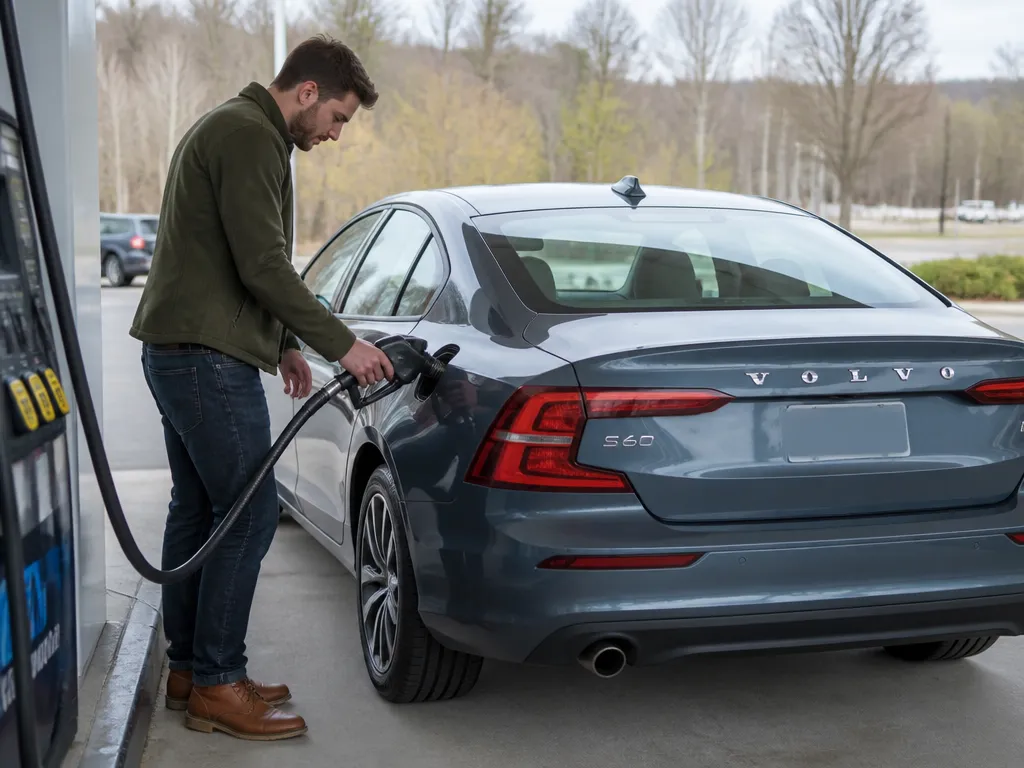
Volvo S60 gasoline engines generally want regular (87 AKI) in the tank. Premium (91 to 93 AKI) is only required when your specific S60 engine and fuel label call for it, which you can confirm on the car’s fuel door sticker or in your owner’s manual.
Top-line Rule By Grade (Use This Before You Look Anything Up)
Use regular unless the vehicle explicitly specifies premium. If the fuel door or manual says premium, knock control and performance calibration depend on that higher octane fuel.
Premium is also a smart choice when you run the car hard, drive in hot climates, or pull the revs frequently, even if your car allows regular. That said, the “higher octane for protection” idea is only valid when the engine is calibrated to it; for many S60 trims, premium is optional, not mandatory.
| Fuel pump label (US) | What to put in the S60 (typical) | When you must upgrade |
|---|---|---|
| 87 AKI (Regular) | Default choice for most S60 gasoline setups | Only if your fuel door/manual requires premium |
| 89 AKI (Mid-grade) | Works if your car allows “premium or higher,” and you cannot find 91 | Do not assume it meets a strict “91 minimum” requirement |
| 91 AKI (Premium) | Required for S60s that call for premium (common in “91 or 93” markets) | Use this when specified on the fuel door |
| 93 AKI (Premium) | Required where the label calls for 93 | Use this when specified on the fuel door |
Match The Pump Grade To Volvo’s Wording (Aki To Ron Quick Check)
US pumps list AKI (Anti-Knock Index), while many other markets use RON. A practical conversion you can use at the pump is that 87 AKI is about 91 RON and 91 AKI is about 95 RON.
Volvo fuel requirements in owner literature may show RON values in certain countries. If the sticker says something like “min RON 95,” that typically lines up with 91 AKI in the US, and 93 AKI in markets where the required RON is higher.
Between Grades (87 Vs 89 Vs 91/93) When You Cannot Confirm The Label
Running 87 instead of premium on a car that requires premium can trigger knock detection and more conservative timing, which can feel like weaker acceleration. Some cars may also light an engine-related warning if the control system reaches its limits, especially after repeated fuel cycles.
In practice, if you are truly between grades and cannot access your fuel door/manual, follow this order: use the grade printed on the fuel door, then choose the highest available grade that matches the required “minimum” value.
For example, if the requirement is effectively “premium 91+” and you only see 89, treat 89 as a short-term compromise, not a guaranteed match, because many calibrations expect a specific minimum octane.
Insider tip: Before you start pouring, check the fuel door label. That sticker is the fastest way to confirm whether your exact S60 needs premium or whether regular is approved.
S60 Gasoline Grade By Year
Volvo S60 gasoline fuel grade depends on the engine family and market. Match the engine option or engine code plus model year to the applicable fuel requirement.
Because trim names repeat across model years, the safest way to match octane is by engine option (or engine code) plus model year, then follow the “minimum octane” line for the vehicle. Premium can be recommended for drivability and knock resistance, but it is only mandatory when Volvo states a higher minimum for that exact configuration.
| Model year | Gasoline engine/trim group | Required minimum octane (AKI) | Premium (recommended/optional) |
|---|---|---|---|
| Typical 2019-2023 markets | Most turbo 2.0L gasoline trims (varies by horsepower) | 87 | 91 if available, especially for heat, towing-like loads, or sustained highway grades |
| 2018 and adjacent years (market-dependent) | Turbo 2.0L gasoline trims | 87 minimum in most cases | 91 when you want extra knock margin or you frequently run in hot conditions |
| All years with “high octane required” labeling | Any S60 configuration explicitly labeled with higher minimum octane | Use the higher minimum shown for your vehicle | Higher premium only if your manual states it, otherwise use the stated minimum |
Special case callouts matter because some markets publish different fuel standards, and some calibrations are more sensitive to knock. If your fuel door decal or manual says higher than 87, treat that as the hard minimum, not a suggestion.
Insider tip: When multiple gasoline trims share the same model year, trust the engine family and the fuel door octane statement over trim badge names. The trim label can change while the minimum octane statement stays consistent for that engine calibration.
When trims overlap, compare your VIN-era specification with the engine type and market information in the owner’s manual, then use the applicable fuel grade row above.
Find Your Engine And Trim Fast

Match your S60 to the correct fuel table row by confirming two things: the engine family and the trim/market. Use the trim badge and VIN, then cross-check the fuel spec wording in your owner’s manual for the exact octane naming (regular versus premium and any ethanol notes).
Quick Ways To Identify Trim And Engine
Start outside the car, then verify inside the door jamb. The goal is to avoid guessing based on year alone, since engine and calibration changes can land mid-year.
For example, two S60s with the same model year can carry different powertrains if one is built for a different emissions/market package. That is why VIN confirmation beats relying on forum screenshots or a quick badge read.
Use Vin To Confirm The Engine Family
Decode the VIN through your Volvo dealer parts lookup or a reputable VIN decoder that shows vehicle configuration. Focus on the engine family and/or engine code shown for your build, since the gasoline requirement can differ by engine calibration.
Confirm the engine identity first, then use the grade table in the next steps to pick the right octane. Keep the last 6 digits handy when you call the dealer, since it speeds up their lookup.
| What you find | Where to look | How it helps |
|---|---|---|
| Trim badge (T5/T6/B5/B6-style) | Rear of car, sometimes front fender | narrows the likely engine family and fuel wording |
| VIN | Dash and driver door label | confirms the exact build and engine code |
| Door-jamb label text | Driver door jamb sticker | verifies market package details for your car |
Owner’s Manual: Where The Fuel Grade Is Actually Named
Open the owner’s manual and go straight to the fuel specification or “Refueling” section. Volvo manuals usually name octane by a standard and may refer to “minimum octane” or “use gasoline with at least…” wording, and they may call out market-specific ethanol behavior.
Tip: In the manual, don’t look only for “premium.” Volvo’s wording often specifies the required octane method (for example, (R+M)/2) and may say premium is optional unless your vehicle is operating under higher load conditions.
For ethanol markets, scan for mentions like E10 or E15 and any conditions or warnings that tie ethanol blends to the fuel grade recommendation. Market differences matter, so use your manual’s exact wording for your region rather than assuming the U.S. spec applies everywhere.
What Low Octane Can Do
Using fuel with an octane rating lower than Volvo S60 calls for can trigger knock-detection behavior in the engine computer. The car protects itself by pulling ignition timing, which can change how the S60 feels under load.
Knock Resistance Strategy (What The Car Does To Protect Itself)
When knock (abnormal combustion) risk rises, the Volvo S60 control module retards ignition timing. Retarding timing reduces cylinder pressure spikes, but it also costs some performance and can shift combustion toward a “less eager” feel.
In practice, this often shows up as fewer “hard acceleration” moments where the car feels quick and crisp. The timing strategy is automatic, so the engine may run normally at light throttle, then feel different when you ask for power.
Common Symptoms You May Feel
For example, hesitation during mid-to-hard throttle, even if the engine starts and idles fine, is a classic low-octane symptom. Drivers often describe it as “it hesitates, then goes,” because the ECU is actively managing knock risk.
In practice, reduced power feel is another big clue. The S60 may still accelerate, but it feels like it is reaching the same speed with less urgency.
| What you notice | What it often points to |
|---|---|
| Hesitation when accelerating | Ignition timing being pulled due to knock risk |
| Roughness or mild stumble under load | Combustion instability from low knock resistance fuel |
| Reduced power on hills or towing-like loads (even if you are not towing) | Knock strategy limiting performance |
Rule of thumb: If the car feels noticeably “detuned” only when you ask for power, fuel grade mismatch is a strong suspect.
Warning Lights, Logs, And When To Stop Driving
A low-octane grade can lead to knock-related fault codes and, in some cases, a check engine light. The engine may also switch to a more conservative strategy, so you can feel the change before any light comes on.
Stop driving and get the S60 checked promptly if you see a flashing check engine light, experience severe rough running, or notice an obvious loss of power that worsens quickly. If the light is solid and drivability is only mildly affected, you can usually correct the issue by refueling with the recommended grade, but it is still smart to have it scanned if the light returns.
Does Premium Actually Help?
Premium fuel helps in an S60 only when the engine is actually pulling less-than-max knock margin. In everyday driving on properly rated gasoline, the difference is usually small because the car already adapts spark and boost within its designed knock limits.
Typical Outcomes In A Volvo S60
Premium can feel smoother under heavy load, but most owners won’t see a measurable change in fuel economy or power. The most noticeable effect is reduced sensitivity to bad batches of fuel when the car is operating near knock-prone conditions.
For example, an S60 that spends most of its life at moderate throttle often shows no seat-of-the-pants change when you switch to higher octane. A performance-minded driver who routinely goes full-throttle, then expects passing power on demand, is more likely to feel a difference.
Who Benefits Most From Premium
Certain operating conditions increase knock risk, so premium can become “worth it” sooner. Higher octane is most helpful when the engine is asked to make extra cylinder pressure while intake air is hot or the fuel quality is inconsistent.
If the S60 is programmed to use a specific minimum octane for your exact year and engine, premium helps only if it meets or exceeds that spec consistently. Using premium when your manual calls for regular often means paying more for no clear gain.
Cost Versus Value, Based On One-tank Reality Check
Premium’s value is a math problem, not a badge. Decide after one tank by comparing drivability and fuel economy, then stick with what makes the car feel right.
| Situation | Premium value | What you should notice |
|---|---|---|
| Most driving is calm, short trips, mixed weather | Often low | No change or very minor change |
| Frequent high-load driving (merges, grades, spirited use) | Often better | Smoother pull and fewer “tight” moments |
| Fuel quality varies by station | Can be helpful | More consistent throttle response across stations |
| Budget-focused routine driving | Usually not worth it | Similar MPG and feel on regular |
Premium doesn’t fix mechanical issues, so if you are chasing power loss, rough running, or repeat warning messages, higher octane will only mask the symptoms briefly. For an S60, address drivability concerns with proper diagnostics if the problem persists after several tanks on the recommended grade.
Insider tip: If you run premium for one tank and nothing improves, switch back to the manual’s recommended grade and save the money. If premium improves the car’s response during heavy load, keep it for that kind of driving or when you cannot choose a consistent regular station.
E10 E15 Ethanol Compatibility
E10 (up to 10% ethanol) is generally compatible with most gasoline-powered Volvo S60 setups that are calibrated for normal pump gasoline in your region. E15 can be compatible in many markets, but only use it when your specific S60’s fuel label and owner’s info allow it, because some models are restricted from higher ethanol blends.
E10/e15 Vs E85: What Most Volvo S60 Gasoline Setups Can Take
Volvo S60 gasoline models are typically built around standard gasoline blends, not flex-fuel chemistry. E10 is the safest “try it” choice when you are staying within normal pump gasoline. E15 is more likely to be permitted than E85, but permission depends on your vehicle’s ethanol compatibility statements.
E85 is the common flex-fuel cutover point, and it is where many non-flex-fuel vehicles run into trouble. Non-flex-fuel cars can suffer hard starting, rough running, and fuel-system warning behavior when they ingest ethanol levels they were not calibrated for.
| Fuel blend | Typical Volvo S60 fitment | What to watch for |
|---|---|---|
| E10 | Generally acceptable on standard gasoline-calibrated cars | Usually no unusual behavior |
| E15 | Often acceptable only if your car allows it on the fuel-cap/owner info | Cold start roughness or drivability issues if unsupported |
| E85 | Only for flex-fuel equipped vehicles | Check engine, idle issues, poor starting |
How To Interpret Pump Labels And What “May Contain” Means
Pump labeling can be confusing because the ethanol percentage may be a maximum. “E15” usually means the fuel is intended for up to 15% ethanol, while “may contain up to” is a warning that actual ethanol content can vary by station and season.
Use the label rules as a guide.
Insider tip: check the fuel door label and your owner’s manual language. If it names an ethanol limit (like E10 or E15), follow it. If it explicitly says not to use certain blends, treat that as a hard limit.
When To Avoid A Higher-ethanol Blend
Avoid E15 or any higher-ethanol product when your fuel door label or owner’s information does not list it as approved for your VIN. Avoid E85 unless the car is clearly flex-fuel and marketed that way in your market.
When the wrong blend is used on a non-compatible calibration, symptoms tend to show up as cold-start hesitation, rough idle, fuel trims that feel “off,” and a check-engine light. Some cars will limp or reduce performance if the engine detects knock risk or fuel quality issues, even if it seems to run for a short time.
Wrong Fuel: What To Do
For a Volvo S60, accidental use of the wrong gasoline grade is usually not an instant “engine failure” situation, but it can cause knock risk and trigger fuel-related fault codes. Keep driving gentle, then return to the recommended grade as soon as practical.
How Fast The System Adapts, And When To Check Symptoms
Fuel trim and ignition learning can start correcting quickly, often within the same drive cycle, but full adaptation takes multiple steady load cycles. Expect the engine to feel normal sooner if you correct the fuel early in the tank.
In practice, symptoms guide you. If you notice spark knock (rattle or ping under load), surging, rough idle, or a persistent check engine light after you switch back to the recommended grade, treat it as more than “temporary adaptation” and plan a scan.
When Fuel Removal Or Service Is Worth It
Fuel removal is worth considering when the mistake is severe or repeated, because the risk is higher than “wrong octane.” If you suspect a stale fuel issue, contamination, or the wrong fuel type (for example, non-gasoline fuel), don’t wait for symptoms to prove it.
Ask a shop to advise on extraction if you have repeated fuel-related faults, strong persistent knock, or ongoing rough running after switching to the correct grade. Extraction and tank/service work costs vary by region and shop rates, but the decision is usually based on how much contaminated fuel remains and whether drivability faults continue.
| What went wrong | Typical response | When to escalate |
|---|---|---|
| Wrong gasoline grade (octane too low or too high by one step) | Drive gentle, refuel correctly, monitor | Persistent knock, surging, or check engine light after correction |
| Stale fuel or fuel sat a long time | Symptoms may appear after refuel | Misfire or repeated codes that do not clear after fresh fuel |
| Repeated wrong-grade refueling or you keep topping off incorrectly | Learning can never “catch up” | Codes and drivability issues keep returning |
| Suspected wrong fuel type or contamination | Do not “run it out” as a first choice | Any severe running problems or confirmed contamination |
Insider tip: if the knock is audible and repeats under load even after switching to the correct grade, don’t keep driving that way. Have it checked, because repeated detonation risk is exactly what the ECU is trying to avoid.
Fuel Best Practices Checklist
Use the fuel grade your Volvo S60’s manual specifies for your exact year and engine, then stick to it at every fill-up. If premium is optional on your trim, use it to reduce knock risk when you regularly drive hot, climb hills, or run higher loads.
Station Choice And Fuel Consistency
Pick busy stations with good turnover so the fuel in the tank is fresher. Consistency matters more than name, so chase the same octane grade and the same label blend whenever you can.
| What you change | What you risk | What to do instead |
|---|---|---|
| Octane grade (example: 91 to 87) | Knock detection may intervene, drivability can feel flatter under load | Return to the recommended grade for your engine and driving conditions |
| Blend (unknown ethanol mix or reformulated fuel) | Cold start and rough running can vary by blend and temperature | Use stations that clearly label the grade and blend |
| Station quality (slow-turnover locations) | More variability in volatility and contamination | Use high-turnover stations and keep your tank reasonably full |
Storage And Seasonal Fuel Notes
Gasoline degrades fastest when it sits for months, especially in heat, and that degradation can cause rough idle, hesitation, and harder hot or cold starts. Ethanol blends make the fuel more sensitive to water contamination, so storage stability matters if you keep extra fuel or your S60 sits for long stretches.
Moisture and evaporation are the big culprits: water promotes phase separation in ethanol blends, and evaporation shifts the fuel blend so combustion becomes less consistent. Store extra fuel in approved containers and avoid keeping it past a couple of seasons, because once it goes stale, adding fresh fuel does not always bring the mixture back to “good.”
Tank Habits: Refuel Before You Are Very Low
Keep fuel above a low level most of the time because the fuel pump and pickup area sit where condensation and sediment can collect. Running near empty also makes it easier for contaminants that are settled at the bottom of the tank to get pulled into the system.
Real-world tip: if you notice surging, misfire-like hesitation, or a new “off” feel after a fuel change, switch back to the prior grade and try a different high-turnover station on the next fill. Consistency fixes more fuel issues than chasing mystery octane experiments.
Quick Summary
Volvo S60 gasoline recommendations depend on the exact engine and model year, but the article’s practical default is regular 87 AKI in many markets. Volvo typically lists 87 AKI as the normal grade, while premium around 91 to 93 AKI is often optional for smoother performance when you drive hard, in hot climates, or under sustained load. The key point is to follow the owner’s manual and fuel door label for your specific configuration.
The article emphasizes that you should not “chase octane” if your manual approves the lower grade, because grade matters for knock control and engine calibration. Running lower-than-required fuel can trigger knock detection and more conservative timing, which can feel slower under load and may even lead to an engine-related warning after repeated fuel cycles. If you cannot confirm the label, check the fuel door first, then use the highest available grade that matches the required minimum. Also note the US AKI to RON quick check, where 87 AKI is about 91 RON and 91 AKI is about 95 RON, and convert using the sticker’s scale when needed.
| Fuel door or manual requirement | What to put in the tank (US AKI) |
|---|---|
| Normal, minimum 87 | 87 AKI (Regular) |
| “Premium or higher” available, strict minimum not known | Use the highest available grade that meets the stated minimum, often 91 AKI |
| Premium required (common “91 or 93” markets) | 91 AKI (Premium) |
| Sticker calls for 93 | 93 AKI (Premium) |
Frequently Asked Questions
What Gasoline Should I Use In My Volvo S60, Regular Or Premium?
In most cases you should follow the fuel grade listed on your fuel door or in your owner’s manual. If your S60 calls for premium, using regular can hurt performance and may increase knock risk under load.
Does My Volvo S60 Need Premium Gas To Avoid Check Engine Lights?
Sometimes, but it depends on your engine tune and emissions calibration. If your S60 is spec’d for premium and you repeatedly run it on regular, you may get knock or fuel-quality related codes, so use the required grade.
Will Using The Wrong Gasoline In A Volvo S60 Damage The Engine?
Running the wrong grade usually won’t instantly ruin the engine, but persistent use of lower octane than required can trigger knock, which can lead to drivability issues and long-term wear. If the vehicle has been misfueled, switch to the correct grade and monitor how it drives.
What Octane Rating Is Recommended For A Volvo S60 Gasoline Recommendation?
The safe answer is the exact octane rating your manual specifies. Because the S60 has had different engines and model years, the applicable octane number varies by configuration.
How Do I Choose Gasoline For A Volvo S60 If I Do Mostly Short Trips And City Driving?
For short trips, the bigger win is quality and correct grade, not switching to a higher octane “just because.” Use the grade required by your S60, keep up with scheduled fuel system service, and avoid letting the tank run very low.
Can I Switch From Premium To Regular In My Volvo S60?
Only if your fuel door and owner’s manual allow regular. If the car is rated for premium, switching to regular can cause poor acceleration or knock-related behavior, so stay with the recommended grade.