


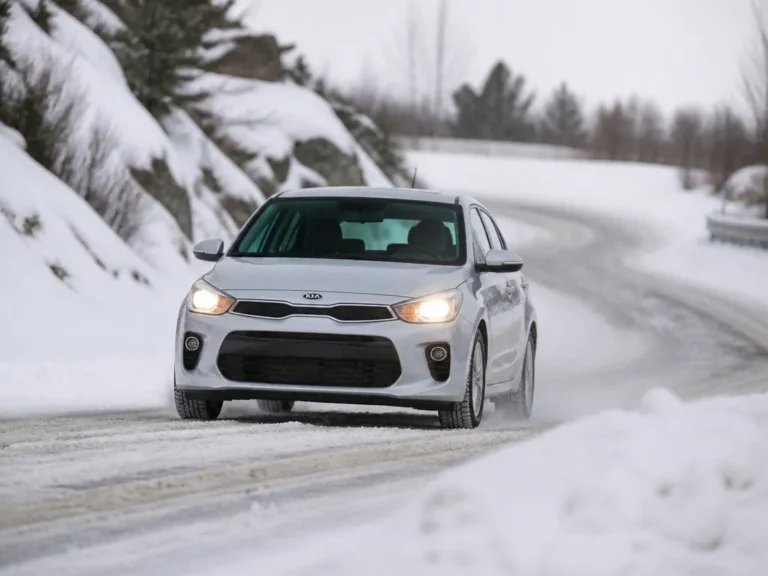
You’re about to leave for work in your Kia Rio and the roads are packed snow, maybe ice under the slush, and you’re wondering how the Rio actually behaves. Do you get wheelspin at takeoff, do you push straight on turns, and how hard can you brake before ABS starts chattering?
Kia Rio is front-wheel drive, so traction depends heavily on tires and smooth throttle. Expect ABS and ESC to work during hard stops and slippery cornering, but stability still drops fast on ice. This guide gives model-specific winter setup, cold-start checks, and a winter prep checklist.
Kia Rio in snow is usually predictable as long as you run real winter tires and drive gently: front-wheel drive sends power to the steerable wheels, so starting is controlled but traction can vanish quickly on glare ice. Aim for winter tires when temps stay below 45°F (7°C), keep correct pressures, and leave about 2 to 3x normal stopping distance.
Kia Rio In Snow And Winter Driving
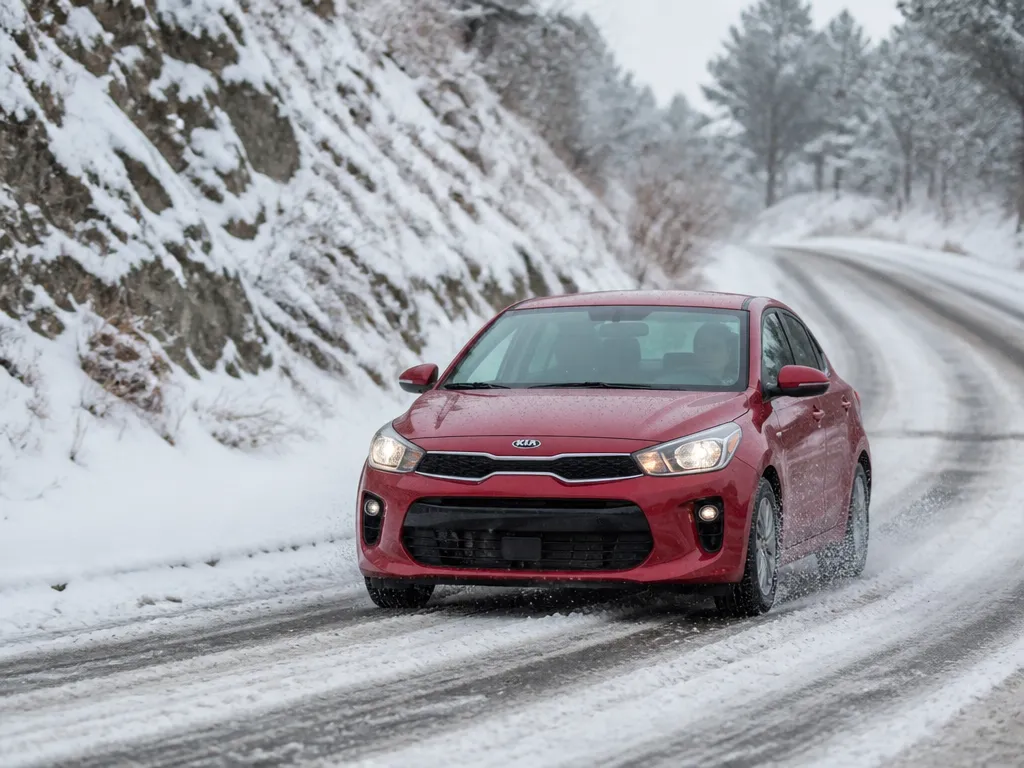
Kia Rio is typically front-wheel drive, and that drivetrain layout is the main reason it feels predictable in light snow but struggles earlier than an AWD car on slick climbs. Electronic Stability Control (ESC), traction control, and ABS work together to limit wheelspin and keep braking steerable when the road is icy.
Trims, Drivetrains, And What Grip You Actually Get
On a front-wheel-drive Rio, the tires that steer are also the tires that drive. In winter, that means you usually get good control on flat, packed snow, but steering can feel “slippery” when the front tires are at their traction limit. If your Rio is equipped with ESC, you will feel it through brief power cuts and slightly reduced throttle response when the car senses spin.
For winter behavior, the biggest real-world differences between Rio setups are tire choice and tire size, not trim badges. All-season tires can be passable in slush and light snow, but ice demands winter tires because tread design and rubber compound are built for cold temperatures. A Rio on winter tires will usually brake more consistently and keep the front end from washing out as early.
| Rio setup | What you feel on snow | What ESC/traction/ABS do |
|---|---|---|
| Front-wheel drive, all-season tires | Earlier wheelspin on starts, more steering “fade” when turning into a slippery throttle input | Traction control flashes reduce engine torque; ABS pulses to prevent lockup during harder braking |
| Front-wheel drive, winter tires | More stable braking and calmer turn-in, less drama when you roll on throttle mid-corner | ESC intervenes less often, ABS still pulses if you over-brake, traction control stays active but shorter |
Esc, Traction Control, And Abs On Ice: What “Normal” Feels Like
On snow, normal behavior is rhythmic traction control activity: slight hesitation, a faint shudder, or reduced acceleration as the system cuts power to the slipping front wheels. ABS typically gives a pulsing pedal during hard braking, and the steering wheel stays more controllable because wheels are prevented from locking.
For example, you might enter a snowy intersection at low speed, then brake firmer to stop. A Rio with functioning ABS will prevent wheel lockup, and the pedal pulses are expected, not a sign of a failed brake. Panic happens when drivers interpret those sensations as loss of control, but those are the systems doing their job to keep the car pointed where you’re steering.
Mechanic tip: If you ever hear repeated grinding, feel long pedal travel, or notice the car pulling hard to one side during braking, that is not “normal ABS.” That is a reason to get the brake system inspected.
Starting And Throttle Control On Packed Snow
On packed snow, the Rio is typically at its least forgiving at the first 5 to 10 mph because the drive wheels reach slip before the tires can build a clean “grip patch.” Small throttle changes and quick pedal lifts matter because traction control and engine torque management decide how much power gets sent before wheelspin starts.
Front-wheel drive Rio launches usually feel jerky if you stomp the pedal, then feel lazy if you over-correct. The sweet spot is a smooth, progressive takeoff where torque rises as the tires warm to the surface.
For example, when the Rio creeps forward slowly at a light, you can keep steering inputs small and let traction control manage torque while you gain speed. If the car spins once and then you stay on the throttle, the system often reduces torque again, and the gap you were trying to close gets worse.
When the Rio won’t get moving: stay pointed straight, keep your seat belt on, and do not keep driving the starter by repeated hard attempts. Ease off the accelerator, shift to a lower speed if the transmission allows it, then try a second launch with less throttle. If it still won’t move, check for snow packed into tread blocks, move to a less glazed spot, or ask for a tow or assistance rather than digging yourself into a deeper rut.
Wheelspin timing tip: the goal is to end up in a short slip event, then traction settles. If you feel continuous wheelspin for more than a couple seconds, reduce throttle and try again from a standstill with a smoother pedal ramp.
Turning Grip And Understeer Tendencies
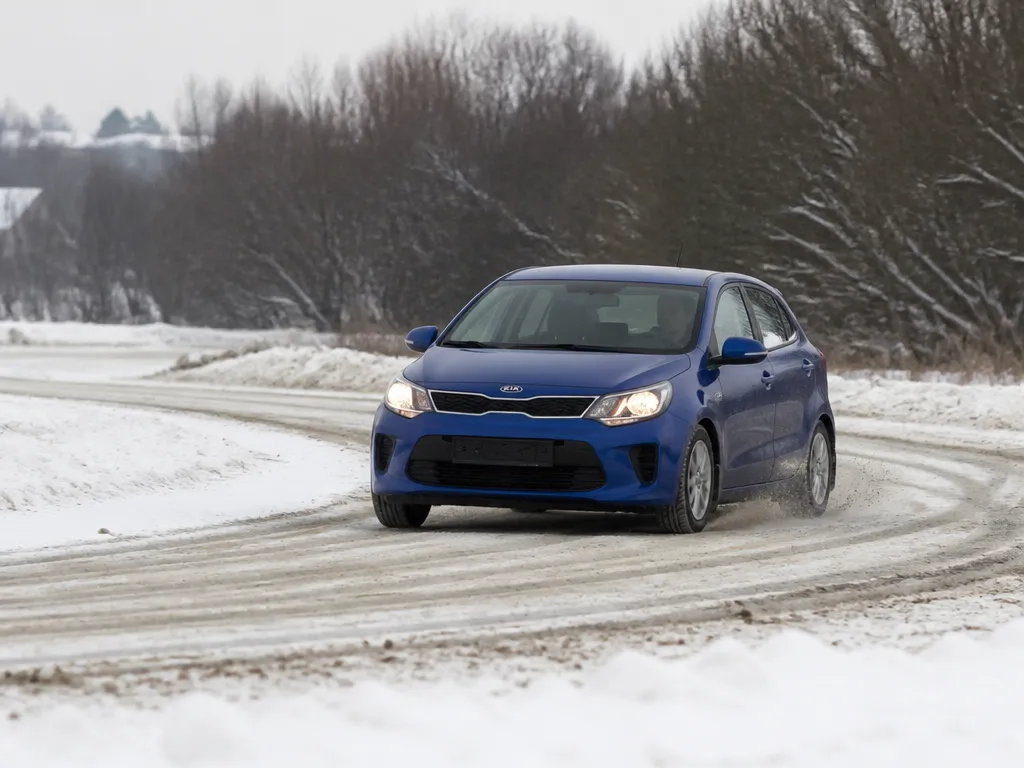
Drive the Kia Rio on winter tires and it turns in predictably, but on ice it still tends to feel “pushy” because the front-drive layout loads the front tires first. When traction falls off mid-corner, a small front-wheel-drive car like the Rio usually slips into understeer (front tires lose grip and the nose wants to keep going straight).
Why a small front-drive Rio often feels pushy in ice comes down to weight transfer and how steering torque meets limited tire grip. The front tires do steering and also handle most of the propulsion, so once the surface is slick, the tires hit their grip limit quickly. Add a steering input that is too quick, and the front end reaches that limit before the rear can help rotate the car.
Speed And Steering Input: What Changes First
Speed is the first thing that magnifies the feel. At low speeds, you can “meter” steering with small inputs and the Rio will follow your line, even if it is slow to tighten. At higher winter speeds, the front tires saturate sooner, so the car resists turning and runs wide before you realize you have less grip than you thought.
Steering input rate is the second trigger. Turn the wheel faster than the tires can respond, and the car will understeer before any traction-control intervention changes the outcome. If you combine steering with throttle in a slide, expect the front end to give up even faster because front-drive torque increases the front axle’s workload.
| Condition | Typical Rio feel | Driver adjustment |
|---|---|---|
| Firm snow with some bite | Steering feels light but controllable | Use smooth, slightly earlier steering |
| Slushy packed snow | Grip changes mid-corner | Hold a steady steering angle, reduce speed before turning |
| Shiny ice | Front end pushes, slow to rotate | Make the turn gentler, ease off inputs, prioritize braking in a straight line |
How To Regain Control When Traction Breaks Loose
Traction loss on slick winter roads usually starts at the front. General recovery is simple: ease off steering angle toward straight, reduce or remove throttle, and keep the car moving in the direction you want it to go while the tires find grip again. Avoid big countersteer swings on ice, because on a front-drive car with limited available traction, sudden wheel changes can extend the push or start a new instability.
Insider tip: If the Rio starts to run wide, treat it like a “front grip limit” problem. Slow down first, then make the next corner turn in with smaller steering inputs.
Road crowned roads, slush, and wind-drifted snow all create uneven tire loading, which changes how quickly the front reaches its grip limit. Crowns load the inside tire differently, slush can act like a lubricant pocket, and wind-drifted snow can hide patches of ice underneath. On these surfaces, make earlier speed choices and keep throttle steady through the corner entry and mid-corner.
Braking Behavior With Abs On Ice
The Kia Rio with ABS on packed snow or glaze ice will feel like steady hard braking turns into a pulsing pedal when traction is lost, and the car will spend most of the stop working for straight-line stability instead of maximum deceleration. Tire choice dominates results more than driver inputs, so a winter tire can cut real-world stopping distance far more than any “technique” change.
Abs Activation Cues You Will Actually Feel And Hear
During a hard stop on ice, ABS activates when a wheel speed drops too quickly compared to the vehicle speed. On the Kia Rio, the most noticeable cues are a pedal that vibrates or chatters in your foot and a rapid clicking or buzzing sound from the ABS modulator area.
Pulsing pedal feel is normal when ABS is working. Holding firm pressure is usually the fastest way to complete the stop, because lifting or “pumping” often resets wheel control and can extend the stopping distance.
Insider tip: If the pedal pulsates, keep your foot planted and steer to where you want to go. Steering corrections during ABS are typically smaller and more gradual than on dry pavement.
Brake Stability: What Keeps The Rio Straight
Straight-line firmness comes from stable tire contact and balanced weight transfer as the Rio slows. FWD helps keep both front tires doing most of the braking work, but the stop still depends on having tires with enough snow biting edges to prevent immediate wheel slip.
Weight transfer is real on a compact, and you will feel the nose dip more on ice than on snow. What helps the Kia Rio stay composed is correct tire pressure, tires that match winter conditions, and a brake system that is free of drag or uneven pad wear.
Limits: When Downhill Braking Turns Into Lockup Risk
Downhill braking can fool you because the car keeps wanting to accelerate relative to the road surface, even while you’re applying the brakes. On ice, the available friction is so low that ABS may cycle continuously, and any extra speed or steering input can push you beyond what the tires can control.
Brake “fade” on snow is mostly a myth in normal winter driving, since temperatures are usually lower than summer hard stops. Real-world performance changes come from colder tires, reduced rubber compliance on ice, uneven pressure, or brake hardware issues like glazed pads or uneven rotor surfaces.
For the Kia Rio, treat ABS pulses as a warning that traction is at its limit, and give yourself bigger gaps than you think you need. On ice, no amount of pedal technique can beat the physics of tire-road grip.
Best Tires For Kia Rio Snow Grip
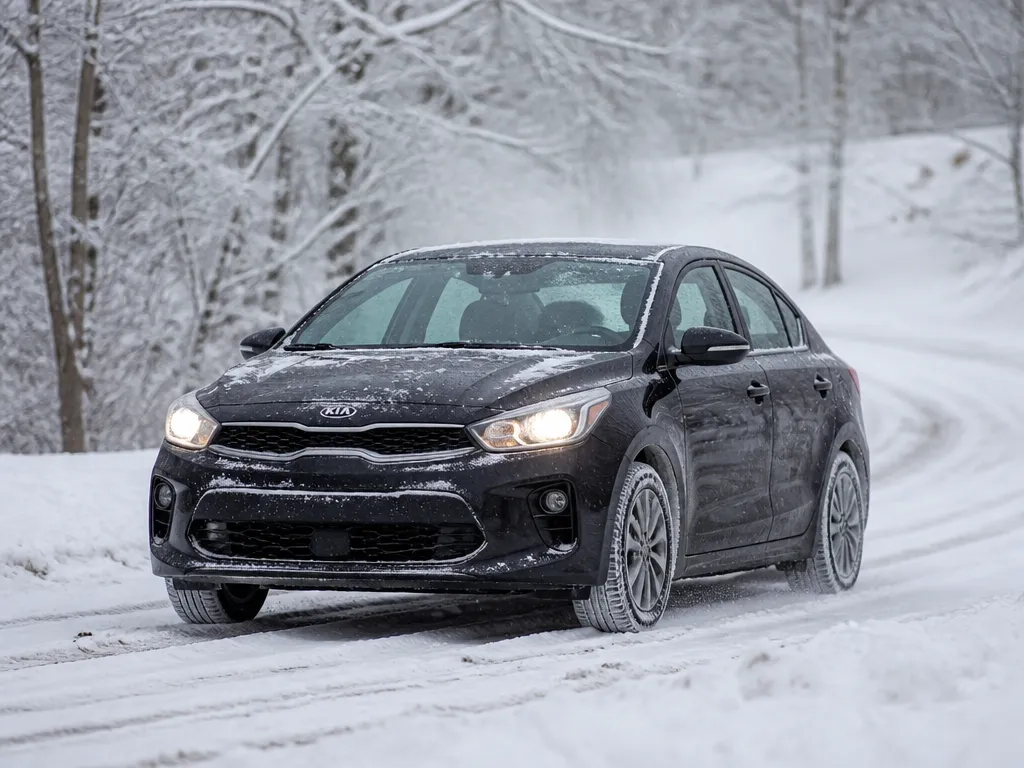
Winter rated tires grip ice and packed snow better because their rubber stays softer in cold weather and their tread pattern is designed to bite and clean out slush. All-seasons can work in light snow, but they usually lose that edge once temperatures stay below freezing and the roads turn slick.
Winter Tires Vs All-seasons On Rio Snow And Slush
On the Kia Rio, traction depends on how quickly the tire can build friction during braking and steering inputs. Winter tires use a different tread compound and more aggressive siping, so they can maintain better contact on ice sheen and reduce the slide you get when an all-season stiffens in cold.
In practice, the biggest difference shows up when the surface is mixed, with wet snow on top and ice underneath. Winter tires also keep more consistent grip as the tread wears, while many all-seasons start feeling “glossy” sooner in deep cold.
Tread Depth Targets And “Replace Now” Feel Checks
For winter performance, tread depth is a grip bank. A tire that starts the season with good tread can stay predictable deeper into the winter, while shallow tread often means longer stops and less bite on curved ramps covered with slush.
For Kia Rio owners, don’t wait for a single bad day. If you have to drive slower than your usual pace just to stay in control, that is your tire telling you winter grip is down.
Pressure Guidance, Rotation, And Matching Sizes
Cold weather drops tire pressure, and underinflation kills snow traction by squirming the sidewall and overheating the tread. Use the tire pressure on the Kia door-jamb placard as your baseline, then check when the tires are cold (morning is ideal).
Rotation and matching tires keep the Rio’s stability control and ABS working from a consistent grip level. Always keep the same tire size and speed/load rating across the set, and avoid mixing brands or models in the same axle.
Chains Vs Studs Vs Choosing The Right Tire (Realistic For A Rio)
Chains are a short-term traction tool for severe snow or ice when you cannot avoid the route. For daily driving in typical Midwest or Northeast conditions, a proper winter tire setup is usually the safer everyday solution because it improves braking and cornering before you reach the limit.
Studded tires are more aggressive on ice, but they can be louder and can wear faster on dry roads. For a Kia Rio, studded tires make sense if you regularly deal with glare ice where chains are impractical, and you are okay with the trade-offs for noise and maintenance.
| Option | Best Use on a Kia Rio | Trade-Offs | When It’s Worth It |
|---|---|---|---|
| Winter tires (non-studded) | Packed snow, slush, sub-freezing temps, predictable braking | Less bite than studs on hard glare ice | Most winter commuters and mixed-road days |
| Studded winter tires | Glare ice and repeated icy patches | Louder, more wear on dry pavement | Frequent ice where you cannot slow down much |
| Snow chains | Extreme snow or steep routes with limited grip | More effort to install, limited range on dry roads | Occasional trips into heavy conditions |
Field tip: If you only plan to use chains a few times, buy winter tires first. Chains can get you out of a jam, winter tires keep the Rio controllable every day.
Cold-start And Cabin Visibility Checks
Cold weather brings two winter issues to the front seat of your Kia Rio: weak battery output and visibility problems from fog, frost, and slushy wiper spray. A quick key-on scan plus a short defrost plan usually prevents most “I can’t see” and “it won’t crank” surprises.
Battery Health At Key-on
At cold temperatures, the battery’s voltage under load drops fast, so your Rio may crank slower even if it still starts. Watch for slow cranking, dimming headlights during crank, and a sluggish first start after sitting overnight. Those signs point to a tired battery or poor connections, since starters draw heavy current the moment the engine is asked to spin.
Before you try multiple start attempts, do these checks from the driver seat. Keep it practical, and avoid long cranking cycles that overheat components.
Cold-start Expectations For Smooth Idle And Throttle
On a Kia Rio in winter, smoothness usually improves after you clear the initial cold soak and bring engine idle up to stable operating conditions. Expect the throttle to feel slightly less responsive for the first minute, especially if traction control is monitoring wheel slip on wet ice. Let the car settle, then drive gently while the tires scrub in moisture and the drivetrain warms.
Wipers, Washer Fluid, And Defrost Strategy
Snow and ice expose two failures that show up fast on the Kia Rio: worn wiper blades that smear instead of clear, and washer fluid that turns into streaky slush. Check blade edge condition before you drive. If the rubber is chipped or leaving chatter lines, replace blades before the first hard storm, because skip streaks are a visibility problem, not a convenience issue.
Defrost works best when you clear the fastest path to a readable windshield. Start the car, set heat to direct to the windshield, and run the fan enough to push warm air across the glass without throttling the system. If you have front defrost modes, use them first, then add rear defog after the windshield is clear.
Winter Checklist For Your Kia Rio
Start every cold-weather drive with a 60-second walk-around and quick gauge check. On a small FWD Kia Rio, the most common winter issues are traction loss from underinflated or worn tires, reduced braking grip, and limited visibility from wiper fluid or frozen blades.
Quick Pre-drive Inspection (Do This Before You Pull Out)
For a compact FWD car like the Rio, tire condition is usually the traction deciding factor. If you have to choose what to fix first, fix tires and wiper visibility before you obsess over other comfort items.
Fluids And Wear Items That Matter Most In Winter
Winter-grade washer fluid and a healthy battery are the two “it always happens at the worst time” items. If your Rio is due for service, schedule oil and battery checks before the first deep freeze.
Emergency Kit For A Compact Fwd Rio
Mechanic tip: keep traction aids dry and in the cabin or trunk where they do not freeze shut. Wet sand can turn into a slick paste and helps less when you need it most.
If You Get Stuck: Safe Steps Before Asking For Help
Stuck situations usually fail because the driver keeps trying with wheel-spin. Traction comes from clearing snow and restoring grip at the tire patch, then trying again with calmer inputs.
If your Kia Rio shows repeated low-voltage behavior after trying to start, pause and reassess. Long cranking in cold conditions can drain a borderline 12V battery quickly, so move to jumper assistance or professional help before you drain it further.
Winter Driving Technique And Limits
The Kia Rio can feel “mushy” in snow because FWD puts most traction demands through the front tires, and traction control will tighten the limits when wheelspin starts. Smooth inputs keep the tires in their grip zone longer, which means less ABS pulsing and steadier steering.
Smooth Throttle And Braking, Following Distance
Backing off a little earlier beats “correcting” later, especially on slush or crusty snow where the surface changes every tire revolution. Use a light touch to keep the driveline calm, then add pressure once you know the tires are biting. ABS is there to help you stay steerable, but it cannot shorten stopping distances on packed snow the way dry pavement can.
Following distance should scale with conditions, because your stopping distance grows faster than your speed reduction. Increase time gap first, then drive slower if the gap forces constant braking.
Low-traction Stops And Uphill Traction Management
For low-traction stops, commit to braking smoothly, then hold the line. If the car begins to slide, ease off slightly to reduce tire spin and allow the ABS/traction systems to regain control instead of pumping harder. Trying to “power through” slippery stops often makes the situation worse because it keeps the front tires busy searching for grip.
For uphill grades, treat speed like a resource: maintain momentum early, then avoid late throttle changes on snow-caked ramps. If you slow too much, you may lose traction and need a restart, which is harder on snow than on a dry incline. Keep steering straight while applying throttle, then straighten the wheel before turning if you can.
Recovery Basics If The Rio Slides
Sliding is information, not a failure you can “muscle through.” Prioritize stability over steering drama: ease off throttle and steer in the direction you want the car to go while keeping inputs small. If the Rio’s systems are working, your job is to stop the chaos at the pedals, then let traction control and ABS finish the correction.
When To Change Plans: Deep Snow, Glare Ice, Visibility Collapse
Change route or timing before you reach the point of no return. Deep snow can trap the tires and overheat components if you spin repeatedly, and those repeated attempts can also dig you in faster. Glare ice is even worse, because small throttle or brake changes can cause sudden loss of control with little warning.
Visibility collapse is a hard limit, even if your tires are good. Falling snow, blowing snow, and ice fog can cut sight lines so badly that your “following distance” becomes meaningless. When you cannot see road edges, lane markings, or brake lights consistently, slow down to a speed that you can stop from what you can actually see.
Quick Summary
The Kia Rio is typically front-wheel drive. ABS, traction control, and ESC work during hard stops and slippery cornering, but stability drops quickly on ice. Expect wheelspin control through traction control and a pulsing pedal when ABS activates.
For winter setup, keep at least 4/32 tread depth and practice from about 10 to 15 mph (16 to 24 km/h) in light snow so you learn how traction control hesitates and how ABS pulses during firmer braking. Cold-start and visibility prep include checking battery health, using winter washer fluid, and defrosting early, with traction aids and a small tool kit packed before the first storm.
Frequently Asked Questions
Can A Kia Rio Really Handle Snow?
Yes, a Kia Rio can handle snow fine if you have the right tires. For winter traction, real winter tires or all-weather tires designed for cold weather provide the most useful improvement because tread compound and grip matter more than the car model name.
What’s The Kia Rio Best Practice For Driving In Snow, Like Starting And Stopping?
Use smooth inputs and give extra stopping distance, because winter conditions often reduce tire grip and increase stopping distance fast even if your brakes are in good shape.
Do I Need Winter Tires On My Kia Rio If I Have Awd?
The Kia Rio is typically front-wheel drive, not AWD. Winter tires remain important because the drive wheels are also the steering and traction wheels. Cold-weather grip depends heavily on tire compound and siping, not drivetrain alone.
How Warm Should I Let The Kia Rio Get Before Driving In Freezing Weather?
You do not need to idle forever, but do give it enough time for engine cooling and transmission temperatures to stabilize. As a rule of thumb, wait until you have clear visibility and the cabin is comfortable, then drive gently for the first few minutes to avoid harsh throttle on cold tires.
What Common Kia Rio Winter Mistake Causes Wheel Spin Or Worse Braking On Icy Roads?
The biggest mistake is pushing too hard too soon, like accelerating aggressively right after starting or braking late. If you feel traction slip, back off immediately and steer smoothly, since repeated spin usually just heats the tires and reduces grip on packed ice.
Can Road Salt And Winter Grime Affect Kia Rio Safety In Snow?
Yes. Salt can lead to corrosion on underbody components and wiring, and slush can pack around brakes and wheel areas, so it’s smart to do a winter rinse when weather allows and keep an eye on brake performance changes.