


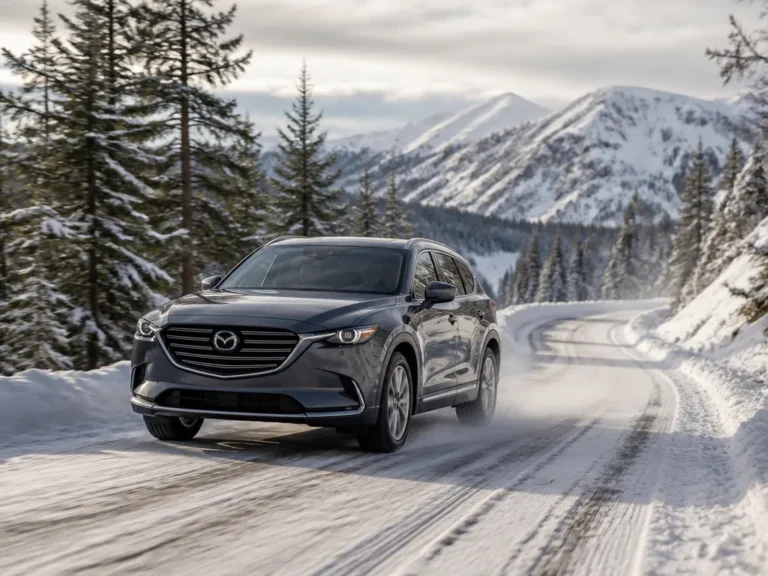
Snow day hits and your CX-9 feels like it is slipping before it even gets moving, traction control flashes, and you wonder if the AWD is doing anything or if something is wrong. You also want the real-world rules for tire choice, tire pressure, and driving technique when roads go from dry to slush fast.
Mazda CX-9 winter grip is a mix of AWD torque management, stability control intervention, and tire traction. Expect traction control to cut wheel spin and stability control to brake a slipping wheel, usually with steering feel getting tighter and the car slowing down a bit. The biggest difference comes from snow-capable tires and correct cold pressure, not clever pedal tricks.
1. Mazda Cx 9 In Snow And Winter Driving Explained
The CX-9 is a winter-focused family SUV because its higher ride height and all-season traction make day-to-day snow commutes more manageable than many lower sedans. The most important winter variable is still tire grip, since packed snow and slush expose weaknesses fast. This item belongs first because it sets up how to use the CX-9’s traction systems and what habits matter most when temperatures drop.
For example, plan on switching to winter tires (or at least a dedicated severe-weather tire) before your first hard freeze, then keep pressures set to the door-jamb spec for cold weather. When snow gets deeper, give the powertrain an easier life by using smoother throttle inputs to prevent wheel spin and driveline jerk. In slushy conditions, reduce speed for longer stopping distances and avoid sudden steering corrections that can kick the tires into a skid.
How The Cx-9 Behaves In Low-traction Situations
In practice, the CX-9’s traction management can help when you are already moving and the tires start to lose grip, but it cannot replace tire traction. You’ll typically feel this as the SUV tries to manage wheel slip through electronic control, so the best strategy is to drive in a way that keeps the system working within its limits. If you’re stuck, repeated rocking can overheat tires and worsen traction, so it’s better to improve the surface (snow brush, move to cleared areas) than keep spinning. Pay attention to the stability control and warning lights, because an active fault means the system may not be able to provide its usual assistance.
2. How Cx-9 Awd Sends Power
Power split AWD matters in winter because it decides how quickly torque reaches the wheels with the most grip when traction changes. In the CX-9, the system routes drive where it is most useful, helping you keep acceleration smoother on snowy on-ramps and during icy turns. The AWD strategy also works with the traction and stability systems, so wheel slip is controlled before it turns into loss of momentum.
In practice, the CX-9’s AWD control uses wheel-speed input and torque requests to react fast when one axle loses traction. That means you are not relying on a single rear or front axle to “hope” for grip.
For example, on a slushy highway where the surface varies by lane and depth, the system can shift torque behavior as different wheels encounter different resistance.
What Torque Transfer Cannot Fix
Even with AWD, driveline grip is still limited by tire compound and contact patch, so tires remain the biggest winter variable. If your tread is worn or your winter tires are underinflated or inconsistent side to side, the system may keep sensing slip and tighten control continuously. AWD also does not change physics: it can help you move and maintain control, but it cannot shorten stopping distances on ice, and it cannot prevent skids caused by abrupt steering or braking inputs.
3. Traction Control Intervention Cues
Traction control is constantly watching wheel speed differences, so the CX-9 in winter will often “talk” to you through subtle cues when the roads get slick. Spotting those cues early helps you correct steering and throttle before wheelspin turns into loss of momentum.
In practice, the system’s intervention behavior is one of the fastest ways to read real traction conditions on the fly.
For example, when you apply steady throttle on packed snow and the tires begin to slip, you may feel a light pulsing through the brake pedal and hear intermittent clicking from the ABS module as the car trims torque. The dash may show a traction control indicator or stability control icon depending on trim and settings, and that momentary light flicker is a hint to reduce acceleration and increase following distance. If traction control is working hard for more than brief bursts, switch to smoother inputs and consider slowing down before exiting a corner.
In practice, you can treat longer, repeated intervention as a traction “budget” warning, meaning the surface is closer to limit than you think. For the Mazda CX-9, that is most common in deep snow takeoffs, icy off-camber turns, and slushy intersections where the road surface changes every few car lengths.
Interpreting The Severity Of Intervention
Not every traction control event is the same. Short flickers, a quick pedal pulse, and a smooth recovery often mean you asked for too much torque for the moment, and the system regained grip. Extended pulsing, repeated stability control warnings, or the car feeling like it is “fighting” your throttle usually means you are riding the edge, such as on glare ice or loose snow that alternates between slick and grippy patches. If you see the indicator stay on steadily, reduce speed immediately and reassess tire condition, tire pressure, and the route, since persistent slip can point to worn tires or an underlying drivability issue.
4. Snow Mode And Safety Settings
Snow mode matters because it changes how the CX-9 sends torque to the wheels, helping reduce wheel spin when traction drops. In winter driving, that traction control calibration can be the difference between controlled starts and a frustrating, slip-prone launch. Pair those driveline tweaks with the CX-9’s stability and traction systems, and you get a much more predictable response on packed snow and slush.
Start with the basics: keep Traction Control (TCS) and Stability Control (DSC) enabled, since these systems work together with drivetrain torque management. If your trim includes a winter drive mode, use it for slow, slippery conditions like snow-covered parking lots, curbside drop-offs, and intersections where you accelerate from a stop. For normal highway plowing conditions, full-time control systems usually do the job without needing aggressive mode changes.
When To Use It
Snow mode is most helpful when traction is inconsistent, like after a thaw when you hit patches of slush, or when you roll onto compacted snow that looks uniform but grips differently wheel to wheel.
In practice, turn it on before you enter the slippery zone, then drive smoothly through the first few minutes so the control logic can respond to the grip behavior you’re providing with your inputs. If roads clear up to dry pavement, switch back to a normal drive setting so throttle response feels more natural. If the CX-9’s system indicators show traction or ABS intervention frequently, that’s a sign to slow down further and avoid additional steering or throttle changes.
5. Best Tires For Cx-9 Snow Grip
Snow performance on a CX-9 comes down to tread compound and siping, but the biggest real-world difference is having winter tires when temperatures drop. For a big, family-focused crossover, correct rubber for packed snow and slush helps you keep steering authority and shorten stopping distance compared with all-seasons. That is why this belongs in the winter-driving breakdown: tires set the foundation before AWD or traction control ever matters.
Choose a true winter tire marked with the Three-Peak Mountain Snowflake symbol, and size-match to your CX-9’s door placard (commonly 18- or 20-inch fitments depending on trim). Plan a seasonal swap, since winter tires wear faster in sustained warm weather, then set them aside around spring when roads stay above freezing.
For example, look for models that use directional or aggressive winter tread blocks plus deeper sipes, and confirm they are available in your exact wheel size before you buy.
In practice, pairing winter tires on all four corners is the safest setup because uneven tire grip can confuse ABS and traction control during sudden braking or turns.
Sizes, Tread Wear, And When To Swap
Most CX-9 owners should shop by the tire size on the driver door sticker and keep the same overall tire diameter so the ABS and traction systems interpret wheel speed correctly. If your wheels are staggered (same diameter usually, but sometimes different widths), buy the correct size for each position so sidewall height and rolling radius stay consistent. Budget-wise, plan on tires plus mounting and balancing, and expect seasonal storage costs if you swap back and forth each year. In regions with hard winters, many drivers move to winter tires around the first consistent cold snap, then switch out when night lows regularly sit well above freezing.
6. Tire Pressure In Cold Weather
Cold weather drops tire air pressure, and that changes the contact patch size Mazda CX-9 tires make with the road. A difference of just a few PSI can soften steering feel and increase the chance of tire wear patterns that show up quickly in winter miles. Keeping pressures correct is a simple win for traction and braking consistency on slush and packed snow.
For most daily driving, check pressure when the tires are cold, meaning the car has been parked for at least a few hours or driven less than about a mile. Compare the reading to the door-jamb placard spec for your CX-9 (front and rear can differ), since the placard is the target Mazda designed for. If your CX-9 uses a Tire Pressure Monitoring System (TPMS), remember the light is triggered by deviation, so waiting for the warning often means you are already underinflated.
How Far To Change It In Real Winter Use
Air pressure tends to track with temperature changes, so when it gets colder overnight you should expect lower PSI by morning.
In practice, adjust the pressure as needed to reach the placard number when the tires are actually cold, then monitor how quickly it drifts when the weather warms back up. If you are running winter tires on separate wheels, store them at a stable indoor temperature before you install them, then set pressure to the placard right away. If you see pressure that drops faster than normal or the TPMS keeps returning, inspect for slow leaks, valve stem issues, or wheel damage, since that is beyond “cold weather” adjustment.
7. Start, Stop, And Brake Technique
Snow and slush reduce tire grip, so the biggest difference-maker in a Mazda CX-9 is how gently you manage the first and last few seconds of motion. Smooth starts help prevent wheel spin, and controlled braking reduces the chance of ABS cycling and skidding. This technique is worth covering because CX-9 traction in winter is only as good as your inputs, especially on packed snow and wet ice.
Start in a higher gear than you would in summer, and ease on the throttle until the vehicle settles into a slow, straight roll.
In practice, give yourself extra distance and brake in a steady, progressive way, aiming to avoid sudden pedal moves that can trigger ABS repeatedly. If you feel the steering start to go light or the nose wants to slide, release pressure slightly, straighten the wheels, and then reapply smoothly.
For example, on a slippery driveway, the right rhythm is pause, creep, and then throttle only as much as needed to keep momentum, instead of spinning and digging in.
Tradeoffs: Abs, Engine Braking, And Pedal Feel
ABS prevents wheel lock, but it does not magically create grip. If you stand on the brakes repeatedly in deep snow, the system can pulse while the tires keep slipping, which can extend stopping distance compared with careful, earlier braking. Engine braking can help slow the CX-9 without extra brake torque, but it can also unsettle the vehicle if you downshift aggressively on slick slopes. Use gentle pedal inputs first, then adjust based on how the car tracks, because pedal feel changes quickly with temperature, slush thickness, and tire compound.
8. Hill Climbs And Packed-snow Starts
Hill starts in packed snow stress traction more than almost any flat-road maneuver, which is why this topic belongs in any winter driving walkthrough for the Mazda CX-9. When the tires spin, the automatic slip control and AWD system can only do so much before momentum bleeds away and the vehicle slows right at the slope. Knowing how to manage throttle, brake release, and wheelspin helps you keep the CX-9 moving uphill without fighting it.
In practice, take off with a smooth, gentle pedal release and low engine speed instead of “rev and dump” launches. For packed-snow starts, choose the lower-speed range (where equipped) and let the transmission build torque gradually while you keep the steering straight. If you are approaching a long grade, keep distance and plan for slower, steady climbs, since repeated wheelspin can reduce available grip even on AWD vehicles.
For example, a short stop sign hill in a snowy parking lot can turn into a long setback if you overshoot with too much throttle and have to back down and try again.
When To Use Gentle “Momentum Building”
Gentle momentum building matters most on grades where the surface alternates between compacted snow and slick patches, because that pattern breaks traction and makes wheelspin more likely. If the front tires start to slip before the rear grabs, you can feel a pause in forward progress, then a sudden lurch when grip returns. In that situation, back off immediately, reset your line, and try again with less throttle. If you hit a wall where the CX-9 cannot climb even with smooth inputs, getting moving again often takes better tire conditions (traction tires, cleaner contact patches) more than any driving technique.
9. Icy Patches And Black-ice Behavior
Icy patches and black ice are the real problem in winter because they can hide under thin snow or clear road sheen, giving you less warning than packed snow. The Mazda CX-9 can still feel “normal” while traction is gone, so this item belongs in a snow and winter driving explained checklist. Treat every cold morning and every shaded stretch as a potential loss-of-grip zone.
In practice, black ice forms when moisture refreezes on the road surface, often around bridges, overpasses, and areas that stay shaded. Even with all-wheel drive, the tires still need friction, so smooth inputs matter more than drivetrain layout. For Mazda CX-9 drivers, the best defense is matching tires to temperature, keeping tire pressures correct for the load, and leaving extra distance for longer stopping time on ice.
For example, if you notice ice under an overpass, treat it like a full traction loss event: cruise slower than you think you need, keep the steering as straight as possible, and give the brakes time to work gradually.
How To Spot And Respond
Black ice often starts small, so you may feel it as a brief loss of stability before ABS or traction systems get busy. When that happens, the right response is to ease off the accelerator and keep steering inputs mild, letting the tires regain grip instead of forcing a correction. If the road is getting worse, turn around early rather than “pushing through,” because the next corner can be the one that is truly frozen. If you ever have repeated traction control or ABS warning lights, or braking feels uneven, get the vehicle inspected, since a sensor, brake hardware issue, or tire mismatch can make an already slippery situation far more dangerous.
Adas And Visibility Limits In Winter
Winter fogging and glare can trick driver-assist cameras and radar into reducing protection, which is why this belongs in a “mazda cx 9 in snow and winter driving explained” list. Mazda’s i-Activsense-style systems depend on clear sensor views, and heavy snowfall, dirty lenses, or a windshield iced over can degrade lane guidance and forward collision alerts. Even when the system is still enabled, it may need extra driver input sooner than you expect.
In practice, keep the windshield and both front camera zones clean, since a thin film of salt mist or a cracked spot in the wrong area can upset detection. Use the front defroster and windshield wipers early, rather than waiting until the glass is fully fogged. For side window visibility, clear the mirror housings too, because winter sprays can obscure reflection-based blind-spot cues.
How Adas Behaves When Sensors Struggle
Most modern ADAS systems will change behavior when they cannot confidently read the road ahead. Expect reduced functionality when the camera is blocked, when the calibration view is contaminated, or when lighting contrast is extreme, like driving from bright snow into shadowed tree lines. In the CX-9, that typically shows up as lane-keep or forward-safety prompts becoming intermittent, with more alerts requiring quicker manual corrections from the driver. If you see repeated “system unavailable” messages after clearing the glass and mirrors, stop and check for a cracked windshield in the camera zone or mispositioned wiper blades, since those are common causes.
Winter Checklist And Troubleshooting
Winter causes fast, noticeable changes on the Mazda CX-9: tire grip drops, battery voltage sag becomes more common, and sensors can flag issues once moisture and road salt get into wiring and connectors. Keeping a short checklist for the cold-season saves time, prevents minor problems from turning into no-start or reduced braking confidence, and keeps the driver-assist systems operating as expected.
Start with a cold-weather basics sweep: check tire pressures when the tires are cold, confirm windshield washer fluid is rated for sub-freezing temperatures, and verify wiper blades clear a full swipe without streaking.
For example, in slushy conditions, a clogged cabin air filter and dirty intake can worsen windshield fogging, so inspect and replace as needed before the coldest weeks hit.
If you run into a recurring warning light, cycle the issue consistently (one trigger, one test).
In practice, record the exact message and when it happens (start-up, turning, braking, or at highway speed) because that timing helps pinpoint whether it is moisture on connectors, a sensor out of calibration tolerance, or a real mechanical fault.
Common Winter Symptoms And What To Check First
Hard starting usually points to battery condition or a fuel delivery problem, but first verify basics like correct tire pressure (rolling resistance affects how the car behaves), and ensure the battery terminals are tight and clean from corrosion. Steering feel changes in snow often come from tire choice, uneven pressures, or a partially seized brake due to salt, so pull-over checks after rough road exposure can save diagnostics time. For traction or stability interruptions, inspect for snow packed around tires or the sensor surfaces, then check that the wheels and tires are balanced and seated correctly. If warnings persist after the road dries and temperatures stabilize, professional scan testing is the fastest safe path.
Quick Summary
When the CX-9 feels like it is slipping before it even gets moving, the article points to how Mazda’s traction management works in winter, not just a simple “AWD is broken” worry. Traction control can cut wheel spin, while stability control can brake a slipping wheel, often with tighter steering feel and some slowing. AWD torque management can only work with the traction available.
Past grip basics, the article gets practical about what you should do as roads change from dry to slush fast. You may feel pulsing brakes, reduced throttle response, and occasional warnings. Cold pressure matters, so recheck after overnight temperature drops. It also covers winter tires, smooth driving, and avoiding prolonged wheel spin while stuck.
| Situation | What you may feel | What to do |
|---|---|---|
| Snow or slush with wheel slip | Throttle reduction, pulsing brakes, traction control or warning lights | Use gentle throttle and steering, brake earlier, recheck cold tire pressure |
| Packed snow or icy transitions | Stability control may tighten steering feel and slow the vehicle | Drive for longer stopping distances, avoid sudden steering corrections |
| Stuck and spinning | Repeated rocking can overheat tires and worsen traction | Improve the surface, clear snow, and avoid prolonged wheel spin |
Frequently Asked Questions
How Does The Mazda Cx-9 Handle Stopping Distance On Snowy Roads?
It still depends mostly on tires and road conditions, not the CX-9 badge. If you do not run winter-rated tires, plan for noticeably longer stopping distances on packed snow and ice. For the safest setup, use tires with the Three-Peak Mountain Snowflake rating and keep an eye on tread depth.
Should I Use Winter Tires On A Mazda Cx-9 Even If It Has All-wheel Drive?
Yes, all-wheel drive does not replace the need for winter tires. AWD can help you move and maintain traction, but braking and steering grip are tire-dependent. If you drive in temperatures that stay below about 45°F (7°C), winter tires generally work better than all-seasons.
What’s The Best Way To Warm Up A Mazda Cx-9 In Winter Before Driving?
Start it, clear snow or ice, and let it settle before you accelerate hard. You do not need long warmups in most cases, but you should wait until the engine smooths out and the cabin defrost is working well. Rushing away with the windows still iced over is a common winter driving mistake.
Does The Mazda Cx-9 Traction Control Automatically Help In Snow, Or Do I Need To Change Modes?
Traction control and stability systems can help, but you still need to drive differently. In snow, keep inputs gentle, because systems cannot overcome physics when tires are under-gripped. If your CX-9 has a selectable driving mode, use it to match conditions, but do not rely on it to “make up” for worn tires.
Why Does My Mazda Cx-9 Feel Like It Slips On Snow Even With Awd?
Most “AWD but still slipping” problems come down to tires, tire pressure, or technique. Check tire pressure when cold, inspect tread for uneven wear, and make sure you are using the right winter tire type for your typical snow and ice. If you notice persistent loss of traction plus warning lights, get it checked by a shop.
What’s The Biggest Winter Maintenance Item For A Mazda Cx-9 Before A Snow Season?
Tires and brakes are your biggest safety lever. Confirm you have enough tread, consider snow-ready tires for your climate, and make sure your brake performance is solid before the first storm. Also verify windshield washer fluid is rated for freezing temperatures, since visibility is what you rely on first in winter.