


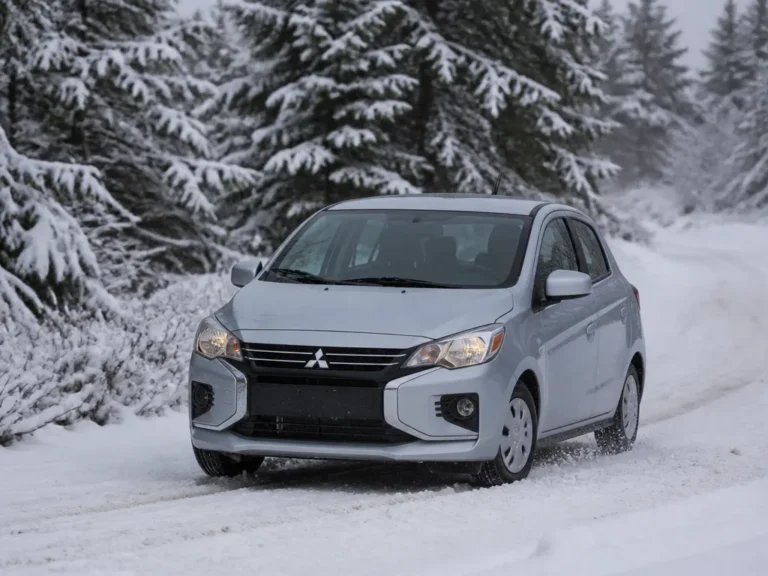
You’re staring at a snowy driveway and your Mitsubishi Mirage is due to make the trip. Maybe traction control is blinking, wheelspin starts early, or you’re wondering if all-season tires are enough. This small FWD car can do light winter driving, but snow depth, tire choice, and how you manage throttle and braking decide whether it feels confident or scary.
Mitsubishi Mirage is front-wheel drive, so expect more front-wheel wheelspin on slippery starts. All-seasons work in light snow, but dedicated winter tires improve bite on packed snow and ice. In the rest of this guide, you’ll get Mirage-specific setup tips, real driving tactics, and a winter checklist for keeping stopping distances and steering control predictable.
Mitsubishi Mirage in snow depends on front-wheel traction, tire grip, and clearance. With FWD, throttle needs to be gentle to avoid wheelspin on packed snow. All-seasons can handle light snow, but winter tires bring better braking feel, especially below 40°F (4°C), when rubber stiffens.
Mitsubishi Mirage In Snow And Winter Driving
Front-wheel drive (FWD) is the Mirage’s biggest winter reality, because the drive wheels are also the steering wheels. In snow, grip is mostly tire and surface related, so the car can feel controllable on packed snow but gets traction-limited fast on ice. The Mirage can still drive safely with the right tire choice, smoother inputs, and lower expectations for hard acceleration.
What Fwd Means On Ice
On ice, the Mirage transfers all the traction demand to the front tires, so wheelspin shows up quickly when you add throttle. Steering typically feels “busy” when the front tires start to slip, because both traction and direction depend on the same contact patch. Lift-throttle control is usually better than trying to power through slippery patches.
Mirage ground clearance is modest, so slush can bring drag from snow packed near the rocker panels or front underbody.
In practice, that means you should avoid deep, wet slush at speed and pick a route with cleaner pavement when possible. Cold-start behavior is also noticeable, so give the car a minute to settle, then drive gently until the tires and brakes come up to winter operating feel.
Traction Control And Abs: What You Will Notice
When traction control activates, the Mirage will reduce engine power and may feel like it briefly “backs off” your throttle input. That is a normal response, but it is a clue that your tires have already reached their grip limit. With ABS, braking can pulse through the pedal and you may hear pump noise, which indicates the car is preventing wheel lock on slippery surfaces.
Expect both systems to work harder in snow and ice, especially during takeoffs from stops and during emergency braking. Steer into the direction you want to go, and avoid sudden, large steering changes while braking or regaining traction after a slide begins.
Realistic Snow Severity Tiers For The Mirage
Mirage winter drivability changes more with surface condition than with temperature. Treat snow as a spectrum from “rolling resistance only” to “instant wheelspin and delayed recovery.” Use these practical tiers to set your pace and plan.
| Surface tier | What you feel in the Mirage | Driver adjustment |
|---|---|---|
| Light snow | Softer turn-in, mild traction control flashes | Stay smooth, keep following distance |
| Packed snow | Throttle limits appear quickly, ABS comes sooner | Increase spacing, avoid quick power bursts |
| Slush | Wheelspin risk rises, brakes feel “busy” | Reduce speed before braking, steer steadily |
| Ice | Traction control works often, steering sensitivity rises | Use the lowest practical speed, brake in straight lines |
Winter rule for the Mirage: traction is limited by the front tires, so the safest “upgrade” is driving technique. Smooth throttle and a wider buffer give the car room to recover when the front end reaches grip limits.
Fwd Traction Limits And Wheelspin
Mitsubishi Mirage drivetrains are front-wheel drive, so traction is limited by how much grip the front tires can generate under acceleration. On snow, the Mirage will usually spin the front tires first because engine torque goes straight to the same tires that must also steer. When grip runs out, traction control tries to save you by cutting engine torque and, in some cases, braking a spinning wheel.
Front-wheel Bias, Torque Steer Feel, And Why It Spins First
Front-wheel drive concentrates both tasks, pulling and steering, into the front contact patches. On packed snow or slush, the first thing you feel is a quick surge to wheelspin as you roll into the throttle, then the car stabilizes as traction control intervenes. The Mirage’s short wheelbase can make this feel “twitchy,” especially when the road has slick spots that load and unload the tires quickly.
For example, when you start from a stop and the nose dips then lifts slightly, weight shifts forward and gives the front tires a brief grip advantage. If you then add too much throttle, the tires break loose immediately, and the front end can pull left or right depending on tiny differences in tread bite and road texture. That drift is a normal symptom of limited front grip on FWD cars, not an automatic sign of a drivetrain fault.
Throttle Modulation To Avoid Spin, Wheel Hop, And Flinchy Traction Control
Throttle control matters more in a Mirage than it does in a higher-traction vehicle because the car is light and the front tires are doing the work. Use smooth inputs, aim for a steady crawl on takeoff, and avoid “stab and release” throttle. If you hear rapid oscillation (engine surging) or the car feels like it is bouncing, ease off immediately, you are past the tires’ traction limit.
Wheel hop comes from trying to accelerate during partial traction, where the tire repeatedly gains and loses grip.
In practice, a slightly higher starting gear (or a calmer launch with less pedal) helps keep the driveline from oscillating on glare ice. Keep in mind that traction control may feel abrupt in snow, it is trying to reduce torque fast when it detects wheel speed difference.
| What you feel in the Mirage | What it usually means on snow/ice | Driver correction |
|---|---|---|
| Front tires spin on takeoff | Front grip is saturated, throttle request exceeds tire traction | Use gentler pedal, start in a lower, steadier crawl, avoid sudden throttle changes |
| Car lunges then settles | Traction control cuts torque, then grip returns as speed drops | Modulate to a smooth, constant output, let the system do its job |
| Steering pulls left/right during wheelspin | Uneven bite between left and right front tires and micro-slippage | Hold steering steady, reduce throttle, correct slowly |
| Vibration or bouncing under acceleration | Wheel hop from repeated traction gain/loss cycles | Lift off to reestablish stable traction, then apply throttle gradually |
| “Grabby” response in slush | Slush packs into tread intermittently, grip changes with tire contact | Drive slower, keep inputs smooth, increase following distance |
Weight Transfer, Twitchiness, And What To Expect On Stops And Starts
When you brake, weight moves forward, which can help the front tires keep traction while the rear is more likely to lighten. When you accelerate, weight stays forward and further increases front tire load, but the Mirage’s light mass means the tire still reaches its grip limit quickly on snow. Short-wheelbase cars respond faster to changes in load, so a small pedal adjustment can create a noticeable change in yaw and direction feel.
For example, at an icy stop sign, the Mirage may feel “ready to move” once the tires find a little bite, then slide if you overshoot with throttle. During rolling starts, keep the car’s nose stable by using gentle brake release, then apply power smoothly. If you feel the front tires break loose, back off and reapply rather than trying to power through it, that approach keeps the front end from skating unpredictably.
Practical rule for Mirage snow starts: prioritize smooth, low-throttle engagement. If you notice the steering or body reacting quickly, lift sooner than you think, because the front tires hit their traction limit fast on compact FWD cars.
Winter Tires Vs All-seasons
All-seasons can work in light, short-lived snow, but they lose braking grip fast once roads turn slushy or temperatures drop into the teens Fahrenheit. Winter tires keep more usable bite because their tread compound stays softer in cold weather and their sipes open up for snow pack traction. For a Mitsubishi Mirage, that difference matters because hard braking and throttle corrections in a front-wheel-drive subcompact are where traction disappears first.
All-season Reality On Packed Snow And Slush
On a Mirage, all-seasons usually feel “okay” on the first clean pavement pass, then grip falls off when you hit packed snow or a wet slush layer. Slush acts like a thin lubricant film, so your stopping distance grows and ABS may cycle more often than you expect.
In practice, use these limits as a sanity check:
A Mirage is light, so tire grip is the whole game. Once the tires saturate in slush, you feel it quickly in both braking and wheelspin.
Dedicated Snow Tires: Why They Help A Small Fwd Car
Dedicated snow tires use more aggressive siping and a cold-weather tread compound. Warmer all-season rubber can stiffen when it gets cold, which reduces how well the tread edges bite into snow and thin ice.
When you mount winter tires, Mirage braking and launch control improve because the tire keeps lateral and longitudinal grip longer, so you spend less time fighting traction systems.
| Condition | All-season on a Mirage | Winter tire on a Mirage |
|---|---|---|
| Cool, dry roads | Good enough, no drama | Good grip, slightly louder feel |
| Light snow | Usually manageable | More consistent bite |
| Packed snow | ABS distance increases | Shorter stopping and more control |
| Slush | Fast grip loss | More resistance to saturation |
Pressure Checks In The Cold And Tread Wear Effects
Cold weather drops tire pressure, and underinflation makes snow grip worse by reducing tread support and increasing sidewall flex. Measure with a cold tire gauge, ideally after the car has sat overnight, and adjust to the door-jamb specification for your Mirage.
Tread wear also hurts winter performance. Worn grooves and fewer functional edges mean less ability to evacuate slush and less biting surface for sipes.
Studded Tires And Chains: When It’s Worth The Hassle
Studded tires can help on glare ice where the pavement stays hard and smooth, but they add noise and can reduce wet-weather comfort. Chains are a tool for specific road conditions like steep, snowy grades or when authorities require them, and they demand careful installation and removal.
Legal rules vary by state and country, and requirements can change by road class. If you run into frequent hard-packed ice, check your local regulations before spending money, and plan for the added wear and install time.
Ground Clearance And Slush Scraping
The Mirage’s lower ride height means the underbody sits closer to packed snow and plowed slush, so it can scrape sooner than taller cars. Slush also acts like a thick “grinder” that can reduce tire bite and trap heat around the engine area.
For winter driving, treat road texture as the bigger enemy than snowfall amount. When slush builds up, it can slick the tire tread and leave a reflective layer that delays braking and acceleration response.
What Slush Buildup Does To Traction And Cooling
Slush packs into the tire grooves and under the fender liners, turning a normal all-season tread into a smooth rubber sheet. FWD grip drops first at launch, then again mid-corner when the loaded tire gets saturated and spins briefly.
Slush can also blanket the lower grille area and crawl into places that normally shed heat airflow. More engine and trans heat happens when airflow is blocked, and the Mirage’s compact packaging gives less “air gap” for that slush to move out.
Driving Lines: Staying Out Of Ruts And Hidden Snow Banks
Ruts and windrow edges hide thicker snow than you see from a distance. For a Mirage, the safest line is usually the one that keeps the tires on cleared pavement or light wash, not the “chewed up” trench that looks passable.
For example, when approaching an intersection after a plow, avoid the outer edge where snow gets pushed up into a slushy berm. That berm is where you end up contacting the underbody or packing slush into the wheels and wells.
Underbody Protection And Inspection Tips After Harsh Storms
Mirage owners get the best payoff from prevention, not hero moves. Keeping the undercarriage clean after heavy slush days reduces the chance of packed debris holding moisture against components and limits how much material gets dragged into the wheel wells.
For instance, after a storm where you drove through standing slush, do a quick visual inspection with good light. Focus on the front air intake area, splash shields, and any underbody panels that could have loosened from impact.
Rule of thumb: If you feel a new vibration, hear scraping, or see fresh snow packed behind the wheel, treat it as a “pause and clear” situation. A few minutes of checking can prevent a damaged splash shield or deeper tread packing.
Abs, Braking, And Stability In Snow
ABS can reduce wheel lockup on the Mirage so you can steer during hard braking on slick roads. On snow and ice, ABS pulsing feels like rapid brake pedal vibration, and grip limits still control how short the car can stop. The key driver skill is steering gently through the pulse instead of yanking the wheel.
Abs Pulsing: Keep Steering Input Smooth
On a FWD Mitsubishi Mirage, the front wheels do most of the work for steering and braking, so when traction drops the ABS cycles more often. You may feel the pedal chatter and hear the pump, which is normal when the system is preventing lock. Hold the brake pressure firmly, but don’t release and reapply repeatedly, because that can interrupt the ABS grip management.
For staying pointed in a straight stop, keep steering angle small and planned. For turns while braking, you can still steer, but the car has less available friction to do both braking and cornering at the same time, so expect slower turn-in and more understeer.
Traction Control Behavior: Braking Vs Coasting Vs Accelerating
Traction control on the Mirage reacts to wheelspin by reducing drive torque, and it can intervene differently depending on whether you are braking, coasting, or accelerating. During braking, ABS is the priority, so traction control may feel less active because the wheels are being managed by the hydraulic anti-lock strategy. During acceleration, traction control is more obvious because it has to calm wheelspin right away.
Coasting is usually the smoothest mode because the drivetrain torque is lower and the front tires are less likely to jump from grip to slip. Hitting the throttle again after the car regains traction can trigger a new burst of wheelspin, so roll on progressively.
| Surface | Braking feel (ABS) | Stability expectation |
|---|---|---|
| Powder | ABS may cycle frequently because tires sink and regain grip | Good chance of straight control if steering is smooth, longer distances |
| Packed snow | ABS pulsing is common on harder stops, pedal vibration is sharp | Steering works, but expect extra understeer if you turn while braking |
| Slush | ABS can pulse early as tires ride on a mix of ice and water | Stability can feel “floaty,” stopping distance grows quickly |
| Black ice | ABS may pulse fast with very little deceleration available | Steering help is limited because grip is extremely low |
Real-world tip: On slick roads, leave extra following distance and plan to brake in a straight line first. If the Mirage starts to feel less stable, easing off the steering and reducing brake force usually makes it calm down faster than fighting it.
Stopping distances change because the tire contact patch is less consistent on snow and slush. When the tire briefly loses grip and then regains it, the car can decelerate in pulses rather than smoothly, which is why the driver feels ABS chatter and sees longer roll to a stop. Cold temperatures also stiffen tires and can reduce grip, especially if road water freezes on top of snow.
Snow Driving Scenarios For The Mirage
Mitsubishi Mirage drivetrains are simple and predictable in light to moderate snow, but traction limits show up fast on steeper hills and packed ice. Front-wheel drive means the front tires do the work for starts, turns, and climbs, so wheelspin is usually your first warning sign. The car can be controlled if you drive early, slow down for inputs, and plan exits before you commit to the throttle.
Starting On Snowy Grades: Momentum Vs Torque Management
On a snowy incline, the goal is to avoid a big torque spike that spins the front tires. Momentum helps, but too much speed makes braking harder and steering less precise. With the Mirage, start your approach earlier and aim for steady throttle rather than a “hard pull” up the grade.
For example, if the road is banked or half-cleared, keep the car centered and build speed only on the flats before the hill. Once you begin the climb, use a smooth, gradual increase in pedal to keep traction control active (if equipped) without digging a rut with spinning tires.
Accelerating From Stops: Pedal Positioning And Launch Timing
Mirage control in snow is all about timing, since a short stop on slippery pavement can turn into a long slide if you jump the throttle. A low, steady pedal position usually gives the front tires better bite than a sudden start. Plan for a little more distance than normal because even with good traction, acceleration is slower.
For instance, at an intersection after a snowfall, allow the engine and mirrors to warm while you check the street surface. If the crosswalk area is shiny or wet-looking, expect ice under the snow and use a longer gap before you move.
Turning On Snow And Ice: Slower Entry, Wider Radius, Smoother Steering
In snow, turning is where FWD cars most easily lose traction because the front tires steer and accelerate at the same time. For the Mirage, make turns more gradual by starting earlier, using a wider radius, and keeping steering angles smaller. Smaller steering inputs keep the tire contact patch loaded more consistently.
For example, when entering a snowy corner, slow down in a straight line first, then steer smoothly at a reduced speed. If you wait to turn while accelerating, the car will tend to push wide (understeer) as the front tires lose grip.
Braking Technique: Distance Planning And What Changes On Each Surface
Brake behavior changes dramatically with surface type, even when ABS is active. On packed snow, braking distance often feels longer, and the car may feel vague until speed drops. On slushy snow, tires can ride up on uneven layers, so braking can feel inconsistent from one block to the next.
For instance, icy patches tend to grab suddenly. Pulse-feeling is common because the tires alternate between limited grip and brief contact, so reduce speed earlier and keep steering straight during braking.
| Surface you’re braking on | Mirage driver feel | Technique change |
|---|---|---|
| Packed snow | Longer, steadier decel until traction falls off | Brake earlier, keep pedal pressure smooth, avoid late braking |
| Slush | Decel can vary due to depth changes | Increase following distance, brake in a straight line, reduce speed before dips |
| Shiny ice | Sudden loss of grip, steering sensitivity increases | Brake well ahead, avoid steering while braking, accept that stopping distance grows fast |
Insider tip: When you need to slow and turn, finish braking in a straight line first, then transition to turning. In snow, mixing heavy braking with steering angles is how small traction losses become big ones.
Mirage Cold-start And Defrost Checklist
Mitsubishi Mirage cold starts in winter depend on battery strength, correct coolant condition, and clear windshield vision before you drive. A little prep also reduces fogging, which matters fast in a small FWD car when you need steady traction and predictable braking.
Battery, Fluids, And Cold-start Health
Before a deep-freeze weekend, check the basics because weak cranking causes long starts, higher starter load, and more chance of leaving condensation on cold glass. Mirage engines tolerate cold weather well when fluids are right and the battery can deliver cranking amps without sagging.
For example, in many cold climates, people top off washer fluid too late and then end up with partial freeze, which leaves you unable to clear salt spray or slush off the windshield during the drive.
| Checklist Item | What to Inspect | Target | Why it matters |
|---|---|---|---|
| Battery | Load test, terminal cleanliness | Strong voltage under load | Faster starts, fewer no-start events |
| Coolant | Reservoir level, correct mix | No low level, correct freeze protection | Prevents freeze and heat-control issues |
| Washer fluid | Freezing rating, fill level | Below your coldest temps | Visibility when road spray hits |
| Tire pressure | Cold pressure check | Set to door-jamb spec | Better grip and steering response |
Wiper, Defrost, And Anti-fog Habits For Winter Visibility
Mirage visibility failures usually happen before traction failures, fog on the windshield can start within minutes after you pull out. Good wiper condition and deliberate defrost habits keep the driver in control while FWD traction limits still exist on snow and ice.
Mechanic tip: Scrape or brush ice first, then use defrost. Hot air on thick ice can create cloudy meltwater that refreezes along the edges.
Emergency Kit And Traction Aids For A Compact Fwd
Mirage is front-wheel drive, traction depends on the front tires gripping the surface. In snow, you cannot “out-accelerate” ice, so plan for a slow recovery if you get stuck in a parking lot or after a light snowfall.
For instance, if you need to get moving in deep, clean snow, traction mats under the driving wheels are often easier than chains for a first attempt, but chains may be necessary for repeated attempts on harder-packed conditions.
When Not To Drive In Winter
Ice, deep slush, and hydro-slush can take the Mitsubishi Mirage’s traction and steering away fast. Mirage is a light front-wheel-drive subcompact, so once you sink a drive wheel or hit a slick patch you can run out of control quicker than you expect.
Hydro-slush And Near-buried Wheel-rut Scenarios
Hydro-slush is especially dangerous for small cars because the tire contact patch turns into a thin “planing” layer. For the Mirage, that means the ABS can pulse and the car can still feel like it is sliding on top of the water and snow mix.
For example, when you see tire tracks that are half-full of slush, staying in the rut can help you ride on compacted ice, or it can drop you deeper until the tire sidewall starts riding on snow. If you feel the steering go light and the tires sound louder, treat that as a stop-and-inspect trigger before you commit to a longer stretch.
Black Ice And Uncontrolled Slicks: Patterns And Escape Routes
Black ice is hardest to spot, so you need pattern recognition. Mirage drivers should treat bridges, shaded overpasses, and the first 20 to 50 yards of a shaded downhill as “ice zones” until conditions prove otherwise.
In practice, escape routes matter more than speed. If the next lane looks clear but the shoulder is snow-filled, it is often safer to slow early and choose the widest low-commitment path than to try to thread between slick patches at the last second.
Ground-clearance Limits: Deep Slush, Snow Drifts, And Scraping Risk
Deep slush and snow drifts can exceed the Mirage’s usable clearance even when the road still looks “passable.” Once the car’s underbody meets packed snow, steering response gets delayed and you can lose momentum where you need it most.
For instance, if the front end starts to push through snow and you hear scraping or feel a harsh drop when crossing a crest, you should stop. Continuing can damage components and it can also bury a drive wheel so traction control and ABS cannot recover you.
Brake And Steering Warning Signs That Mean “Stop And Inspect”
On the Mirage, braking and steering cues tell you quickly whether traction is recoverable. If the pedal behavior changes or steering becomes inconsistent, you should stop in a safe location and inspect before trying to push through.
If you need multiple attempts to get moving through the same slick patch, that is the car telling you conditions exceed what the tires and traction limits can manage. Turn around early or wait until plows and sanding improve the surface.
| Condition | What you may feel | What to do |
|---|---|---|
| Hydro-slush | Skate feeling, ABS activity, delayed response | Slow early, avoid lane changes, stop if steering steadiness drops |
| Near-buried ruts | Pull to one side during braking, loud tire noise | Stop and back out if safe, avoid committing farther |
| Black ice | Shiny surface, sudden loss of grip after a transition | Do not accelerate through it, reroute if available |
| Deep slush/drifts | Scraping, push through snow, harsh drops | Stop and inspect for wheel and underbody obstruction |
Quick Summary
The Mirage’s biggest winter reality is its front-wheel-drive layout, since the drive wheels are also the steering wheels, so traction is quickly limited by what the front tires can grip. In light snow, it can stay predictable if the tires have tread and you keep throttle gentle, but on ice the car becomes highly throttle-sensitive and wheelspin shows up fast. All-season tires can handle light snow, yet the article calls out that dedicated winter tires improve bite on packed snow and ice, especially as temperatures drop.
Cold-weather control comes down to smooth inputs, proper tire condition, and avoiding nasty surface conditions. Below 40°F (4°C), the article notes winter tires help because rubber stiffens in colder temps, improving packed-snow braking feel and steering consistency. It also warns to avoid deep slush because the Mirage’s modest clearance can scrape and reduce traction, to expect ABS pulsing and traction control reducing engine power, and to steer into your intended direction while braking. The most important takeaway is matching tire choice and driving inputs to surface conditions, not just the weather.
| Surface tier | What you feel in the Mirage | Driver adjustment |
|---|---|---|
| Light snow | Softer turn-in, mild traction control flashes | Stay smooth, keep following distance |
| Packed snow | Throttle limits appear quickly, ABS comes sooner | Increase spacing, avoid quick power bursts |
| Slush | Wheelspin risk rises, brakes feel “busy” | Reduce speed before braking, steer steadily |
| Ice or glare ice | Traction control works often, steering sensitivity rises | Use the lowest practical speed, brake in straight lines |
Frequently Asked Questions
Is A Mitsubishi Mirage Good In Snow, Or Is It A Winter Liability?
The Mirage can handle light snow if you drive it like a small front-wheel-drive car, but winter safety depends more on your tires and braking than the badge. For snow, prioritize fresh winter tires (or at least 3-season tires that are rated for severe snow) and keep speeds conservative.
What Winter Tires Work Best For A Mitsubishi Mirage In Icy Conditions?
Look for tires with a 3PMSF snowflake rating and good tread depth, because icy traction drops fast when tread is worn. If you only have one upgrade, spend on tires first, since they do the heavy lifting for stopping and cornering in snow.
How Do I Prevent Wheel Spin When Starting Off In Snow With A Mitsubishi Mirage?
Use gentle throttle, start in a lower-traction situation, and avoid “digging” by flooring it when the wheels spin. If you have traction control, keep it enabled, and expect it to reduce wheel spin but not create grip where there is none.
Why Does My Mitsubishi Mirage Feel Like It Wants To Slide In Winter, And What Should I Check First?
Most winter “sliding” issues come from tire grip problems like worn tread, low tire pressure, or the wrong tire type for snow and ice. Also check basic items like brake performance and alignment, because even mild pull or uneven braking can make a small car feel unstable on slick roads.
Do I Need An Engine Block Heater For A Mitsubishi Mirage In Freezing Weather?
For very cold starts, an engine block heater can make starting easier and reduce wear, but it is not automatically required. Use common sense, if it is extremely cold where you live, and follow your owner manual guidance on cold-weather starting and recommended maintenance.
What Is The Most Common Mistake People Make Driving A Mitsubishi Mirage In Snow?
The biggest mistake is relying on a “careful” driving mindset while using the wrong tires or driving with low tire pressure. Always set tires to the recommended pressure for cold temperatures and upgrade to snow-rated tires before the first real storm.