


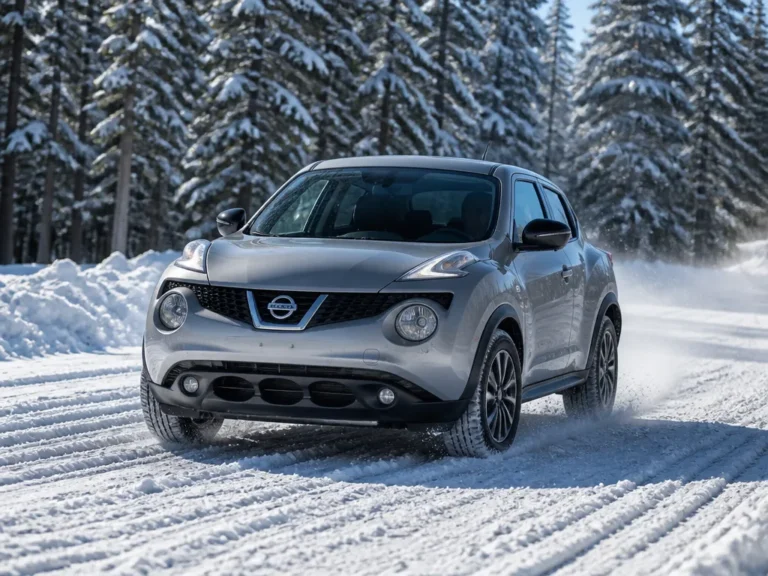
You’re fine until the first real snow hits, then your Nissan Juke feels like it slips earlier than your buddies’ crossovers. Maybe it’s the moment you step on the gas, or how it behaves when you brake on slick slush. This is the Juke in winter reality, with model-specific differences that actually matter.
Expect traction to drop fast once roads go from packed snow to ice, and steering feel to change when tires lose grip. The outcome depends heavily on your Juke’s setup, with FWD typically doing better than you think on light snow and AWD trims (where equipped) helping on harder starts. You’ll get tire, pressure, and technique tips plus what the safety systems do when they intervene.
Nissan Juke in snow and winter driving depends on drivetrain and tires: FWD Jukes usually feel safest in packed snow at steady throttle, while ice demands gentle inputs and longer stopping distances. When stability and traction control kick in, expect pulsing brake feel and reduced engine power within seconds. Winter tires with tread depth near 6/32 in help the most.
Nissan Juke In Snow And Winter Driving: What Changes By Trim
Winter behavior on a Nissan Juke mostly changes with two things: drive layout (FWD versus AWD) and how the transmission manages wheel slip. Tire choice and tire size then set the ceiling for traction and braking, even with the same trim.
Juke sold in North America typically uses a CVT on many trims, and that matters in snow because the drivetrain will protect itself by limiting torque when it senses slip. Check your door-jamb tire label for your exact tire size and load rating, since the same trim name can wear different tires by model year and region.
Model-year And Drivetrain Confirmation (What To Verify)
Before you judge how your Juke behaves on ice, confirm the following from the vehicle sticker or owner documentation: drive type (FWD or AWD), transmission type (often CVT on Juke), and the exact tire size (example: 215/60R17 type formats). Those details determine how much sidewall flex you get, how quickly ABS triggers, and whether traction control feels gentle or intrusive.
Practical rule: the same AWD system can feel “slower” in snow because it shifts power management to keep the tires from spinning. Likewise, a FWD Juke can feel perfectly competent in packed snow until you hit glare ice, when you will still get wheel slip at the powered wheels.
Fwd Juke: Traction Limits And Typical Slip Patterns
FWD puts all the drive torque through the front tires, so acceleration traction comes down to how well the front tread can bite. In packed snow, you usually feel controlled slip first, traction control pulses, and the car may hesitate slightly as it modulates throttle and brake torque.
In practice, the most common winter pattern on a FWD Juke is “front end goes first.” When the road gets icy, the front tires spin sooner, steering may feel a bit “light,” and braking can become less predictable if you are relying on cold tires with shallow or hardened winter tread.
Awd-equipped Juke: What Awd Can And Cannot Fix
AWD helps keep the car moving when one axle loses grip, so it can reduce front-tire spin during takeoff and help the vehicle pull through light snow. AWD does not eliminate physics, so on pure ice you still need tire friction for steering and stopping, and you can still get an understeer slide if the tires cannot generate lateral grip.
AWD also cannot “correct” bad tires. If your tires are all-season and have less tread depth, AWD may keep the car from bogging on acceleration, while braking and cornering still depend on tire grip and contact patch stability.
| Situation | FWD Juke | AWD Juke |
|---|---|---|
| Launch on packed snow | Front wheel spin limits torque early | More consistent crawl out as grip shares improve |
| Glare ice | Spin happens fast, steering can feel vague | Spin may be reduced, stopping and steering still limited |
| Brake on slick mix | ABS controls lockup, distance still grows with low friction | ABS still governs, improved traction does not fix ice friction |
Cvt Feel In Winter: How Logic Changes With Slip
A CVT can feel “different” on snow compared with a stepped-gear transmission because it tries to prevent excessive wheel speed differences. When traction control senses slip, the CVT’s torque delivery can become more muted, so the car feels like it is holding back even if your foot position stays steady.
In practice, that is a benefit when you want stability, but it can surprise you if you expect immediate response. Gentle throttle applications and earlier braking inputs reduce the chance you will provoke traction control cycling, which makes the car feel inconsistent.
Wheel And Tire Basics: The Biggest Change You Can Make
Tire traction is the limiting factor for both FWD and AWD Juke setups. Tire pressure matters in cold weather because underinflation reduces contact patch efficiency, while overinflation can reduce grip as the tire rides on a smaller portion of the tread.
For winter driving, prioritize the correct tire size and a winter-appropriate tread pattern. Dedicated winter tires usually outperform all-seasons on ice and deep cold snow, and staying matched across all four corners helps traction control and ABS behave predictably.
Mechanic tip: If you feel the Juke “works” in snow but struggles on braking or corner entry, check tires first. Drivetrain type helps, but winter tire grip is what moves the stopping distance and steering confidence the most.
Traction On Takeoff: Packed Snow Vs Ice
Packed snow usually lets the Nissan Juke move with steady, cautious throttle, because the tires can “bite” the snow even when the surface is slick. Ice is the opposite, the tires lose the ability to generate normal grip fast, so the Juke feels delayed, then intermittently surges as traction control clamps wheelspin.
For a FWD Juke, packed snow often feels progressive. The CVT (common on many trims) will hold engine speed while the traction-control system meters torque, so you feel brief traction-control pulsing as the tires alternately slip and regain grip. When you ease into the throttle, the pulsing is smaller and the launch feels calmer.
For example, on a flat road covered in compacted snow, roll on to about 15 to 25 percent throttle and keep it there. Expect a soft surge, then a light “stutter” (traction control braking the slipping wheel) until the tires find a stable shear layer in the snow. If you go harder, the Juke will respond quicker, then traction control intervenes sooner, making the response feel choppy.
Light snow is trickier because the Juke can alternate between “suction” and spin as the tire tread repeatedly cuts through a thin layer. When you start from a stop, the first few feet may feel smooth, then the traction suddenly drops as the tire digs down to something colder or slightly glossy underneath.
Insider tip: In light snow, the most common mistake is adding throttle right when the car slows down. Give the tires another half-second to regain traction instead, then continue.
Icy grades are where the Juke can feel like it is stuck even if the engine is making power. Ice reduces friction so much that traction control has to clamp wheelspin by braking a driven wheel, and the CVT will keep the engine near its efficient range while the system fights slip. The result feels like forward motion is “limited” even though you are pressing the accelerator.
Wheelspin signs on the Juke include an immediate RPM rise with little vehicle speed change, tire chirp that sounds sharper than you would get on snow, and steering wheel vibration that increases under load. Wheelspin also makes it easier to build a slick layer under the tires, so each attempt can get worse. Flooring it often trains the car to keep slipping while traction control repeatedly interrupts torque.
| Surface | What you feel from a stop | What traction control does | Best launch approach |
|---|---|---|---|
| Packed snow (flat) | Soft surge, minor pulsing with harder inputs | Reduces torque by braking the slipping wheel(s) | 20 to 25 percent throttle, smooth steady roll-on |
| Light snow (variable) | Smooth for a moment, then grip drops and surges | Stops wheelspin, then re-allows torque as grip returns | Small increments, pause when deceleration happens |
| Ice (especially up a grade) | Feels “stuck,” RPM rises, speed barely increases | Frequent wheel braking to limit slip, CVT holds engine range | Gentle throttle, steady pedal, avoid repeats of wheelspin |
Cornering Stability And Esc Interventions
Nissan Juke stability and traction control react fast on snow and ice because tire grip drops unevenly and quickly. When the front end loses grip, the car often feels like it wants to keep going straight, then the system tightens by trimming wheelspin and applying brake pressure to the slipping side.
Turn-in on snow usually brings two different “tells.” Understeer shows up as the nose pushing wide, the steering angle increases, and the speed you picked feels too high for the available traction. Traction loss cues feel sharper as the front stops responding and, depending on your drivetrain and tires, you may also notice a brief surge in engine speed followed by a calming effect as traction control clamps down.
ESC behavior in the Juke typically feels like the vehicle tries to steer you back toward a stable line while also limiting your ability to accelerate through the slide. You may feel brake pulsing and hear intermittent traction/stability control sounds, along with a noticeable reduction in power delivery. ESC will work even on icy roads where tires lose lateral grip quickly, but it cannot create friction that is not there.
Slushy ruts and uneven roads make stability harder because the tires can climb a ridge and unload traction in a split second. Steering corrections that work are short and progressive, aimed at keeping the tires pointed where you want to go while you reduce throttle to regain a consistent contact patch. Long, late steering inputs over-correct into the rut, which is when ESC starts doing more braking per degree of turn.
| What you feel | What it usually means | What to do |
|---|---|---|
| Front push on entry | Understeer from limited front grip on snow/ice | Soften steering, slow down, avoid adding throttle |
| Brief power cut during turn | Traction control limiting wheelspin | Hold smooth throttle, steer less, let traction return |
| Brake pulses, car straightening itself | ESC correcting yaw instability | Reduce throttle and steering input, aim for stable line |
| Vibration with steering corrections | Rutting and uneven surface unloading | Use smaller steering moves, slow to match the worst patch |
Practical technique: drive slower than you think you need, start braking in a straight line before the corner, and make one change at a time. If you must correct mid-turn, reduce speed first, then fine-tune steering, because ESC has an easier job when you remove the excess demand.
Braking On Snow: Abs Feel And Stopping Distance
The Nissan Juke’s ABS keeps the wheels from locking by pulsing brake pressure, and on snow you can feel that as a steady pedal movement instead of a solid “stop” feel. On low-grip surfaces, ABS can shorten stopping distance compared with lockup, but the overall distance still grows because tires generate less friction on ice and compacted snow.
ABS behavior on a cold Juke typically feels like this: firm pedal pressure at first, then light pulsing and sometimes a shudder as the system modulates pressure. Brake vibration is common, especially when traction is very limited (ice or glare), and it can look aggressive even though the system is doing its job.
Driver callout: During ABS activation, keep your foot firmly down. Releasing and reapplying rapidly can interrupt the pressure cycles and costs you distance.
During deceleration, ABS – not traction control – manages the front wheels if they begin to lock. You may feel pedal pulsing as it releases and reapplies brake pressure, but the system does not create additional grip on snow or ice.
Slushy Roads, Icy Intersections, And Downhill Starts
Slushy roads make stopping worse as temperatures change because the surface can switch between wet, compacted snow, and a thin ice film. Cooler air later in the day can freeze the slush at the tire contact patch, so the same route that felt “manageable” can turn into a longer stop with more ABS cycling.
| Winter pavement | What you’ll feel | What to avoid |
|---|---|---|
| Snow (light to moderate) | ABS pulsing in a regular rhythm, pedal shudder | Sudden steering while braking |
| Slush | ABS cycles may intensify as slush turns to ice | Assuming the surface is consistent down the road |
| Ice | Very frequent ABS cycling, long stopping distance | “Pump” braking or lifting the pedal to “reset” ABS |
Bottom line for the Juke: ABS and stability systems can keep you controllable, but they cannot beat basic physics. If the road is icy or freezing up, increase your following distance and plan earlier braking, because every hard stop costs extra distance regardless of how well the electronics perform.
Tires And Tire Pressure For Juke Winters
Winter grip on a Nissan Juke starts with the right tire and the right pressure. Temperature drops shrink tire pressure and reduce tread contact, so you need a pressure strategy that matches winter temps, not summer weather.
All-season Vs Dedicated Winter Tires
All-season tires can work on a Juke in light snow and slush because their compound and tread pattern are designed to handle mixed conditions. All-season tread is still a compromise, so dry-road braking and cornering in sub-freezing weather is usually worse than what you get with a true winter tire.
Dedicated winter tires (3PMSF rated) are the better choice when you regularly drive in snow, cold rain, or temperatures below about 40°F. Winter tires keep working when rubber stiffens on all-seasons, and their sipes help bite on packed snow and ice-forming slush.
| Juke winter situation | Best tire choice | What you feel |
|---|---|---|
| Occasional slush, temps near freezing | All-season, in good condition | Stable enough braking, traction can fade as roads get icy |
| Regular snow days, cold mornings | Dedicated winter tires | More consistent pedal response and less wheelspin |
| Mixed commute, some ice, quick temperature swings | Dedicated winter tires | Better confidence when grip changes suddenly |
Tread Depth Targets: When To Replace, When To Rotate
Tread depth is your “bite reserve.” As winter tires wear, the sipes and channels lose the ability to clean slush and form traction edges.
Tip: If you can measure tread depth, do it before the first storm and again mid-season. Tires that start the season “fine” can become marginal by the second half of winter if wear is uneven.
Pressure In Cold Weather: Grip And Wear Without Guesswork
Cold weather lowers tire pressure, so a Juke can end up underinflated after a few nights. Underinflation increases sidewall flex and heat, which can worsen wear and make steering feel vague on slick roads.
Use the placard value for your Juke’s tire size (driver door jamb). Measure cold pressure after the car sits overnight, then adjust to the placard number, not to what your tires read after driving.
For winter driving, avoid “extra air” to chase better wear, and avoid “letting it down” for more contact. If pressure is wrong, ABS and traction control can work harder because the tires grip differently than intended.
Mismatched Tires And Different Tread Depths
Mismatched tread depth is a traction-control troublemaker. On the Juke, different rolling circumferences between tires can trigger stability and traction interventions sooner, especially while accelerating on snow where the tires constantly seek grip.
Wheel Selection: Stay Within Juke Tire Size Specs
Wheel width and diameter must match the tire size your Juke uses. A tire that is stretched too wide or too narrow changes tread shape, which is a big deal on snow because grip depends on how the tread contacts the road.
Stick to tire sizes listed on your door-jamb placard and tire spec sticker. Using a different size can affect ABS wheel speed calibration, traction-control behavior, and overall stability, especially when roads get slippery.
Before you mount winters: confirm the winter tire size matches your Juke’s OEM spec and that the wheel offset is within the allowable range for proper clearance. A tire shop can cross-check the exact tire-and-wheel combo for your VIN.
Chains And Cable Use On Juke Tires
Snow chains or tire cables make sense when traction is the limiting factor, especially in deep snow, packed drifts, or icy commuter routes where you need dependable forward bite. The Nissan Juke can move in light snow with good winter tires, but chains and cables become a tool when tires start spinning and momentum disappears.
When To Use Them On A Juke
Use chains or cables on the Juke when the road surface stays covered with slush or glaze ice and you see wheel spin during normal acceleration. For a front-drive Juke, traction demand is highest during pull-away and hill climbs, so chains often help most there.
Use chains when conditions stay “high burden” for long stretches, like sustained freezing rain, packed snow at intersections, or a climb that repeatedly bogs down. Remove them once you’re back on bare pavement, because hard contact can accelerate tread wear, damage sidewalls, and stress wheel well clearance.
Fitment Essentials That Prevent Wheel-well Damage
Chains and cables must match the exact tire size stamped on the sidewall, like “215/60R17,” because the link or cable geometry changes with tire diameter and width. Fitment also depends on clearance behind the tire, around the wheel wells, and near the suspension and brake hardware.
“It fits the tire” is not enough. The chain needs room at full lock and under compression, so you should check the clearance while the vehicle is still on level ground, with the wheel turned both directions.
| Fitment check | What to look for on a Juke |
|---|---|
| Tire size match | Sidewall size matches the chain or cable package spec |
| Wheel well clearance | No contact with plastic liners at normal tire deflection |
| Full steering clearance | No rubbing when the wheel is turned left and right |
| Brake and suspension distance | No chain interference near calipers or control arms |
Installation That Avoids Roadside Mistakes
Install chains or cables before you’re stranded, ideally in your driveway or parking lot. Doing it in the dark on packed ice increases the odds of wrong sizing, loose tension, and chain shift.
Driving Rules With Chains On A Juke
Drive slower than you normally would, because chains change steering feel and can cause a bounce or tug if they shift. Keep speed conservative, follow local rules, and avoid sudden throttle changes that spike wheel spin and derail traction control logic.
Turning on chains gets touchy, especially on a short-wheelbase crossover, so set up turns early and keep inputs smooth. Remove chains or cables as soon as roads are clear of snow or ice, because sustained dry-road use increases wear and raises the chance of clearance damage.
Insider tip: If the chain set contacts the wheel well or you feel repeated hopping, stop immediately and re-tension. Roadside “it seems fine” is how broken links and scratched liners happen.
Why “It Fits” Can Still Be Risky
Under load, the tire grows in the wheel well due to sidewall deflection and suspension movement. A chain that barely clears at straight-ahead can start rubbing at full lock or during a dip in the road.
Underbody risk is also real on a Juke, since contact points can be plastic liners, splash shields, or heat shields. Chain damage can be hidden at first, so after any rough contact event, inspect for torn liners, cracked plastic, and abnormal tire wear before driving again.
Before-you-drive Juke Winter Checklist
Walk around your Nissan Juke and verify six quick systems before you drive, because cold temps expose small problems fast. Make these checks in daylight if possible, then run a short safe test in a quiet area.
In practice, a Juke with good tread but underinflated tires will feel vague and can lose traction early on packed snow. A Juke with visibly healthy tires but uneven wear patterns may need an alignment or brake inspection before winter roads teach you the hard way.
| Check | What to verify on the Juke | Stop driving if you see |
|---|---|---|
| Cold start | Stable dash power, smooth idle within 1 minute | Rough running, repeated cranks, warning lights that stay on |
| Battery/terminals | Tight, clean connections | Cracked cables, heavy corrosion, loose clamp |
| Brakes | Fluid level at marks, no leaks, normal pedal feel | Low fluid, wet spots, spongy pedal, grinding on first stops |
| Wipers/washer | Blades wipe clean, washer sprays | Smearing, chatter, clogged sprayers, frozen fluid line signs |
| Tires | Good tread, no sidewall damage, correct cold pressure | Bulges, cord showing, deep cuts, pressure far below placard |
| Underbody debris | Wheels clear, no packed ice on guards | Tire rubbing, guards hanging loose, chunks blocking airflow |
Technician tip: Treat the first 5 minutes as your “system validation.” If the Juke’s brakes, steering, or traction control feels unusually off, stop, reassess, and don’t push it just because the rest of the drive is “only a few miles.”
Juke Winter Limits And Realistic Expectations
Ground clearance and traction physics decide how the Nissan Juke behaves in winter, long before AWD mode or traction-control light plans do. On snow-covered roads, the Juke can feel predictable on clean, plowed pavement, then quickly turns into a “stop before you start” situation once the surface gets deep, icy, or slushy enough to load the tires and underbody.
Where The Juke Handles Well, And Where It Struggles
High, plowed streets and steady light snowfall are where the Juke feels most competent. Sticky tires and correct pressures let the front end generate usable grip, and ABS plus stability control can reduce the chance of a big slide when you brake or steer harder than the surface allows.
Deep snow and slush are where the Juke runs out of its advantage, because clearance is limited and the front bumper and underbody can get high-centered. Weight transfer also matters: climbing a slick grade shifts weight rearward and can unload the front wheels, while turning on packed snow can shift load so quickly that both traction and steering feel “on/off,” even if traction control is active.
| Winter situation | What the Juke usually does | Realistic expectation | Why it happens |
|---|---|---|---|
| Clean plowed road + light snow | Stable braking and controllable acceleration | Drive normally, just slower | Front traction stays consistent |
| Pack snow in corners | Front grip drops early, steering feels vague | Expect understeer, ease inputs | Load shifts off the tires as yaw builds |
| Slushy intersections | Throttle response is delayed or harsh | Use smooth acceleration | Tire slippage overwhelms available friction |
| Deep snow ruts | Gets stuck first, traction second | Turnaround early, don’t “push through” | Underbody can high-center before wheels spin freely |
| Icy grades | Wheel spin and ABS cycling | Avoid if you can | Friction coefficient is too low for traction control to “save” momentum |
“Awd Helps,” But It Does Not Override Tire Physics
Juke all-wheel drive variants can improve launch grip because more drive torque can reach the surface, but AWD does not create friction. On climbs and exits, the AWD can still hit a limit if the tires are at the wrong pressure, have worn tread, or if the surface is a thin ice film over packed snow.
Weight transfer in turns and climbs is the part most people feel first, especially when throttle is added mid-corner. Hill Start Assist and stability control help manage the sequence, but those systems work by reducing wheel slip and managing yaw, so the car may feel “busy” or slow to respond when you ask for more than the available grip.
Comfort Versus Capability, And Why Winter Tires Change Everything
Winter tires improve traction and braking, but they also can ride firmer and noisier than all-season tires, especially on dry pavement. The trade-off is worth it in snow and cold because the compound stays grippy and the tread blocks can bite instead of skating across slush.
Keeping pressures at the manufacturer’s recommended cold spec helps the tire contact patch stay effective, and checking pressure after a cold snap is smart because low tire pressure increases sidewall flex and reduces steering response.
When To Avoid Driving (And When To Slow Way Down)
Icy grades are the most realistic “walk-away” scenario for a small crossover, because momentum is all that matters and traction-control cannot create grip. Low-visibility storms where you cannot read the road surface are also a bad mix, because speed plus uncertainty is what triggers ABS cycling and the need to steer around hazards.
For example, heavy freeze-thaw conditions create thin ice on bridges and shaded stretches, and slush can refreeze at night. Treat those areas as glass even if the main roads look fine, and plan routes with fewer hills and more plowed corridors.
Winter Maintenance That Directly Improves How The Juke Behaves
Winter maintenance is mostly about keeping tires and braking consistent. Alignment matters because a slight toe or camber issue can wear tires faster and reduce predictable steering bite when the tread is half worn.
Brake health matters too, because wet snow and road spray can exaggerate problems like uneven pad wear or sticking hardware. Worn pads reduce braking effectiveness when ABS is needed most, and warped rotors can create pedal pulsing that makes threshold braking harder to manage in slick conditions.
Realistic Juke winter expectation: drive like you are on tires one size smaller than you actually are, because packed snow and ice cut grip so quickly that “confidence speed” gets punished fast.
Quick Summary
Once the first real snow hits, a Nissan Juke can feel like it slips sooner than other crossovers, especially when you step on the gas or brake on slick slush. Traction drops fast when packed snow turns to ice, and steering feel changes when tires lose grip. The article emphasizes that your setup matters, with FWD usually faring better than you expect on light snow, while AWD trims (where equipped) help on harder starts.
As conditions worsen, the Juke’s safety systems manage wheel slip by intervening through stability and traction control, and you can feel brake pulsing with reduced engine power within seconds. For stopping, expect longer distances on ice even with ABS, because ABS prevents lockup but cannot create friction. The biggest practical upgrade is winter tires, and the article calls out tread depth near 6/32 in and use when temps stay below 7°C (45°F). Most important takeaway: winter tires plus gentle inputs and earlier braking beat drivetrain alone on glare ice.
| Situation | What to expect in a Juke | What helps |
|---|---|---|
| Packed snow | FWD traction control pulses and front end goes first; lift-throttle mid-corner reduces slip | Steady throttle, smoother inputs |
| Glare ice | Spin happens fast, steering and braking depend heavily on tire friction | Gentle inputs, longer stopping distance planning |
| When systems intervene | Stability control triggers pulsing brake feel and reduced engine power | Stay off aggressive throttle and brake smoothly |
| Best tire setup | Winter tires grip much better than all-seasons | Use below 7°C (45°F), target about 6/32 in tread depth |
Frequently Asked Questions
Is A Nissan Juke Good In Snow, And What Usually Limits Traction?
The Juke is compact, so snow handling mainly comes down to whether you run the right tires and keep them in shape. Worn tires, low tread depth, or all-season tires that are past their prime will make any small SUV feel sketchy.
What Tire Setup Should I Use On My Nissan Juke For Winter Driving?
Use winter tires when temps stay near or below freezing, typically starting around 45°F (7°C) and colder. Prioritize tire compound and tread design, and make sure tire pressure is set to your door-jamb spec for cold temperatures.
How Do I Stop My Nissan Juke From Sliding In Snow If The Traction Control Light Comes On?
When traction control or stability systems intervene, it usually means you are exceeding available tire grip. Back off the throttle, avoid sudden steering inputs, and slow down for longer stopping distances, because tire grip in snow is limited even with stability control.
Why Does My Nissan Juke Struggle To Start In Winter, And What Should I Check First?
Cold starts are often a battery and engine oil issue first, not the starter. Check the battery condition and make sure you are using the correct winter-appropriate oil viscosity per your owner’s manual, then verify the battery terminals are clean and tight.
Does Using Winter Mode Or Driving Modes On A Nissan Juke Help In Deep Snow?
It can help, but it does not create traction that the tires do not have. Driving modes typically change how the throttle and traction control respond, so use them for smoother power delivery, but still drive slower than you think you need to.
What Are The Most Common Winter Mistakes Owners Make With A Nissan Juke?
The big ones are waiting too long to switch to winter tires and running incorrect tire pressure after temperature drops. Another common mistake is spinning the wheels while trying to “power through,” which can dig you deeper and overheat components.