


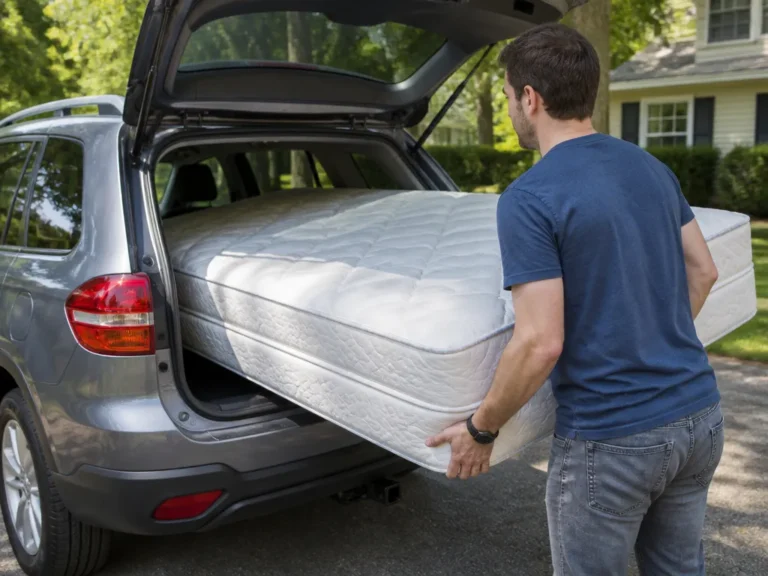
You’re staring at a mattress that’s too long for the driveway, and your only vehicle is an SUV. Maybe it’s a queen you want to haul inside, or a king that keeps catching on the hatch. This is one of those chores where a bad tie-down turns into a safety problem fast, so getting it right matters.
Plan around cargo measurements, protect the interior, and secure the load with tight, redundant straps. You’ll get a size-fit guide for twin, full, queen, and king, plus step-by-step loading setups for seats-down and upright options, so the mattress stays put for the whole trip.
Hauling a mattress with an SUV is easiest when you measure first: SUV cargo width, height, and length, then compare to twin (about 39×75 in) and queen (about 60×80 in) mattress dimensions. Load inside when possible, protect with moving blankets, and strap down using at least two ratchet straps with the slack taken out before driving.
Hauling Mattress With Suv: Quick Setup
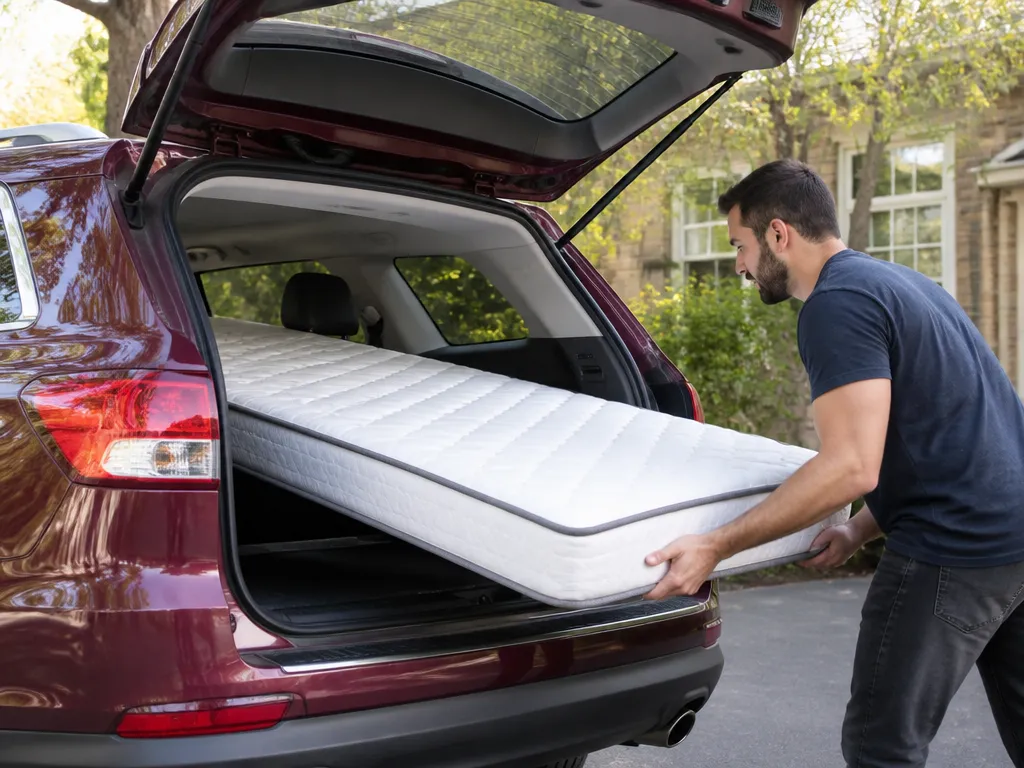
A mattress haul in an SUV is mostly about three things: planning the size fit, protecting the mattress and interior, and choosing the load orientation that lets you secure it without blocking visibility. Get your measurements done in minutes, then stage the straps and padding before you lift a single corner.
Quick Measurement Plan (2 Minutes, No Guessing)
Measure the SUV cargo space you will actually use, then compare it to the folded or strapped mattress profile you plan to carry. Record three numbers: cargo floor length, cargo floor width between wheel tubs (if your SUV has them), and the height from the cargo floor to the hatch opening.
For speed, add an allowance for tie-down hardware and for padding thickness. A mattress cover and a couple of blankets can easily add a half-inch to an inch across the load faces, which matters when you are already tight on clearance.
| Mattress | Typical size (approx.) | Fast fit expectation in many SUVs |
|---|---|---|
| Twin | 38 x 75 in | Usually fits laid flat inside most midsize cargo areas |
| Full | 54 x 75 in | Often fits flat by length, may need snug tie-down points |
| Queen | 60 x 80 in | Frequently needs diagonal placement or partial hatch opening |
| King | 76 x 80 in | Usually does not lay fully flat, upright or diagonal likely |
Basic Gear Kit You Should Have Before Loading
Set up a small kit so you are not improvising with rope or bungee cords at the worst moment. Use proper tie-down straps with hooks or ratchets and plan on at least one soft barrier between the mattress and the interior.
Quick mechanic tip: anchor straps to built-in cargo tie-down points, cargo rails, or reinforced seat-belt mounting hardware intended for restraint use. Avoid running straps over trim edges where they can scuff, cut, or slip under vibration.
Pick A Loading Method Based On Mattress Size
Match orientation to size so you can keep the load stable and avoid blocking mirrors or the rear view. When you can, lay the mattress flat and strap it down low, because that reduces bounce and keeps the center of mass closer to the SUV floor.
Before you drive, do a fast shake test while parked, grab the wrapped mattress at both ends, and try to twist it. If you can move it more than a small amount, add another strap or re-route it to a different anchor point before you hit the road.
Hauling Mattress With Suv: Measure And Fit
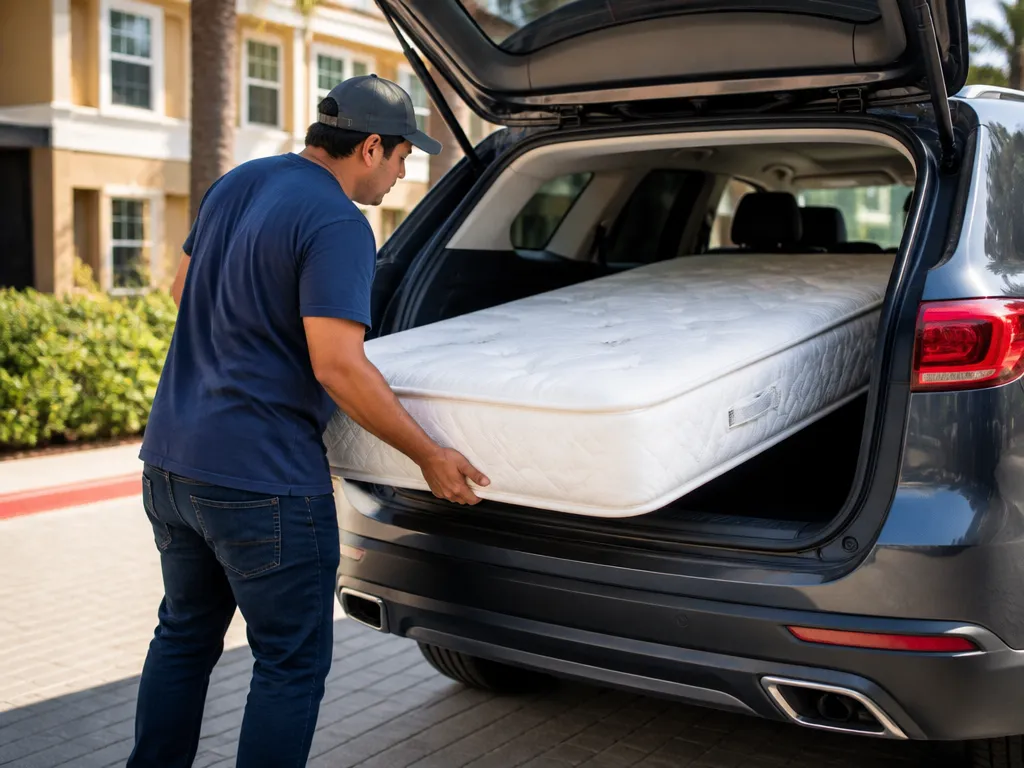
Measure your SUV cargo opening width, cargo floor length, and the maximum height you can fit with the seats folded or removed. Use the mattress label size plus real measurements, because older mattresses and “deep” models can be off by a few inches.
For example, a typical SUV cargo opening often becomes narrower at the wheel wells, so the usable width can be 2 to 6 inches less than the rear door opening. Measure at the actual contact area where the mattress will travel.
| Mattress size | Typical dimensions (L x W) | Typical thickness | Fit notes in an SUV |
|---|---|---|---|
| Twin | 38 in x 75 in (96.5 cm x 191 cm) | ~6 to 12 in (15 to 30 cm) | Usually fits easiest laying flat, often with seats folded; thickness mostly affects the height clearance. |
| Full / Double | 54 in x 75 in (137 cm x 191 cm) | ~6 to 14 in (15 to 36 cm) | Commonly workable, but wheel-well narrowing can limit width at the cargo opening. |
| Queen | 60 in x 80 in (152 cm x 203 cm) | ~8 to 16 in (20 to 41 cm) | Length can be the limiter; diagonal loading can help if height is available. |
| King | 76 in x 80 in (193 cm x 203 cm) | ~8 to 18 in (20 to 46 cm) | Often too wide for a typical SUV floor area; may require removing an additional seat or using a trailer. |
Rule of thumb: If your measured cargo floor length is at least 2 to 3 inches longer than the mattress length, you get safer clearance for straps and small angle adjustments.
For instance, a queen mattress that barely fits flat at the floor can still snag at the tailgate sill or wheel-well curve while loading. Do a dry run with the mattress in your hands (no straps yet), then adjust your plan based on where it binds.
Hauling Mattress With Suv: Gear You Need
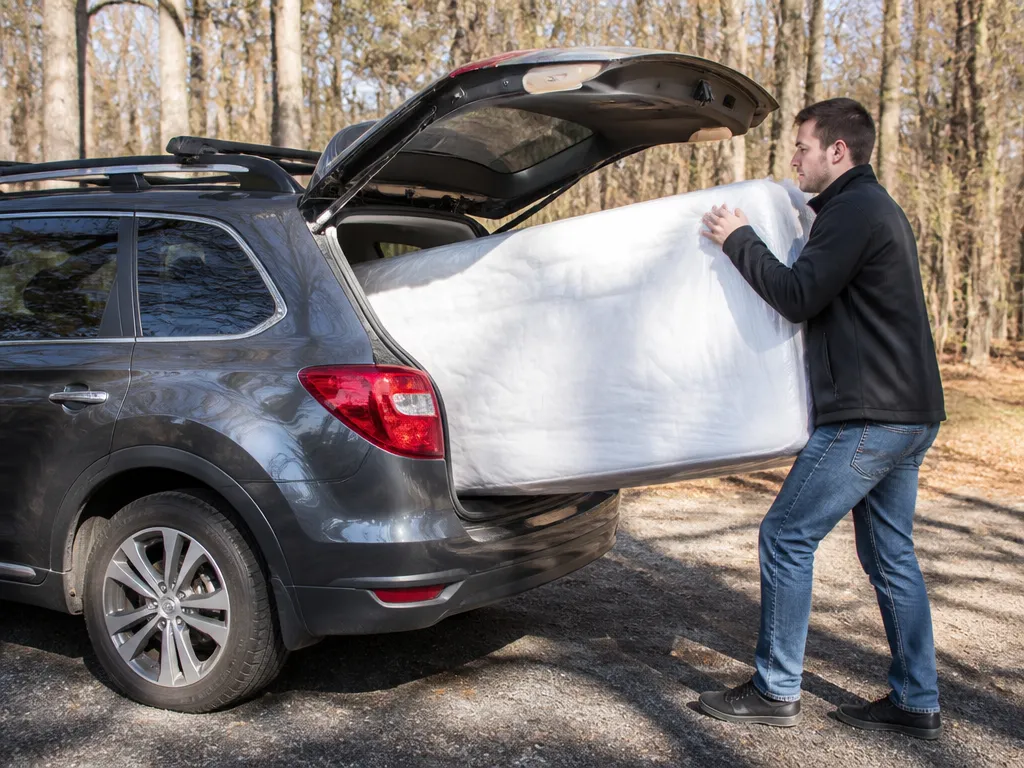
A safe haul starts with protection for the mattress and control for the load, so buy gear that blocks edge damage, prevents sliding, and seals the surface from dirt and moisture. For most SUV moves, you need corner protection, moving blankets, a mattress cover, and strap hardware that can cinch down without crushing springs too hard.
Protect The Mattress First
Moving blankets and corner protectors keep the mattress from getting torn at the edges or scuffed by cargo plastic and seat brackets. Wrap the mattress so the cover stays tight during cornering, and pay extra attention to the top and bottom corners, those are the spots that take the first impact when the load shifts.
Mattress bags or fitted covers reduce dirt transfer and help keep the mattress from soaking up road spray. Edge protectors (foam or folded cardboard sleeves) are cheap insurance, especially for foam and hybrid mattresses where the outer seams are easier to damage than the core.
Secure It With The Right Restraint
Ratchet straps give you repeatable tension, but rope can work if you can tie consistent knots and keep the slack out. For SUVs, strap length and reach matter, you want straps that can run from the mattress area to solid anchor points in the cargo floor or factory tie-down rails.
Non-slip mats help the whole system, they reduce the initial slide so your straps do more holding than wrestling. Towels can also help as a friction layer between the mattress cover and the SUV surfaces, just keep them dry and avoid stuffing thick towels into gaps where straps could slip.
| Gear | What it prevents | Common mistake |
|---|---|---|
| Ratchet straps (with hooks) | Load shift, bounce, edge stress | Strapping directly to the mattress edge seams |
| Rope (good-quality, tied tight) | Minimal movement | Leaving slack so the load pumps on bumps |
| Non-slip mat | Sliding before tension takes over | Skipping it on smooth cargo floors |
| Towels or fabric strips | Minor friction boost | Using wet towels that soak into the cover |
Pro tip: Put a non-slip mat under the “contact area” of the mattress, then add edge protectors anywhere a strap could press into the corners or seams. This combo makes cinching safer and reduces the chance you end up re-tightening every few miles.
Sanity Check The Quantity
Plan on wrapping the mattress in blankets first, then bag it, then prepare friction and edge cushioning before you strap. Most SUV pickups of a twin to queen size need enough blanket coverage that the mattress can’t directly touch hard plastic trim when it shifts a little.
Hauling Mattress With Suv: Loading Inside Cargo
Seats-down cargo loading keeps the mattress inside the vehicle, so you are driving with fewer exposure issues than roof hauling. The key is to protect the interior from moisture and dirt, then secure the load so it cannot shift under braking.
Protect the interior with sacrificial layers where the mattress can rub, especially the wheel-well area and the rear seat latch points. Use painter’s tape or foam pads at contact points if your mattress bag tends to pull against trim when the vehicle turns.
Unloading Sequence And Quick Road-trip Tips
Unloading order matters because the load can spring free once you cut the restraining forces. Release straps last, after you have a firm grip on both ends of the mattress, then lift outward slowly while a second person guides the corners away from trim edges.
Pro tip: If the mattress is slightly longer than the usable cargo opening on a given SUV, do not force it against the tailgate or hinge area. Adjust the position so straps sit on flat cargo floor zones and contact points stay padded.
For comfort and safety, aim for a snug, flat lay inside the cargo area, then let straps handle the movement. If you cannot secure a queen or king without the mattress pushing into trim or the hatch area, switch to a different loading approach or a different transport option in the next part.
Hauling Mattress With Suv: Upright Or Diagonal Loading
Upright loading works best when the mattress edge can sit on the cargo floor without bending, and diagonal loading works best when you need more “effective length” from the rear opening. Pick the orientation that keeps the mattress straight, protects the corners, and leaves you a clear path to secure the straps to solid tie-down points.
For example, an SUV like a Ford Escape, Honda CR-V, or Toyota RAV4 often has enough width for an upright carry, but the opening can force the top to get close to the headliner or hatch trim. In that case, use diagonal placement because it keeps the mattress slightly away from delicate interior surfaces while still letting you cinch it down.
| Orientation choice | Where it works well | Main trade-off |
|---|---|---|
| Upright on edge | Shorter cargo openings, when width is available to stand it | More sensitive to corner contact and strap slippage |
| Diagonal | Longer mattresses (queen, king) and tight rear openings | Requires careful strap routing to prevent rotation |
Orientation decisions come down to clearance and protection. If the top edge is within a few inches of the hatch trim or glass, switch to diagonal loading and add corner padding so the mattress does not grind or lever against the seal.
Mechanic’s tip: After you strap it upright or diagonally, close the hatch gently and recheck strap tension. Cargo tie-down points and hatch seals can shift slightly, and that small change is what causes mattresses to walk forward on the first few miles.
Hauling Mattress With Suv: Securing And Checks
Secure the mattress with straps that reach solid anchor points, not trim, seats, or latch hardware. Tension the load so it cannot slide forward or bounce, then confirm strap tension after the first few miles. Covering the mattress and protecting interior contact points prevents scuffs and helps keep straps from chafing on fabric edges.
Anchor Points And Strap Selection
Use cargo tie-down loops, factory-rated lashing points, or welded anchor locations in the cargo floor area. Avoid wrapping straps around seatback frames unless the vehicle manual lists that as an approved tie-down method. For an SUV, cargo tie-downs in the floor and side rails are usually the best choice because they take load direction changes.
Choose ratchet straps or cam straps with a working load limit (WLL) appropriate for the mattress and any foreseeable bump forces. For mattress jobs, 1-inch (25 mm) webbing is common and easier to tighten without cutting into fabric. Inspect straps for fraying, cracked hooks, or stretched webbing, and never hook onto anything that can flex or break under tension.
Tensioning Steps And Slack Checks
After tightening, check strap webbing is flat, not twisted, and hooks are fully seated. Make sure the strap paths do not cross in a way that lets one strap loosen as the other tightens.
Redundancy, Coverage, And Interior Protection
Use at least two independent strap points to control movement fore and aft, then add side straps if the mattress can drift left or right. Redundancy matters because one strap can loosen from vibration, strap stretch, or a hook that was not fully locked.
For coverage, keep the mattress wrapped or bagged so dust and allergens stay contained and the fabric does not act like a “grinding wheel” on straps. Put thicker padding at corners and along any area that touches the SUV body, because mattress edges can transmit sharp loads into door sill areas and trim.
Mechanic tip: If your straps contact a hard edge, slide a towel, moving blanket strip, or purpose-made edge protector under the strap. A half-inch of protection prevents premature strap wear and keeps tension more consistent.
Final Safety Checks Before Departure
| Check | What you’re looking for | Fix |
|---|---|---|
| Strap slack | Load moves when pushed by hand | Tighten forward straps, then retest |
| Strap routing | Twisted webbing or strap rubbing trim | Reposition straps, add edge padding |
| Hook security | Hook not fully seated or can vibrate free | Replace strap, use correct anchor |
| Visibility | Rear or side view blocked | Reposition load, reduce extension |
Stop and correct immediately if you hear straps clicking, see webbing migrating, or notice the mattress creeping during the first few minutes. For SUVs like the Honda CR-V, Toyota RAV4, Subaru Forester, Ford Escape, and Jeep Cherokee, these steps are the same because the weak points are the same, unapproved anchors, slack, and strap chafing.
When the mattress still cannot be stabilized with safe anchor points, switch methods or timing rather than forcing it. Choosing a different loading approach or an alternative hauling option is safer than relying on improvised tie-downs that can loosen or fail.
Hauling Mattress With Suv: Roof Loading Caveats And Alternatives
Roof loading is only advisable when the mattress cannot fit inside the cargo area and you have a proper roof rack rated for the load. Even then, wind lift and rain exposure make roof hauling harder to secure than inside cargo. If you must do it, plan for extra strap time and a stricter driving speed.
When Roof Loading Makes Sense, And When It’s A Bad Idea
Roof loading is the safer bet when the SUV has a factory-style rack or crossbars, the mattress is dry and sealed, and you can keep it low and centered over the vehicle. Roof hauling is a bad idea when you have to improvise mounts, you expect heavy rain, or you need to drive highways fast for a long distance.
For example, a shorter trip in mild weather with a mattress that stays fully wrapped is workable on many crossbar-equipped SUVs. A long interstate run in storms is where roof loads start acting like a sail and people discover straps loosen faster than they expect.
Hardware And Installation Basics That Matter For A Mattress
Roof racks are not all equal. You need crossbars or a complete rack system with known load capacity and compatible mounting points for your exact SUV, plus ratchet straps or cam-buckle straps designed for tie-down use.
Hardware that keeps a mattress from migrating is simple, but it has to be right. A roof rack, four quality straps, edge protection, and a non-slip layer are the difference between “it held around town” and “it stayed put in crosswinds.”
Weather, Road Visibility, And Practical Driving Limits
Rain and road spray are roof-loading’s biggest downside. A mattress cover that is “water resistant” can still wick moisture, and damp foam or fabric can retain odor for weeks after the trip.
Visibility also takes a hit when cargo is tall. A roof load can block mirrors or change headlight aim by shifting the front end load, and it can create additional wind noise that distracts on long stretches.
Legal Considerations And Local Rules You Should Confirm
Most jurisdictions treat cargo that is unsecured, overhanging, or obscuring visibility as a ticketable violation. Roof loads can also trigger rules about protrusion beyond the vehicle footprint and requirements for secure tie-down and warning for loose debris.
Because rules vary by state and country, confirm locally for maximum permitted overhang, requirements for coverage of exposed loads, and whether you must use a flag or marker if any portion extends rearward.
Alternatives When The Suv Is Not The Right Tool
A roof rack is a compromise, and sometimes the cleanest move is switching vehicles. Vans and small box trucks let you lay the mattress flat inside, keep it dry, and secure it with fewer moving parts.
For instance, a 5 by 8 foot (or larger) cargo area in a rental van usually allows a queen mattress to travel with less wrestling and less wind exposure. Trailers are another solid option if you can secure the mattress to a flat deck with straps and keep it covered.
| Option | Why it’s better | Main trade-off |
|---|---|---|
| Rental van | Inside load is easier to keep flat and dry, and security checks are faster. | Costs more than using your SUV and requires the right pickup schedule. |
| Trailer | Stable deck lets you strap down low, with less wind lift than a roof. | Needs trailer setup skills and careful weight distribution. |
| Professional delivery | Someone else handles wrapping, loading, and securing. | Higher cost, but low hassle. |
“If the mattress has to ride high, plan like it can slide every mile. If you cannot do that check and re-tension quickly, switch to a van or trailer.”
Quick Summary
The safest choice depends on the mattress size, the SUV’s actual cargo dimensions, and whether the load can be secured without blocking visibility or contacting fragile trim. Use the fit tables to compare twin, full, queen, and king dimensions, then choose flat, upright, diagonal, roof, or alternative transport based on the available clearance.
For setup, use the appropriate protective layers and solid anchor points, inspect the restraint path, perform a parked shake test, and recheck the load shortly after departure. A king mattress often needs upright or diagonal transport, while a queen may require diagonal placement or another vehicle if the SUV cannot provide safe clearance.
| Mattress size (approx.) | Fit expectation in many SUVs (from article) |
|---|---|
| Twin, about 38 x 75 in | Usually fits laid flat inside most midsize cargo areas |
| Full, about 54 x 75 in | Often fits flat by length, may need snug tie-down points |
| Queen, about 60 x 80 in | Frequently needs diagonal placement or partial hatch opening |
| King, about 76 x 80 in | Usually does not lay fully flat, upright or diagonal likely |
Frequently Asked Questions
How Do You Haul A Mattress With An Suv Without Damaging It Or The Upholstery?
Use moving blankets and keep the mattress away from sharp edges, exposed hardware, and unprotected trim. A protective tarp or rubber mat can add a friction layer, while a properly routed restraint prevents rubbing during turns and braking.
Can A Mattress Fit In An Suv Without Folding Down The Seats?
Sometimes it fits, but it depends on the mattress length and your SUV cargo opening height and width. If it does not clear the opening, you will typically need to fold the rear seats and place the mattress lengthwise to reduce strain on door seals and keep the load stable.
What Is The Safest Way To Secure A Mattress In An Suv?
Use solid, approved anchor points and a restraint system that prevents movement during turns and braking. Avoid bungee cords, keep the load below the window line where possible, and perform a final push test before driving.
How Do You Transport A Mattress In An Suv If It Has To Go Up The Roof Or Rear Liftgate?
If you use a roof rack or carry it above the cargo area, use mattress-appropriate straps and keep it centered to prevent wobble. Make sure the liftgate can fully close if it is carried at the rear, and do not cover essential lights or block your view.
Will Hauling A Mattress In An Suv Void The Mattress Warranty Or Cause Damage?
There is often no blanket rule, but many warranties require proper handling and storage conditions. To avoid issues, transport it in a clean, dry blanket or bag, keep it protected from moisture, and do not compress it tightly for long distances if it is a foam or hybrid mattress.
What Common Mistake Should I Avoid When Hauling A Mattress With An Suv?
The big one is not securing the mattress well. Loose loads can shift and rub against interior panels, and unprotected edges can tear upholstery, even on a short trip, so spend the extra time on straps and padding.